Posts tagged ‘West Sussex’

How many elements + which aspect ratio = different results

The three images which make up this entry are essentially the same subject but in terms of their composition are all quite different. Through this post I want to illustrate the decisions we have to make each time we make a photograph and what we can learn from the process.
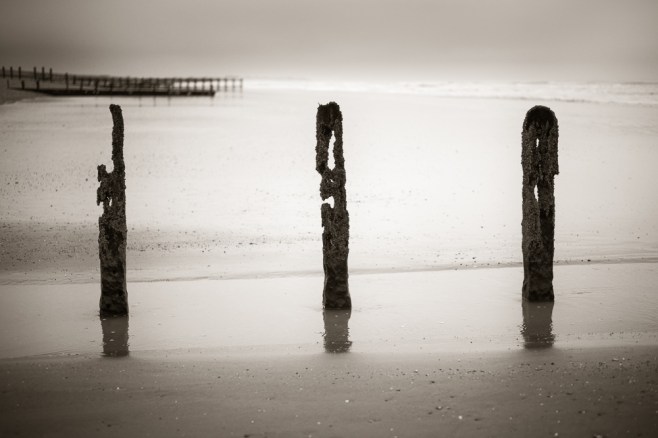
Groynes

The first image above, uses a classical 3:2 aspect ratio….the same as any 35mm film or full frame sensor. The composition is balanced with three groynes, with the one in the centre arguably being the most visually interesting. The distant and out of focus groynes on the horizons provide both context to the location but also depth. I think it’s important to have retained separation between the left hand groyne and those in the distance.

Groynes-2

The second image shares the same elements but is further simplified as only two groynes are included in the frame. The distant groynes are a more important third element in this picture, creating a triangle with the groynes. There is added space between them and the much shorter groyne on the left hand side, which gives a more open feel to the shot. The aspect ratio is now 5:4, the equivalent of a medium or large format film camera.

Groynes-3

And finally the third image. The single groyne fills more of the frame and is clearly the main focal point. The distant groynes are less intrusive but still play a key role in providing context and depth. The 1:1 or square aspect ratio, is one I particular like and lends itself well to this more minimalist composition. This aspect ratio mimics the 6:6 medium format ratio found in the classic Hassleblad 500 series of cameras.

So do I have a preference as to which image I enjoy the most? The first picture is too busy for my liking. Increasingly I find myself drawn to simpler compositions. The second image has a little more tension as the three elements form a triangle and I like the fact that one of the groynes is much shorter than the other which adds visual interest and feeling of openness. The third image is simpler still, but might be even stronger if the distant groynes were not in the frame.

It doesn’t really matter which image you or I prefer, although I would welcome your comments. What I wanted to demonstrate is how a relatively simple subject can be treated in different ways. What do you include and what is better left out? Your choice of aspect ratio and how this can impact on the end result. How simple or complicated do you want the composition to be?

For all these reasons it makes sense to me to truly explore or work a location and subject. Look around, consider the visual relationships between all the elements in the frame and at the same time think about a variety of aspect ratios and how these may improve the final image.

‘The tide is high’ at Bosham

Chichester Harbour Project-54

I have been wanting to make the above image for some time. The view is across the harbour from Chidham towards the village of Bosham with its instantly recognisable Church and spire reaching to the sky.

I often return to this particular spot when out walking but to get the result I was looking for, the height of the tide had to be at a certain level. Too low and there is too much vegetation…..too high and the posts are disappearing into the water. I do have the ‘Tides Planner’ App for my iPhone which tells me the height of the tide, so today I headed out with time to spare to watch and wait as the tide started to come in. I had also been cotemplating that a long exposure would enhance the scene and this of course would require a tripod, ND filters etc. Not the sort of stuff I usually carry with me when out walking. I am normally a spontaneous photographer but this shot was planned and thought about in advance.

Although a fairly bright day there was no direct sunlight which is exactly what I wanted. Too much contrast would have made life more difficult, so a little bit of good fortune was on my side. Welly boots on, tripod securely standing in the silt, camera set up with a 28mm lens, composition decided, hyper-focal distance set and after 12 seconds at f11, the image was exposed to the sensor. I checked the histogram which showed me no blown highlights and in truth a balanced tonal range. Ideal for post processing.

I sometimes wait a few days or even longer before I process my images but on this occasion I couldn’t wait, so earlier this afternoon I sat down at my Mac, fired up Lightroom and overall I am pleased the result.

Here is another image taken at the same time. I thought about placing the posts in the centre of the frame but I rather like the fact they are offset to the left and lie on ‘the rule of thirds’. Placing them in the centre was a little too obvious.

And lastly another image of Bosham taken yesterday from a different position on the shoreline. This time at low tide.

All of these photographs are being added to my ‘Chichester Harbour’ project portfolio and when I get the time I will upload a gallery to this site.

Do click on an image to view a larger version.

‘Lost Glove’ – photo titles or even some Haiku perhaps?

dew on hand of wool
posts and wire in mist belong
cold fingers missing

I don’t know what you think but when it comes to giving a photograph a title it can be something of a struggle. At best a title can enhance the image; at worst it can be bland and add nothing at all. Some are purely factual which can at least inform the viewer, but these lack any artistic merit. I have even read a few titles and to be perfectly frank they were a distraction and it would have been much better to have let the image stand on it’s own two feet. There are of course occasions when the photographer feels the need not just to give the photograph a title but also a very lengthy description, which somehow almost becomes more important than the image itself.

All of this got me thinking, particularly as I have almost certainly been guilty of poor and uninspiring titles, overlong descriptions, the list goes on…….

I can’t profess to be a great lover of poetry but I do see a definite connection between the art of photography and writing poems as a creative art. What if the two were combined? Well it’s hardly the most original idea but I thought I would give it a try. 

One of the simplest forms of poetry is Haiku, a Japanese poem of just seventeen syllables on three lines – five on the the first line, seven on the second and five on the last line. Traditionally the poem evokes images of the natural world. There is no requirement for rhyme and whilst the number of syllables on each line has changed over time I thought I would stick with the original guidelines. I like the minimalist approach and the strict parameters prevent verbosity – something I could be accused of in this post!!

So below the photograph is my very first attempt at a Haiku verse combined with one of my ‘Chichester Harbour’ project images. ‘Lost glove’ is an apt, albeit unimaginative title, but I think the verse adds a little something extra. Masters of this form of poetry would probably mock the result, but I enjoyed linking words to an image. Will it be something I will use again? I can’t answer that but I’m pleased to have had a go. Your thoughts as always would be most welcome on both the image and the words!

Private Jetty at Bosham – and thoughts on split tone presets for a b&w image

Firstly some background information about this shot. Bosham (pronounced Bozzum) is arguably the most picturesque sailing village (read tourist honeypot) forming part of Chichester Harbour. Regular readers will know that a current project of mine is to photograph this area but in trying to do so I am very keen to avoid the typical picture postcard view.

Everyone who visits Bosham takes out their camera and posts their results on social media for all to see. They are mostly in colour and feature the church from across the water with a few boats in the foreground for good measure. If the sun is setting, then this is a further attraction, as it’s unquestionably a great place to be at the end of the day. (Scroll down to the end of this entry to see an example)

Read more

All by myself

All by myself

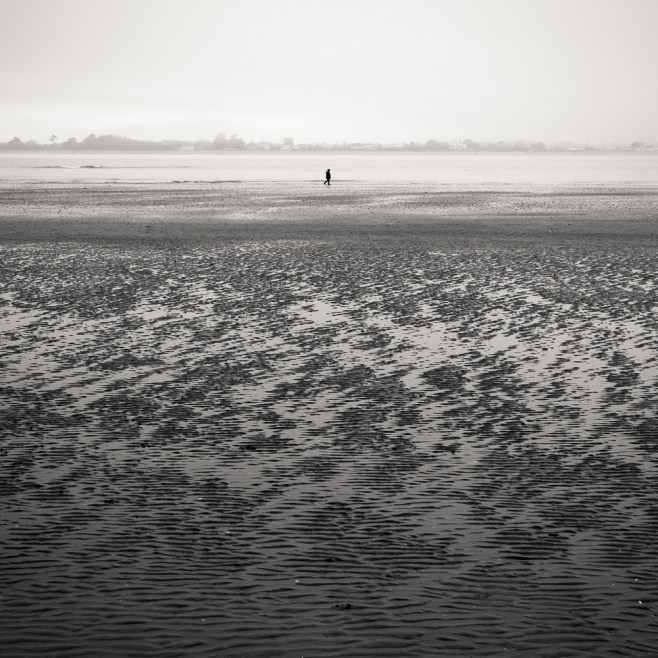
Despite the title, this isn’t a long distance selfie! I am though drawn to lone figures in relatively empty spaces walking along with only their thoughts for company. Perhaps it’s because I can readily empathise with the concept of being on alone in a quiet space. After all there is so much ‘noise’ in this world that it has become something of a luxury and a joy to find somewhere with solitude and even a little silence.

Alone yes, but even here there is the sound of gentle waves lapping against shore and feet squelching as each step lands on the soft wet sand. I just hope this person had the good sense to switch off their mobile phone, or better still left it at home to avoid the temptation to check for messages, emails, likes or comments!

There is of course one other person present, and that’s me the photographer. Photography tends to be a solitary pursuit and I am very happy this should be the case.

As you are looking at this image there is now a third person, you the viewer. For as Ansel Adams once said – ‘There are always two people in every picture: the photographer and the viewer’ – and how right he was.

Depending on the device you are using to view this picture, you might like to click on the image to see a larger version, as the main point of interest is very small but hugely relevant!