Posts tagged ‘Wales’

Early morning dew in Snowdonia – one from the archives

20151028-L1004287-Edit

Having posted a few images taken in Pembrokeshire recently, I thought I would return to a Lightroom folder named Snowdonia, which I visited back in November 2015. I stumbled across this photograph which I had never processed before. It had just been sitting on my hard drive but I am rather glad I found it.

I remember the morning it was captured. The tree was backllit and the early morning light glistened on the heavy dew which had formed on the grasses overnight. The dark background was the perfect foil for the solitary tree.

There is always the temptation to process images soon after they were taken but there is also an argument that you should let images mature, untouched for many months and then return to them at a later date before processing. Something which was dismissed at the first edit, is re-discovered and what a pleasure this can be. Not only finding a ‘lost’ image, but in the process remembering the visit, the location and the conditions…….. a very worthwhile exercise in my view.

Pembrokeshire – A ‘letterbox’ view

L1000301-Edit

As I write this post the sun is shining and Summer is almost here but these four images depict a very different time of year. They were all taken on the same day back in February. Some may say a typical late winters day in Wales, when nobody in their right mind would be out with their camera. Mist, drizzle and poor visibility. However these conditions can be ideal for the monochrome photographer.

In all cases the native 3 x 2 crop of the 35mm sensor included too much sky, and with little or no interest in this part of the picture I have cropped each image to what might be described as a ‘letterbox’. The aspect ratio is about 3 x 1, but what really matters is whether or not the crop works compositionally, and I believe it does. Photography is often about what you choose to exclude from the frame to strengthen a picture, not just about what is included already.

In the first shot taken at Newgale Sands, I focused on the foreshore which has softened the figures, the sea and distant rocks. This has helped to emphasize the misty conditions. The couple and their dog are an essential part of the image. The provide scale and as they are the only people on the beach they serve to reinforce the fact that the weather was so poor keeping most sensible people indoors, but for dog walkers and photographers!

L1000306-Edit

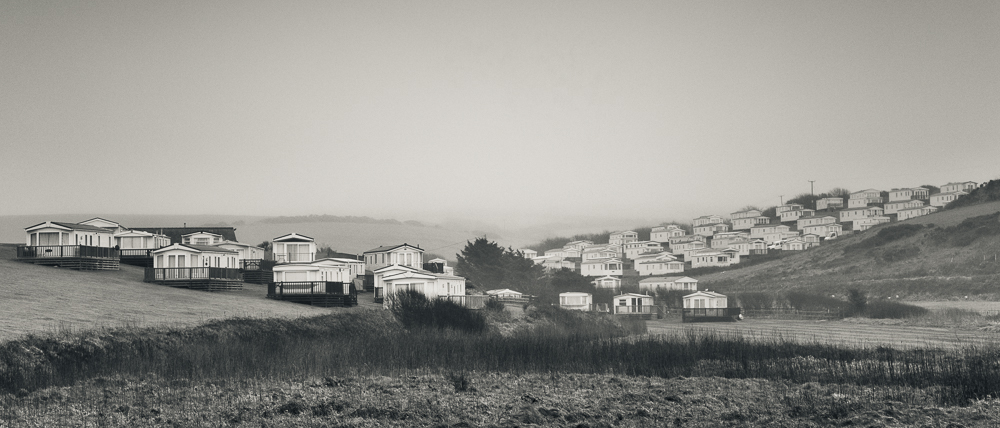
After taking the first shot I looked behind me only to find a swathe of mobile homes which overlook this section of coastline. Very quiet at this time of year, and only coming to life when the weather improves and the holiday makers return.

L1000338

Moving further along the coast I stopped at Little Haven. Conditions remained the same and this time I wanted to capture the tidal movement of the sea. Resting the camera on a wall I used a ND filter to give me  a slow shutter speed, about 1.6 seconds. Several exposures where necessary to give me the look of the movement in the sea water I was after.

L1000365

Finally a shot of what I assume is a farmhouse taken at Marloes. A typical dwelling in this part of the world but what appealed to me was the telegraph poles and how they could be used to create what I think is a pleasing composition.

Each picture looks better larger, so do click on an image to view a larger version which will open in a new window.


Marloes, Pembrokeshire – soft proofing in Lightroom

Marloes

If you read my blog on a regular basis you will probably have noticed that although I work almost entirely in monochrome, rarely are my images in ‘pure’ black and white – in other words they are toned. Either with a single colour, or more recently I have used a split tone where the highlights are toned with one colour and the shadows are toned with a different colour. This split tone is easily applied in Lightroom and the balance between the two tones can also be adjusted.


Screen Shot 2017-05-31 at 18.06.17


Whilst I like the effect of split toning it does present me with a new problem, and that is one of printing. I very much enjoy the process of printing; in many ways it’s the rightful conclusion to everything that has gone before it. In the past printing a ‘pure’ black and white photograph was fairly straightforward from my point of view. The fact that my monitor wasn’t properly calibrated (good but not great) didn’t matter hugely to me; I could produce a perfectly acceptable print by observing the histogram, processing accordingly and adjusting the contrast to achieve the look I was after.

With split toning, however subtle the effect, I am now printing a ‘colour’ image, so what I see on the screen and how that image is produced in print becomes much more critical. The choice of paper (and there are now so many excellent photographic papers), use of the appropriate colour profile for printing, as well as having a correctly calibrated monitor, now all play a more important part than they did before.

For these reasons I started exploring the soft proofing panel in Lightroom which forms part of the ‘Develop’ mode. It is easily opened by pressing ‘S’ on the keyboard. From here you can select the colour profile for the paper you wish to use and select either perceptual or relative as the intent. From here Lightroom will create a virtual copy of the image with the colour profile and intent embedded. The name of the file/copy will include a reference to the colour profile, which is a very convenient feature for future reference. This is an invaluable benefit and one that Lightroom makes so easy. Depending on how the image changes its appearance in soft proofing you can go on to make the usual processing adjustments to the contrast, clarity, exposure etc so that the image reflects how you want the photo to be printed. By choosing a matt paper colour profile I found the proof copy was much ‘flatter’, it lacked contrast when compared to the original image. In processing I added back more contrast to the proof copy.
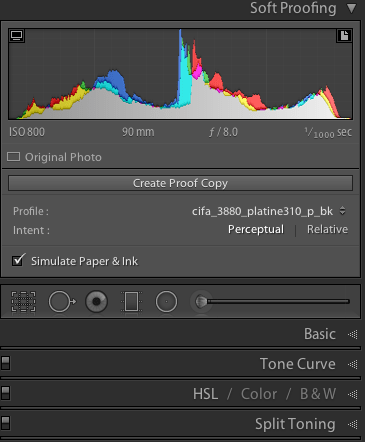
 

I do not own a device for calibrating my monitor and perhaps that is something I should acquire in the future. In the meantime I did use the Display Calibratior Assistant on my iMac and whilst not a precise tool, I have been able to calibrate my monitor to more closely represent what comes out of the printer.


There is no question that I still have more to learn regarding printing and with two exhibitions on the horizon this year; one in July and one in November, I am very keen to make a decision on my choice of paper and be able to produce consistent results. More test printing is required. I also know that Photoshop has a soft proofing feature and in time I may look into this as well but for the moment Lightroom seems to be a very straight forward way to achieve the results I am wanting.

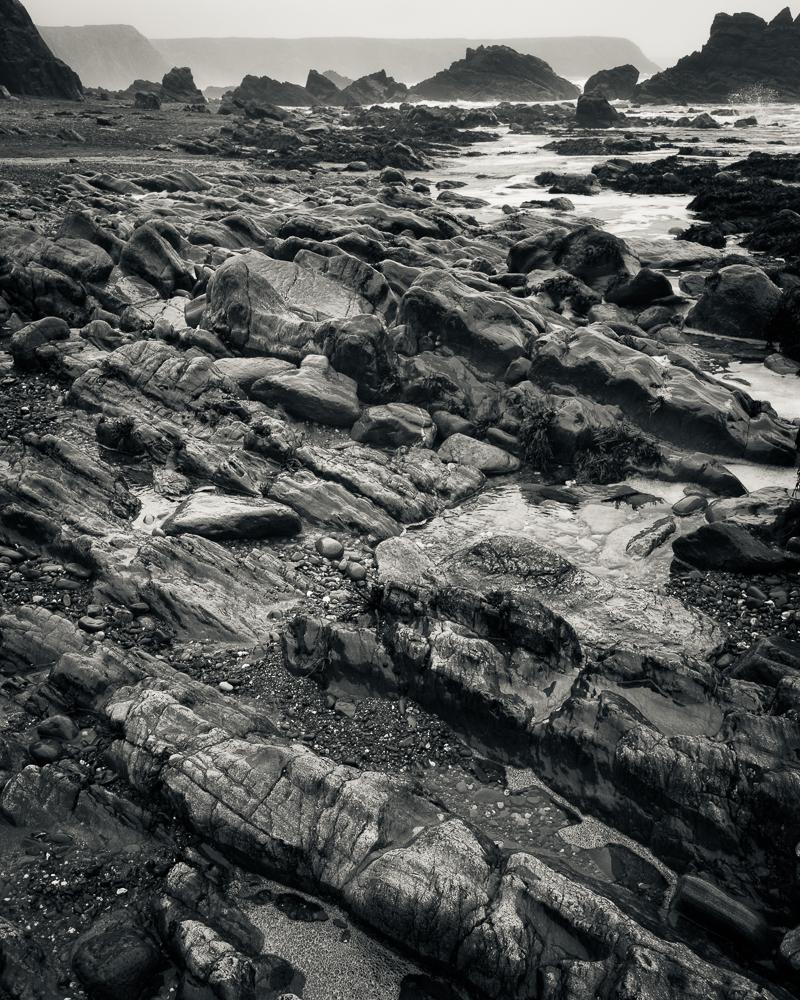
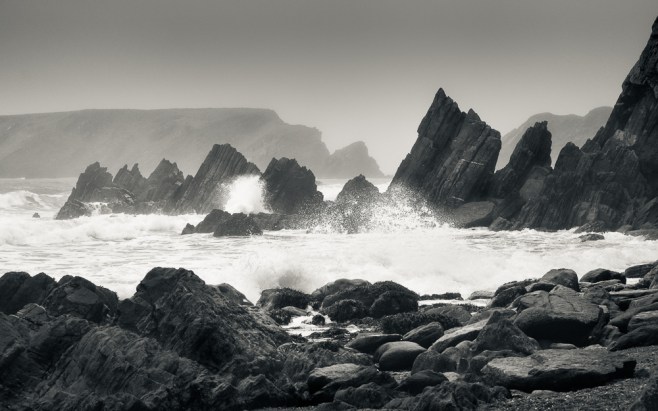
I shall leave you with a few more images of Marloes in Pembrokeshire, Wales. Fortunately when I visited this location earlier in the year, the height of the tide was just about right – ideal conditions for some dramatic coastal photography.


Please note that I am using Lightroom 5 and I am not using the most recent operating system on my iMac, so the screen grabs may look different. To be frank I am not a great one for always upgrading to the latest software. If it works then I don’t feel the need to automatically change anything. I do realise this might get me into trouble one day but for now I’m very happy with what I’ve got and it works for me!

St Davids Cathedral – capturing the light

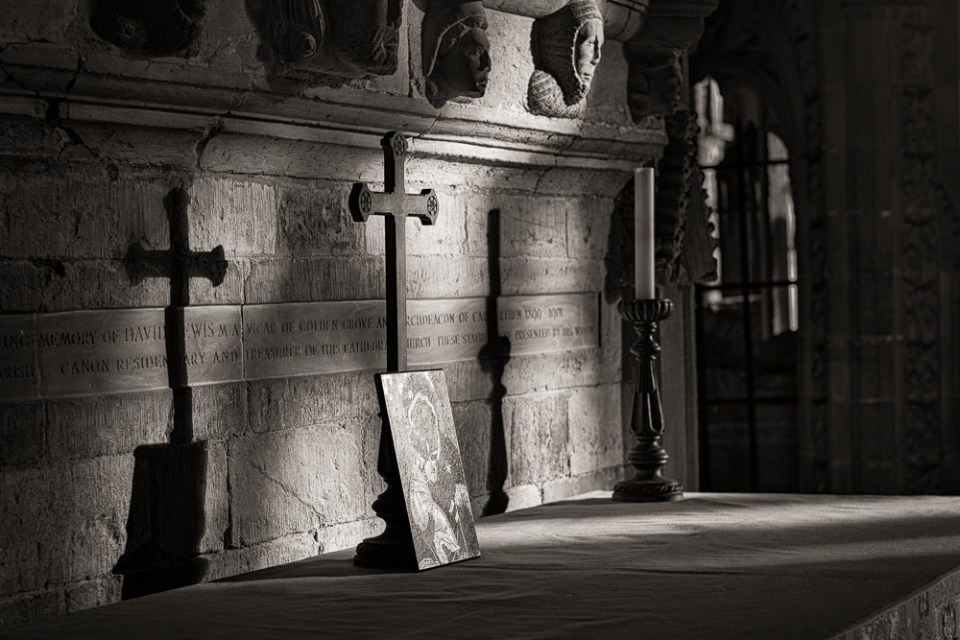
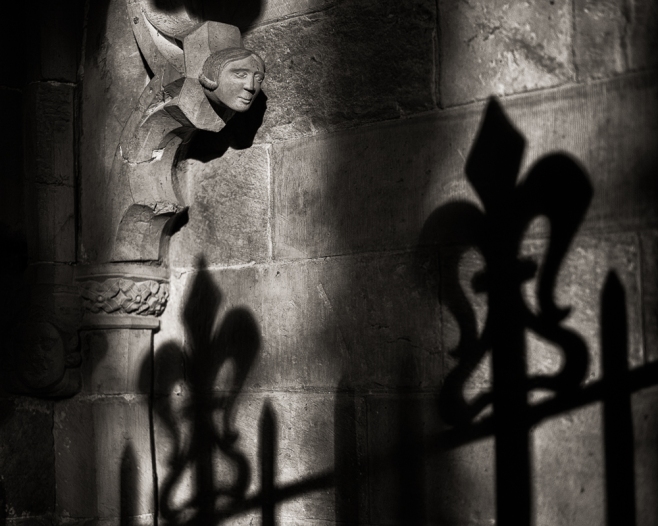
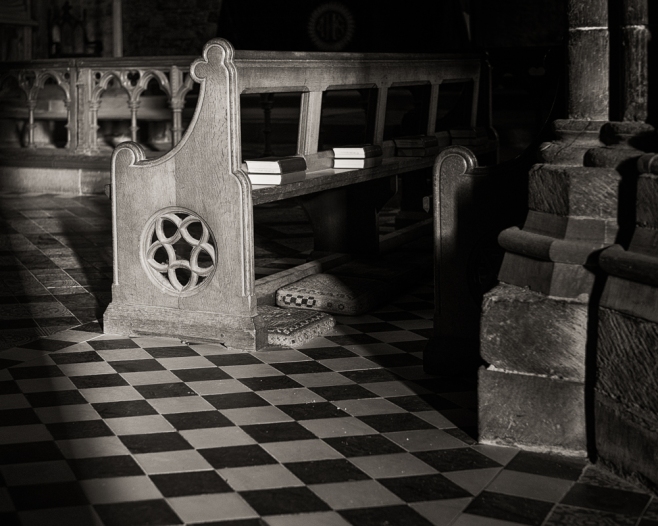
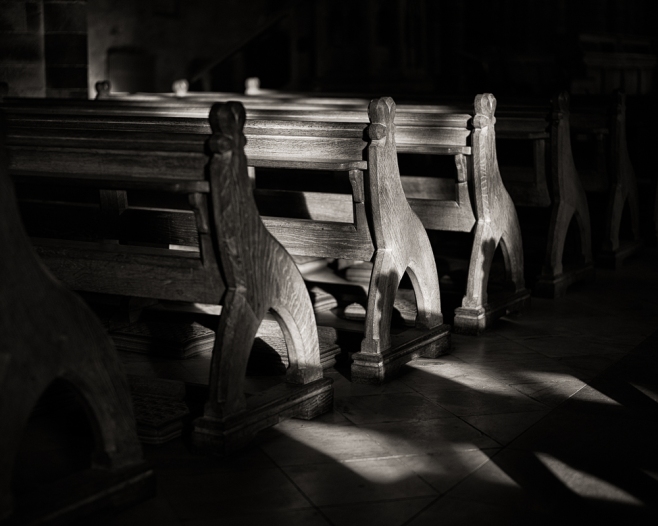
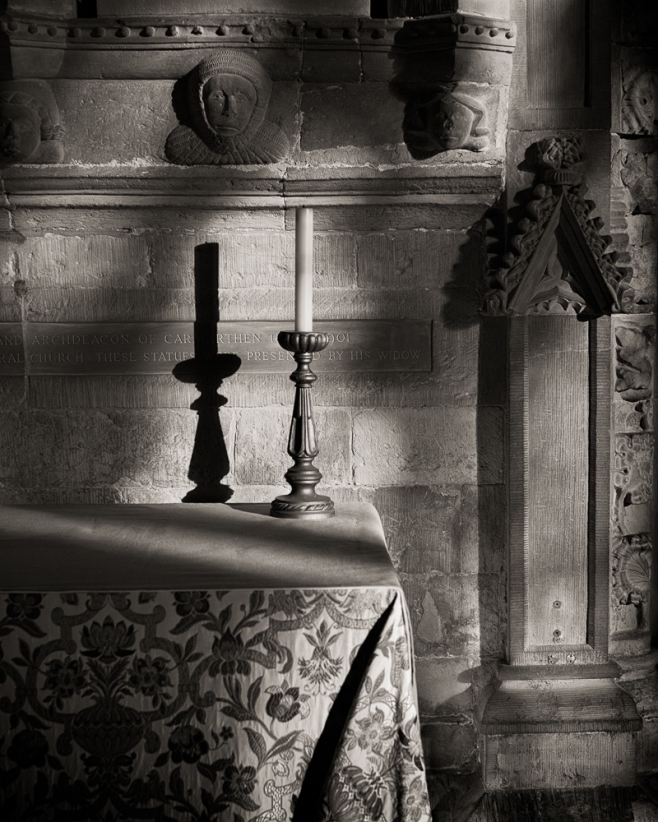
There are many reasons why I enjoy being in a church or cathedral. Making photographs which capture the light inside these special places is just one reason – it gives me a great deal of pleasure.

Regular readers of this blog will know that I can spend many an hour waiting for the right light. There are also occasions when little or no waiting is required and a sixth sense just tells me I should be inside even when the sun is shining outside. Photographing St Davids Cathedral on the first afternoon of my visit to Pembrokeshire turned out to be one such occasion.


St Davids Cathedral


I had driven the best part of 300 miles that day and had arranged to meet Andy Beel FRPS and the three other photographers in our group at 4pm. The light was good and St Davids Cathedral was only a short walk from our small hotel where we would be spending the next few days.

Bathed in the late afternoon light the Cathedral and grounds looked lovely but as soon as we arrived I instinctively knew that I should be inside and not outside. I just had a feeling that the lighting conditions could be working their magic and so it was.


St Davids Cathedral-4


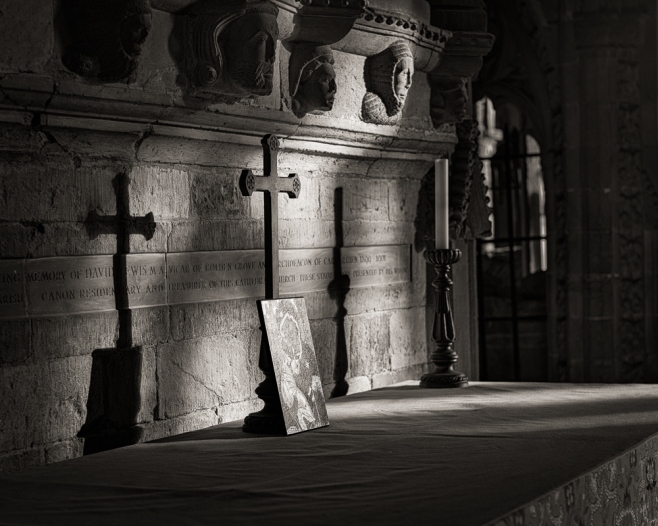
The combination of the strong low sunlight and the shadows that were being cast only lasted about half an hour but it was more than enough time for me to capture the five images that make up this post.


St Davids Cathedral-5


St Davids Cathedral-3


St Davids Cathedral-2


During the course of the week we did return to St Davids Cathedral at different times of the day, but the light was never quite as good as that brief encounter on the first afternoon. I am sure my fellow workshop participants captured some good shots outside, but I don’t regret my decision to have acted differently and I hope they have forgiven me for disappearing so quickly after our first meeting.

I will be posting more entries and photographs of this Cathedral in the near future.


Whitesands Bay – late in the day

Whitesands

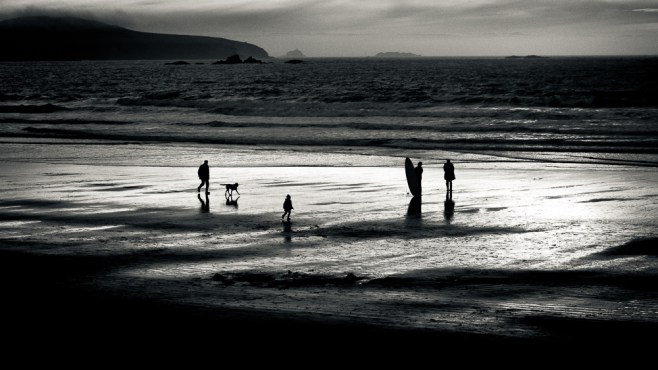
Taken on the first evening during my recent visit to Pembrokeshire, this shot was taken late in the day as the sun started to set. There were only a handful of other people about, all pleased to be at this rather lovely sandy bay.

It’s a location which is popular with surfers but on this occasion there was only one person with a board, but I like the separation and variety of the other characters in the picture. The man walking his dog, the young child running towards his or her mother who is looking out to sea. We do not know if there is a connection between this group of people. It doesn’t really matter, for they were doubtless enjoying their time there, just as much as I enjoyed the scene and taking a few frames.