Posts tagged ‘black and white photography’

The British Grand Prix at Silverstone – a belated report
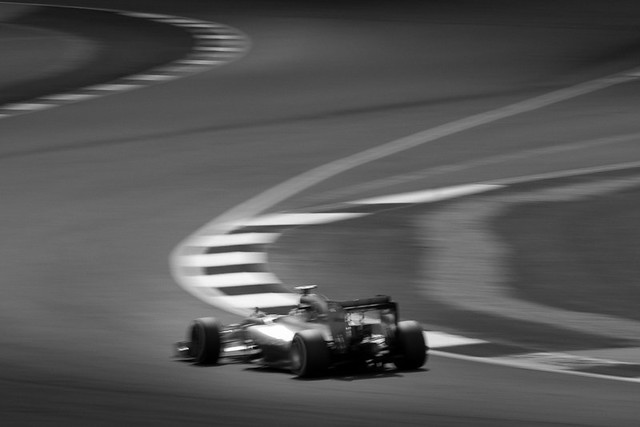
Rosberg through Becketts

Rosberg through Becketts
Probably my favourite shot from the Grand Prix.
Nothing is sharp, but there is movement both in the car and also in the sweeping lines of the track at Becketts corner.


I have to admit it feels rather bizarre writing this entry at the end of December, when this great sporting event took place back in early July. Perhaps it just sums up how busy the year has been.

Despite being a keen follower of F1 for many years, I had never been to a Grand Prix, so when my good friend suggested we might go, it was an opportunity too good to miss. It was a special occasion as it was also the 50th Anniversary of the British Grand Prix.

We attended all four days and to avoid the worst of the traffic (it can be notoriously bad) we arrived on Wednesday evening, pitched the caravan and didn’t leave until Monday morning. Whilst I took a fair number of photographs, this was never going to be an outing with my camera, as I wanted to enjoy the racing, the atmosphere, the people and the whole experience, which is what we both did.

The rain came and went, as it always seems to do during the British Summer of sport, but this did nothing to spoil the racing in fact it only added to the drama. For anyone who follows F1 you will know that Lewis Hamilton misjudged how quickly the track would dry out in qualifying, and others, including his own team mate Nico Rosberg posted quicker lap times, leaving Hamilton in 6th place on the grid, and Rosberg on pole. The tight duel between them was nicely set up for a thrilling race, which Hamilton won, much to the delight of the home crowd. He was of course helped by Rosberg breaking down with a gearbox problem which happened right in front of us. The partisan crowd around us rather unsportingly cheered loudly as Rosberg, with head looking towards the ground, walked away.

The tide had started to turn in Hamilton’s favour and the rest of the season is now history. Hamilton won his second Formula One Championship and joined an elite number of British drivers who had won the title more than once. The others being Graham Hill, Jim Clark and Jackie Stewart. Only time will tell if Lewis Hamilton will go on to win more titles.

The photographs included in this entry hopefully capture some of the flavour and atmosphere of being at a Formula One race. Even with a 200mm (400mm equivalent) telephoto lens on the Olympus EM1, it is not easy getting close to the action, and even when you can, a wire fence will be between you and the track.
Read more

Blakeney to Morston…..along The Peddars Way or Norfolk Coast Path

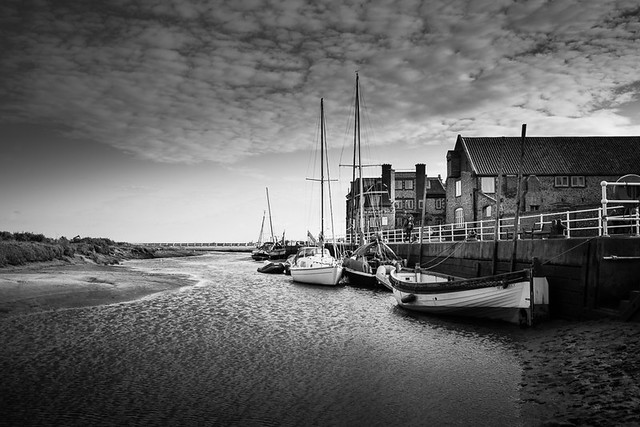
Blakeney Harbour

Blakeney Harbour


For a variety of reasons we didn’t go on holiday this year until the middle of October, so when we finally got around to deciding where to go, we thought we would visit a part of the UK which was not known to us. We chose the North Norfolk Coast and stayed in a pretty village of Weybourne which we were reliably told by the locals was pronounced ‘Weben’. A short drive from here is the small harbour town of Blakeney and one of our favourite walks started by the jetty and followed the Peddars Way footpath to Morston.

For this entry I have chosen to include a selection of images taken over a number of days, which hopefully capture something of the essence of this rather beautiful part of the UK coastline.

Read more

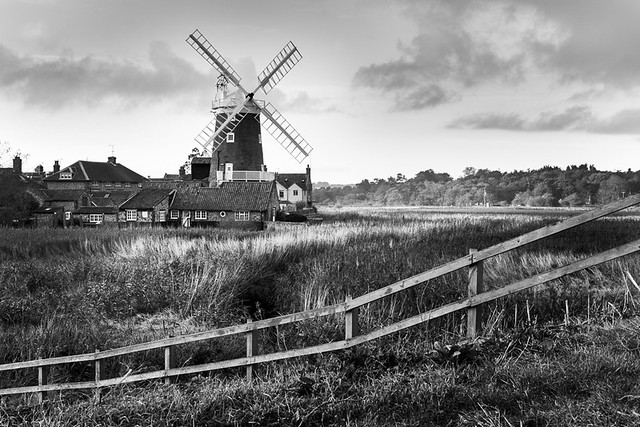
Cley Windmill – decisions, decisions.

Cley Windmill


I recently uploaded this photo of Cley Windmill to Flickr. A traditional view and treatment of this much photographed and prominent building on the North Norfolk Coast. A relatively pleasing image, well composed I think, but is there anything more to say about it, or just as importantly, could I do more with it in post processing?

When I looked at it again a few days later,  I wondered whether or not I should have processed it in another way and that got me thinking. What if I came up with three more versions of the same image using only Silver Efex Pro2, promising myself that I would take no more than five minutes on each version. My plan was to start with one of the many pre-sets and then make some minor adjustments until I finished with an image I liked but had a very different look to the first attempt. What would I learn from this quick experiment? Would I prefer any of the ‘new’ pictures? ….. and finally how would all these photographs compare to the original RAW file from the Leica M Monchrom. Just how flexible are the files it produces?

Read more

‘Broadchurch’ – 100 steps + 180 degrees = 2 very different images

'Broadchurch' cliffs

‘Broadchurch’ cliffs
In truth the spectacular Jurassic coastline at West Bay in Dorset.


The fishing village of West Bay to the south of Bridport in Dorset was the ‘film set’ for one of the best television crime dramas for many years. With Olivia Colman and David Tennant in the leading roles, the series was called ‘Broadchurch’ after the fictional town in the story. In the opening episode the body of a young boy was found on a beach at the foot of some spectacular cliffs.

Read more

Into the woods – a shallow depth of field

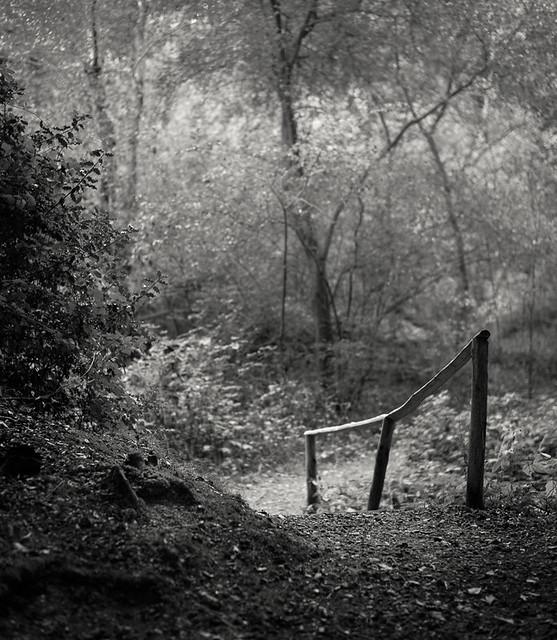
Into the woods

Into the woods


Up until the summer of this year I had never used a 35 mm full frame digital camera, nor such a fast lens. This all changed with the arrival of the Leica M Monochrom and a Leica 50mm f1.4 Summilux lens. I am only just beginning to appreciate the creative possibilities of this combination.

This image was taken back in September in a wooded copse fairly close to my home. I was largely experimenting at this time and took the shot wide open (f1.4) and focused on the near post of the hand rail. Even though this post was some distance from where I was kneeling, the plane of focus is very narrow. Only the leading edge of the path and the branches of the small holly tree to the left are in sharp focus. Checking the depth of field chart Leica provide for their lenses, at a focusing distance of 5m at f1.4, the depth of field is only 4.6m to 5.5m. i.e less than a metre before things are no longer sharp. This means two things – focusing is critical even on a subject which is not that close to you and secondly and more importantly, the careful selection of the focusing point can greatly influence how the image is rendered. It becomes a creative choice just how much or how little is in focus. I like that!

Had I used my Olympus Micro 4/3rd’s camera with the Panasonic 12 to 35 at 25mm (50mm in 35mm sensor terms) and set at its widest opening of f2.8, the equivalent ‘full frame’ aperture opening would be f5.6 because of the crop factor. As a consequence I suspect all of the handrail would have been in focus, together with the foreground. The background trees may have ‘softened’ a little, but I think the appeal of this picture is how the background is very soft. Call it ‘bokeh’ if you like but it adds depth to the image which would be lost if everything was in sharp focus.

There was very little light when this shot was taken. Not only did I use a fast aperture, the ISO was set at 2000 and this still only gave me a shutter speed of 1/750, so that I could happily hand hold the camera.

As I grow in confidence and develop a greater understanding of how best to use a shallow depth of field I think f1.4 might fast become my favourite aperture setting.