Posts from the ‘50mm Summilux’ category

After dark in Chichester
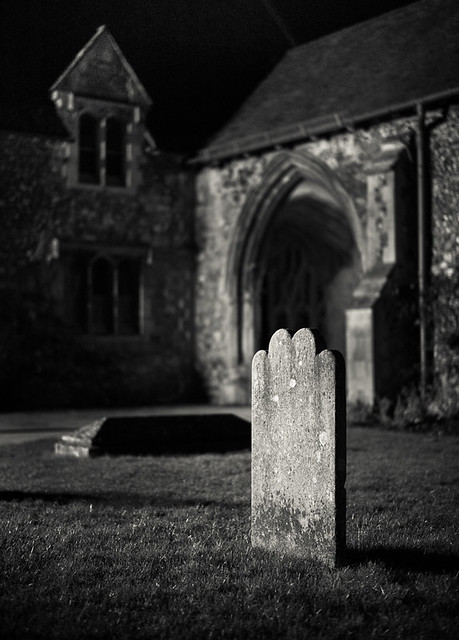
 

Gravestone

Gravestone
In the grounds of Chichester Cathedral
1/180 sec.


There is one particular advantage to the short days of winter, it gets dark very early. Obvious I know, but when I decided a few days ago to take some shots after dark, I was able to do so at a civilised hour, in fact shortly after I had finished work. I very rarely take photographs after the sun has disappeared below the horizon, so I took my Leica M Monochrom to work and on the way home stopped in the centre of the City of Chichester to see what I could find. I limited myself to an area very close to the the Cathedral, as I only had an hour to spare.

I set the ISO to 6400, and the 50mm Summilux lens to f1.4, its widest aperture opening. These settings gave me fairly fast shutter speeds, which allowed me to comfortably hand hold the camera without having to resort to using a tripod. Just as well really as I didn’t have one with me and even if I had, I wouldn’t have wanted to use it. This exercise was more for fun. It was a test to see how the Monochrom worked in very low levels of light, even though I did make use of the artificial light sources available, including the flood lights which illuminate the Cathedral.

This exercise has made me think what might be possible shooting after dark. The joy of being free from a tripod is quite liberating and having looked at the exif data I could easily have used a lower ISO setting. Nevertheless the grain or noise at ISO 6400 does not in my opinion degrade the quality of the image, but on reflection ISO 3200 might have been more appropriate.

All the photographs were processed in Lightroom, and to finish I applied a tone to give the the images a little more warmth.
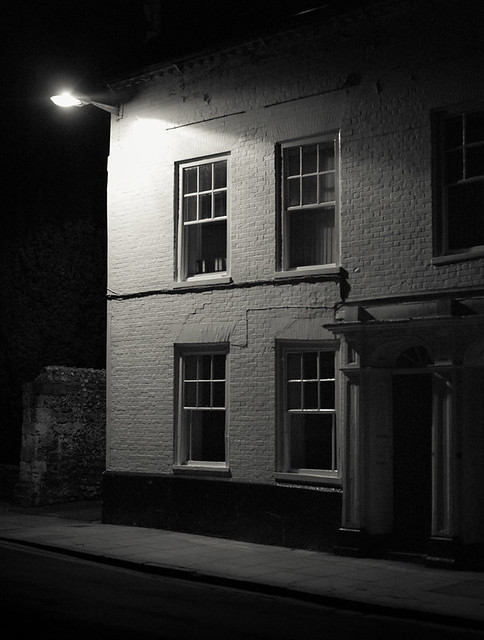
 

West Street

West Street, Chichester
1/1000 sec


The young couple

The young couple
1/90 sec


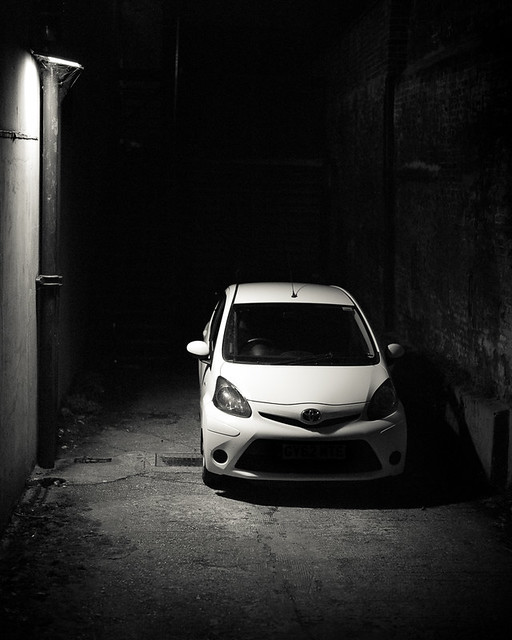
Alley car

Alley car
1/500 sec


Old glass window

Old glass window
1/250 sec


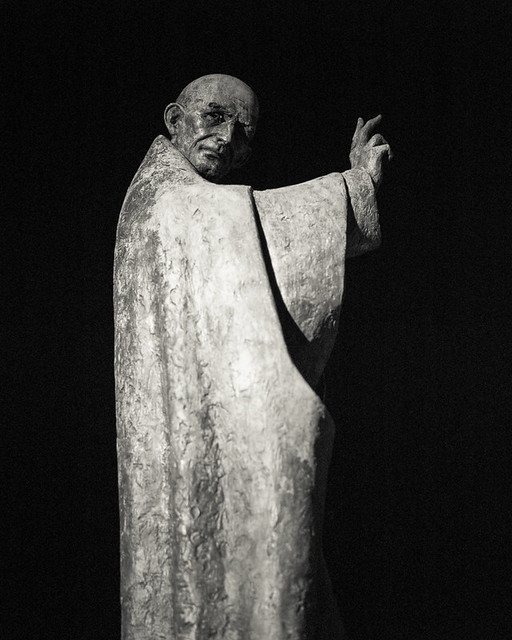
St Richard

St Richard
1/750 sec


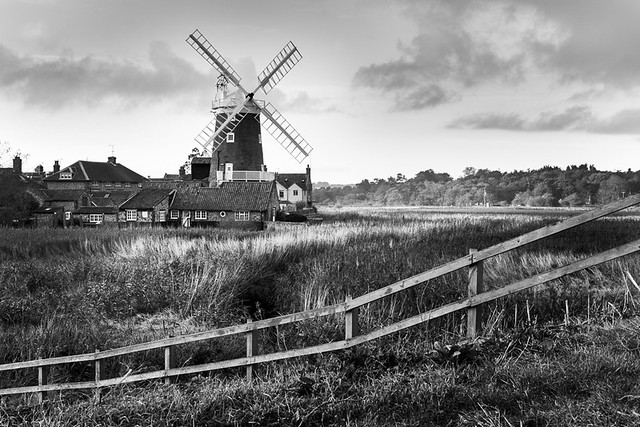
Cley Windmill – decisions, decisions.

Cley Windmill


I recently uploaded this photo of Cley Windmill to Flickr. A traditional view and treatment of this much photographed and prominent building on the North Norfolk Coast. A relatively pleasing image, well composed I think, but is there anything more to say about it, or just as importantly, could I do more with it in post processing?

When I looked at it again a few days later,  I wondered whether or not I should have processed it in another way and that got me thinking. What if I came up with three more versions of the same image using only Silver Efex Pro2, promising myself that I would take no more than five minutes on each version. My plan was to start with one of the many pre-sets and then make some minor adjustments until I finished with an image I liked but had a very different look to the first attempt. What would I learn from this quick experiment? Would I prefer any of the ‘new’ pictures? ….. and finally how would all these photographs compare to the original RAW file from the Leica M Monchrom. Just how flexible are the files it produces?

Read more

Into the woods – a shallow depth of field

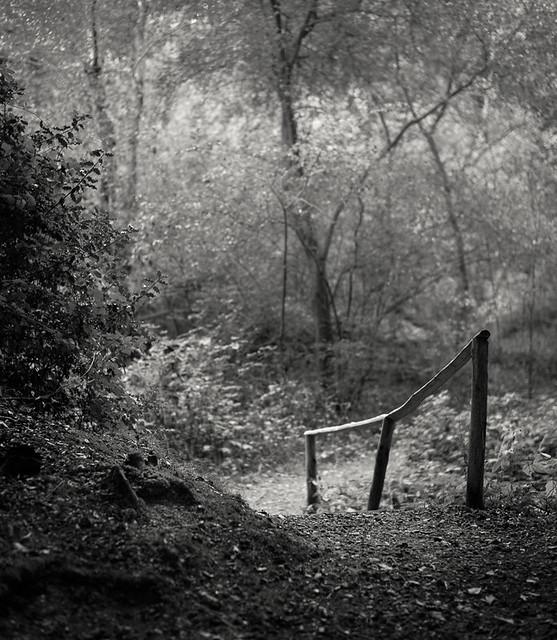
Into the woods

Into the woods


Up until the summer of this year I had never used a 35 mm full frame digital camera, nor such a fast lens. This all changed with the arrival of the Leica M Monochrom and a Leica 50mm f1.4 Summilux lens. I am only just beginning to appreciate the creative possibilities of this combination.

This image was taken back in September in a wooded copse fairly close to my home. I was largely experimenting at this time and took the shot wide open (f1.4) and focused on the near post of the hand rail. Even though this post was some distance from where I was kneeling, the plane of focus is very narrow. Only the leading edge of the path and the branches of the small holly tree to the left are in sharp focus. Checking the depth of field chart Leica provide for their lenses, at a focusing distance of 5m at f1.4, the depth of field is only 4.6m to 5.5m. i.e less than a metre before things are no longer sharp. This means two things – focusing is critical even on a subject which is not that close to you and secondly and more importantly, the careful selection of the focusing point can greatly influence how the image is rendered. It becomes a creative choice just how much or how little is in focus. I like that!

Had I used my Olympus Micro 4/3rd’s camera with the Panasonic 12 to 35 at 25mm (50mm in 35mm sensor terms) and set at its widest opening of f2.8, the equivalent ‘full frame’ aperture opening would be f5.6 because of the crop factor. As a consequence I suspect all of the handrail would have been in focus, together with the foreground. The background trees may have ‘softened’ a little, but I think the appeal of this picture is how the background is very soft. Call it ‘bokeh’ if you like but it adds depth to the image which would be lost if everything was in sharp focus.

There was very little light when this shot was taken. Not only did I use a fast aperture, the ISO was set at 2000 and this still only gave me a shutter speed of 1/750, so that I could happily hand hold the camera.

As I grow in confidence and develop a greater understanding of how best to use a shallow depth of field I think f1.4 might fast become my favourite aperture setting.


The Reader – a new approach to my photography perhaps?

The Reader

The Reader


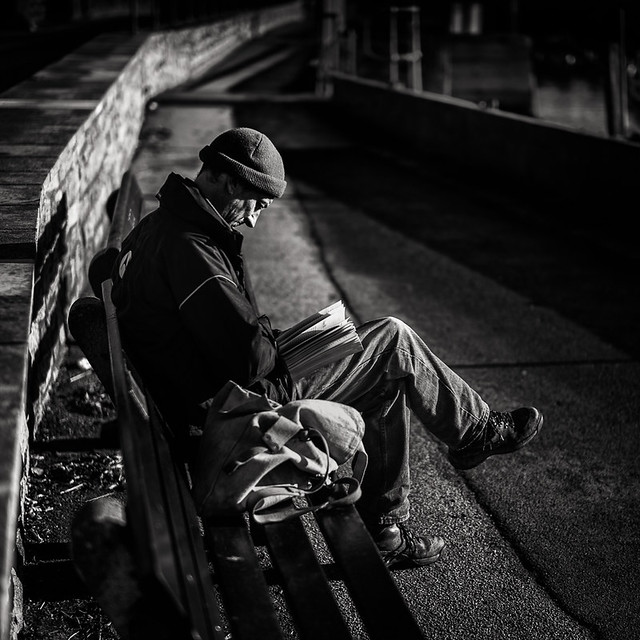
Following my one day workshop with Andy Beel in Bath recently, I have started to observe and then process my images differently. I would like to think that I am trying to approach my photography is a more artistic way. This ‘new’ style is also a result of my acquiring a Leica M Monochrom earlier this year, which when coupled with the 50mm f1.4 Summilux lens provides me with plenty of creative opportunities. The files it produces are quite superb and allow plenty of latitude in post processing. I have yet to fully appreciate all of its capabilities but the learning curve is a very good one! For a start, the one camera and one prime lens approach also means that I spend more time looking and taking pictures instead of zooming in and out, or swapping lenses. The fully manual controls also help to ensure I am thinking about the look I am trying to create. I haven’t perfected it yet, but manually focusing is getting much easier and more intuiative.

The shot featured in this entry was taken yesterday in the fishing village of West Bay in Dorset. I was attracted to the way the light fell on the man’s face and clothing as he sat in the winter sun by the harbour side, absorbed in the pages of his book. I guess he probably works in the fishing industry but found himself with time on his side. I have increased the contrast and darkened areas of the picture, so the eye is drawn to his profile which is sharp in comparison to the out of focus background. I also like the way the light is falling on the harbour wall as it disappears into the distance. I have added a ‘copper tone’ at 20% in Silver Efex which I think suits this image.


Thanks to everyone who has started following my blog recently.


Morning glory

Burning off the mist

There are many occasions when my wife and I will take our dog for a walk in the beautiful countryside which surrounds us, when shortly into the walk she will say –

“Did you bring your camera with you?’

To which I will reply

“No, I haven’t.”

Almost inevitably a few minutes later a scene worthy of capture will present itself and I curse myself for not having bothered to pick up my camera and thrown it over my shoulder.

Many a missed opportunity, but this morning was the exception and I must learn the lesson to always have a camera with me. It’s an old cliche but a very true one.

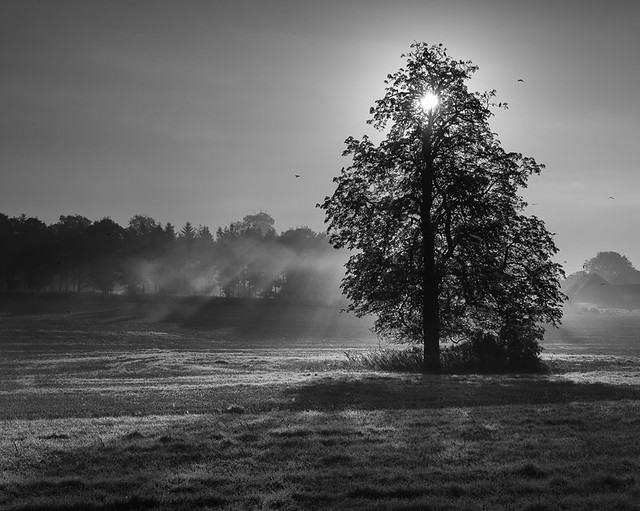
Within five minutes of leaving our car we came across this scene. The sun was rising, the morning mist lifting and the dew on the ground added another attractive element to this autumnal scene. The birds flew around the lone tree in the field and the distant farm buildings to the right completed the composition. I took the shot and we continued our walk. I am guessing but I would think that five or ten minutes later the early morning mist would have been burnt away and this glorious view would have been lost.

For me this is a very special time of year and I am looking forward to the weeks and months ahead. Needless to say I will try and remember to have a camera with me at all times.