Posts tagged ‘Thoughts’

Main Exit – dissecting the visual components of a photograph

Main Exit

Main Exit

I often ask myself the question – ‘Why does a photograph interest me and hold my attention for more than a few nano seconds? What are the various components of the image that make it visually appealing to me and maybe to others?’

In answer to these questions I thought I would try and dissect the key elements of this photograph which I have called – Main Exit. Do click on the image to view a larger version as this will help you see all the detail in the picture.

To begin, the image is monochrome; obvious I know, but a colour image of the same picture simply wouldn’t be as interesting. This shot is all about tone, texture, contrast and the overall composition. Colour would be a distraction. There is though a subtle tone which has been applied in post processing, which may not be immediately apparent.

The main focal point is the man in the top right hand corner walking into the building. We can’t see all of his body or his head, but we do see a reflection of his pale jacket and he stands out against the dark background. White on black will always draw the eye. He is framed within a dark square which ties in well with the square crop of the image itself. It’s virtually a picture within a picture.

A square crop doesn’t always work but in this example I think it enhances the overall composition. There is a strong diagonal lead in line from the bottom left hand corner which takes your eye to the main subject of the picture. There are paler lines in the ground which also lead the eye. These are in contrast to the vertical lines of the modern windows. The ground also slopes upwards, so that the metal base of the building narrows to a point where it meets the man. This aids perspective and adds to the sense of depth.

Reflections always provide visual interest because they distort reality. The older buildings are all askew, there is half a car and half a waste bin. Behind the glass there is a person sitting down  which begs the question as to what’s inside and the purpose of the building itself.

Top right there is a sign which says ‘Main Exit’ but the arrow points in the opposite direction to the man entering the building – has he gone through the wrong door?

As well as being a contrasty image there is also the visual contrast of the new and old buildings, the young person behind the window and the older person walking through the door. The contrast in texture between the ground and the mirror like surface of the windows.

Lastly a border has been added to provide a frame round the image.

For me it makes a visually appealing image, as the sum of all the component parts make for an intriguing story, complete with different textures and tones, all held together by strong compositional and geometric elements as well.

I have found this exercise beneficial and I hope you have enjoyed my ‘dissection’ of a photograph interesting. Arguably the approach could work just as well on images that you don’t like, as well as the ones that do. It’s worth a try.


My new camera – an iPhone 6S – a useful photographer’s sketchbook

Most photographers will be familiar with the saying – ‘The best camera is the one you have with you’. I can’t disagree with this adage but just how good are smartphones as a true photographic tool? Let me say rather swiftly that this is not intended to be a review of my recent upgrade from the iPhone5 to the iPhone 6S, but merely a selection of images and a few opinions of my own about the value of taking images with a mobile phone. I hope you will find my thoughts interesting.


IMG_1280


The iPhone 6S now boasts a 12mp sensor, so it’s no wonder that the use of smartphones have stolen a huge number of sales from the compact camera market in recent years. (Click on this link to a page on Flickr which only confirms what most of us already know about the use of camera-phones). However I am all too aware that more megapixels doesn’t necessarily equal better quality pictures. The biggest factor is always going to be the person taking the shot, not the equipment being used, but that’s a topic for another day!

The four images in this post were all taken in the past few weeks whilst out and about walking our dog. I have never found it easy to multi task and keep one eye on the subject being photographed and the other eye on the dog, just in case he gets bored and runs off out of sight. So a quick shot is really all the time I have. The pictures have been imported into Lightroom from the iPhone 6S and then converted to black and white. Some limited post processing has been used to enhance each image if only to prove to myself what is possible with the jpeg files.


IMG_1183


So what are my thoughts? Well the results are pretty remarkable all things considered. The iPhone 6S has coped well with some high contrast conditions and to a certain extent the files are flexible in post processing. There isn’t much detail in the shadows but it’s unquestionably a better performer than the iPhone 5. They are certainly good enough for posting on the web which is where the vast majority of images now end up. What I would say is that the quality deteriorates significantly when zooming in, so it’s arguably better to take a ‘full size’ image and then crop in post. Would I want to make an A4 or even an A3 size print? – I haven’t tried, it would be an interesting exercise but I doubt I would be happy with quality, however I might be pleasantly surprised.


IMG_1200


I enjoy taking pictures on my phone but for now it will never replace any of the cameras I take so much pleasure in using. For me the camera-phone is the equivalent of an artist’s sketchbook. Something which is very portable and convenient to have with me at all times. Something I can use to make a visual record of a particular location. Something to inspire me and to think about when considering a return visit. A photographer’s sketchbook – most definitely yes, and a very good one at that. A replacement for my cameras with interchangeable lenses and the ability to shoot in RAW – no way, but still worth having with me at all times – if only to make the odd phone call!


“You see, but you do not observe ” – a quote from Sherlock Holmes

I rather like this quote by Sherlock Holmes taken from the novel – ‘A Scandal in Bohemia’. It is just as relevant to Holmes as he tries to decipher the clues to a crime, as it is to a photographer trying to decide what to photograph and why.

We so often arrive at a destination and in haste the camera comes out of the bag, a lens is chosen and a moment later the shutter has been released and we move on to the next shot. Or at least that’s what I am inclined to do, particularly when time is limited. Have I just seen and not observed? If I gave myself more time and slowed the whole process down, would I start to observe and not just see. There is an important difference. Would it just be better to leave the camera in the bag and resist the temptation to take the first photograph until your eyes have truly observed what it is your mind wants to capture?

Do you appreciate something more if it has been observed, experienced and enjoyed as opposed to just seen and captured?

This question brings me rather nicely onto something I heard on Radio Four earlier this month. As I was getting myself ready for work I listened to ‘Thought for the Day’ by The Rev. Dr. Sam Wells.

In the broadcast he recites the story of being in The Alps waiting for the cyclists in the Tour de France to pass him by. He deliberated as to whether or not to take a photograph on his smartphone and capture the moment as they raced by, or simply watch as they came towards him, cycle past, then away into the distance and out of sight. He chose to take the photograph but he admits he missed the race. He goes on to say that Benedict Cumberbatch is playing Hamlet at The Barbican in London and coincidentally the same actor also plays Sherlock Holmes in the recent BBC TV series. In Hamlet his adoring fans are trying to capture him on their smartphones, but are they missing the play, the superb acting and the wonderful words of Shakespeare?


 Benedict Cumberbatch as Sherlock Holmes in the BBC series Sherlock. Photograph: Robert Viglasky/PA

Benedict Cumberbatch as Sherlock Holmes in the BBC series Sherlock. Photograph: Robert Viglasky/PA


(I urge you to listen to the short broadcast – it lasts under three minutes and in my view, is well worth hearing.)

Thought for the Day on Radio 4 by Rev. Dr. Sam Wells, the Vicar of St Martin in the Fields. First broadcast on 12th August 2015.


As a photographer I often wonder if I am missing the experience of just being in a certain location, enjoying the surroundings in which I find myself, as opposed to concentrating on the point of focus, composition and exposure settings. Or in other words ‘living the moment’.

Perhaps by keeping the camera switched off for a little longer, not only will we enjoy the experience even more but it will also teach us to observe and not just see. It may enhance our lives and through closer observation and appreciation of the subject, improve our photography as well.

Thanks as always for looking, reading and perhaps listening as well.


Do click on the image to view a larger version.

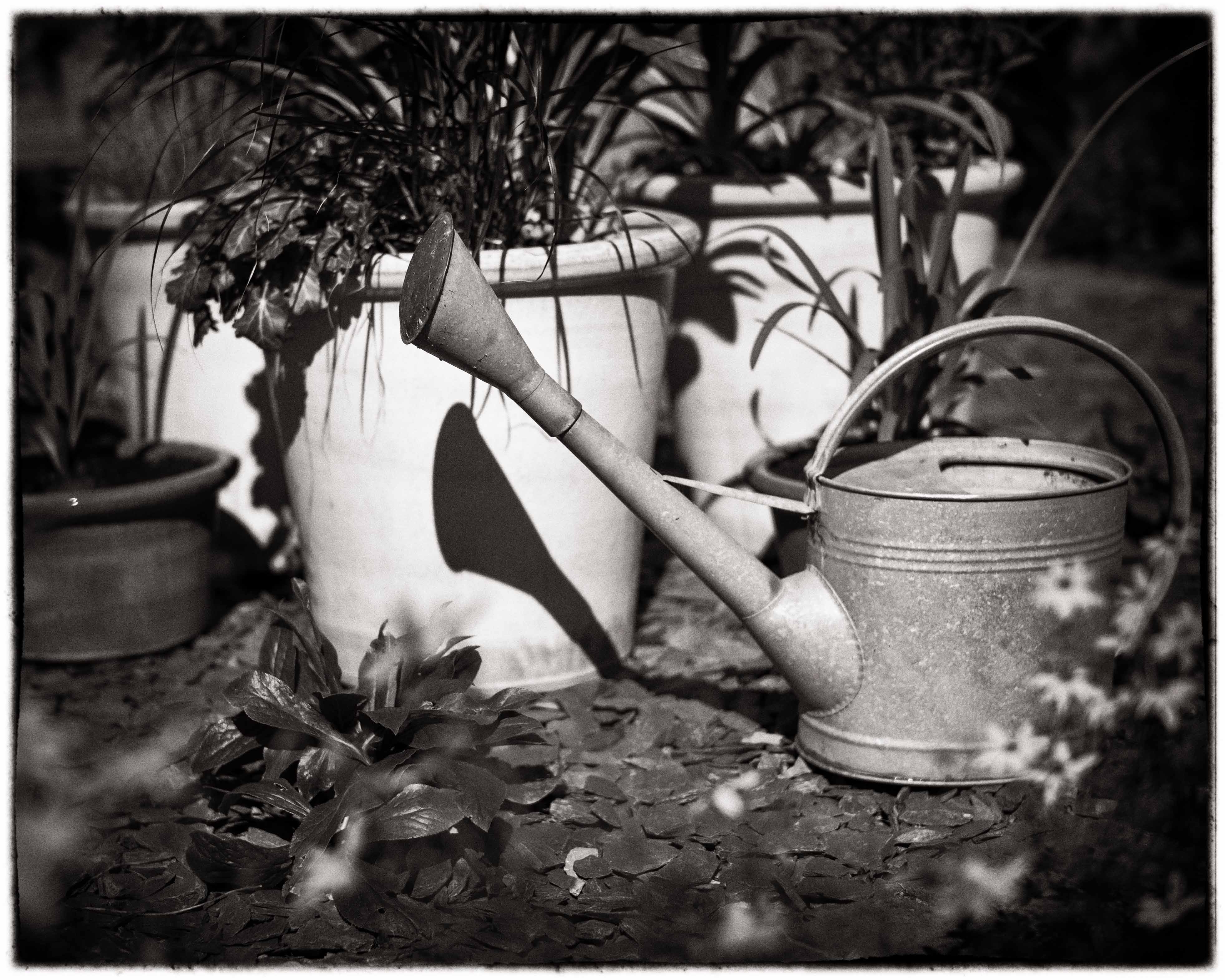
The tale of the missing watering can!

Watering can-3

My wife and I do not profess to be gardeners, although we have spent the summer trying to make our back garden less of a wilderness of weeds and more one of pots, plants and climbers – in other words a place not to be ashamed of but to enjoy.

Having bought a few new plants we of course needed to keep them well watered. Our old watering can was required but unfortunately we could not find the rose which is normally attached to the stem of the can. Without the rose, the water comes out at a furious rate drowning the new plant and rendering the watering can a rather poor piece of gardening equipment.

We decided to see if we could buy a new metal rose and not a plastic one, which might work perfectly well but to our eyes would look rather odd. We even went so far as to take the can to a number of garden centres to ensure that we bought a rose which would fit. We couldn’t find a metal rose anywhere, so we resigned ourselves to buy a new plastic watering can. Not great but it did the job and was quite cheap.

A week or so later we were back in the garden and my wife found the old metal rose behind a small pile of bricks. Frustrated and delighted to have found it we went looking for the old watering can. We hunted around the garden, which isn’t very big, in the garage and the shed. It was nowhere to be found. We could be forgiven for losing the rose but losing a watering can, well that’s not quite so easy! We soon came to the conclusion that we must have left it at one of the garden centres when we were searching for a replacement rose. How embarrassing! However that didn’t stop my tenacious wife ringing the places we had been just in case someone had stumbled upon our missing watering can. No such luck but it was worth a try.

This weekend we went shopping for a few more plants and as we walked around we had half an eye out for our watering can. No such luck, but before we left I said to my wife, lets just take a look at the watering can section inside the garden centre. It had been moved to a new area but undeterred we found it. Much to our surprise, there on one of the shelves was our old metal watering can! Unlike any of the others for sale, it certainly didn’t look new (because it wasn’t), it had no price tag, but along with all the other cans it had been diligently moved by if not one, then possibly by two or more members of staff to a new display.

Much to our delight we picked it up and having paid for our plants and a few more pots at the checkout, we returned home and reunited the rose and the watering can.

It has a valued purpose in life; looks so much better than the plastic version, and thanks to this little tale, now has a character all of its own.

To see the watering can in all its glory do click on the image to view a larger version which will open in an new window.

Haytor – a chance to reminisce.

Haytor

Haytor

I recently came home from a very enjoyable and relaxing family holiday on the borders of Devon and North Cornwall. On the return journey I wanted to take a small detour and visit the town of Bovey Tracey, which lies on the eastern edge of Dartmoor National Park, and more specifically to go and see the granite outcrop of Haytor. This is perhaps the most recognisable and accessible of all the Dartmoor Tors, so on arrival I was not surprised to find a visitor centre, car and coach park catering for the tourists. Fortunately the weather was inclement and the number of people clambering up the relatively easy hill to reach Haytor were few.

I wanted to return mainly for sentimental reasons. I have fond memories of family holidays in this part of Devon when I was in my mid teens, some forty plus years ago (take large gulp…… and ask how is that possible?) and had not been back since. Life moves on and sadly both my parents and my sister have all passed away in the intervening years. My wife stayed by the car to photograph the very tame Dartmoor ponies and I walked up the hill with my grown up daughter and our dog.

I was pleased that the rocks of Haytor were just as I had remembered them; exposed to the elements but to my eyes nothing had really changed. My memory of Haytor is now as it was when I was a teenager. Still proud and strong, still dramatic and still commanding spectacular views of the surrounding countryside. It felt good to be back experiencing this great location with my own family and for a few moments to stand quietly, touch the stone, and reminisce about past times.

It was also good to be reminded that some things change and some things remain the same, which is just as well, as we all need a ‘rock of stability’ in our lives.