Posts tagged ‘monochrome’

Into the woods – a shallow depth of field
Into the woods

Into the woods


Up until the summer of this year I had never used a 35 mm full frame digital camera, nor such a fast lens. This all changed with the arrival of the Leica M Monochrom and a Leica 50mm f1.4 Summilux lens. I am only just beginning to appreciate the creative possibilities of this combination.

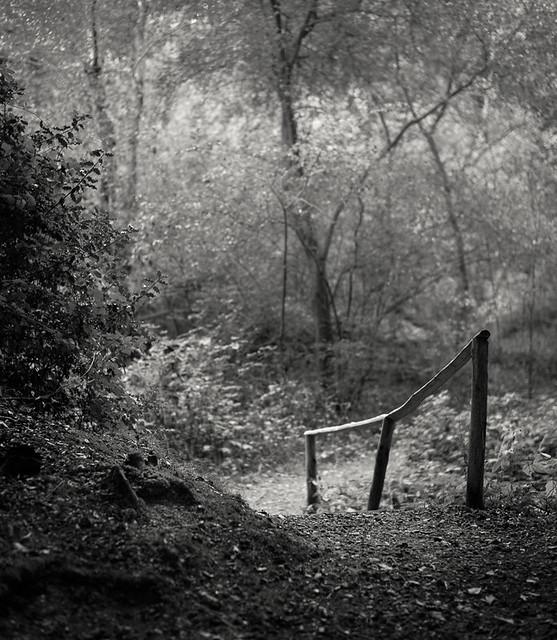
This image was taken back in September in a wooded copse fairly close to my home. I was largely experimenting at this time and took the shot wide open (f1.4) and focused on the near post of the hand rail. Even though this post was some distance from where I was kneeling, the plane of focus is very narrow. Only the leading edge of the path and the branches of the small holly tree to the left are in sharp focus. Checking the depth of field chart Leica provide for their lenses, at a focusing distance of 5m at f1.4, the depth of field is only 4.6m to 5.5m. i.e less than a metre before things are no longer sharp. This means two things – focusing is critical even on a subject which is not that close to you and secondly and more importantly, the careful selection of the focusing point can greatly influence how the image is rendered. It becomes a creative choice just how much or how little is in focus. I like that!

Had I used my Olympus Micro 4/3rd’s camera with the Panasonic 12 to 35 at 25mm (50mm in 35mm sensor terms) and set at its widest opening of f2.8, the equivalent ‘full frame’ aperture opening would be f5.6 because of the crop factor. As a consequence I suspect all of the handrail would have been in focus, together with the foreground. The background trees may have ‘softened’ a little, but I think the appeal of this picture is how the background is very soft. Call it ‘bokeh’ if you like but it adds depth to the image which would be lost if everything was in sharp focus.

There was very little light when this shot was taken. Not only did I use a fast aperture, the ISO was set at 2000 and this still only gave me a shutter speed of 1/750, so that I could happily hand hold the camera.

As I grow in confidence and develop a greater understanding of how best to use a shallow depth of field I think f1.4 might fast become my favourite aperture setting.
 

Oh what a tangled web we weave…..

Tangled web

Tangled web


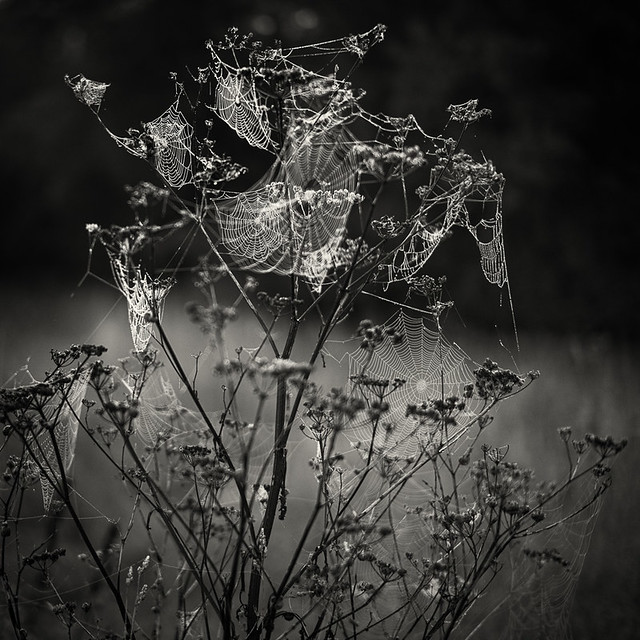
From a very young age I always remember the saying – ‘Oh what a tangled web we weave, when first we practice to deceive.’ Whilst I have always tried to live my life accordingly, its relationship with the image is quite simply the fact that it was the first thought that entered my mind when I took the shot at the end of October. The cow parsley was absolutely covered in cobwebs, woven in amongst the drying flowers and stems. The dull and damp morning added another ingredient. Poor lighting but I knew I could add contrast in post processing.

Focusing and composition was a challenge, but I was more aware of the background and how it affected the overall appearance of the picture. I didn’t want it to be in focus, far from it, but I did want it to compliment the subject and provide the contrast necessary so that the cobwebs and lower stalks were clearly visible. The dense backdrop of trees provided the dark upper layer and the grasses in the field the paler lower layer.

This photograph may not be to everyone’s tastes, but it is very much a feature of the countryside in the autumn.

Tangled web yes, deceitful no; just testimony to the creative talent of the humble and sometimes scary spider!

The Reader – a new approach to my photography perhaps?

The Reader

The Reader


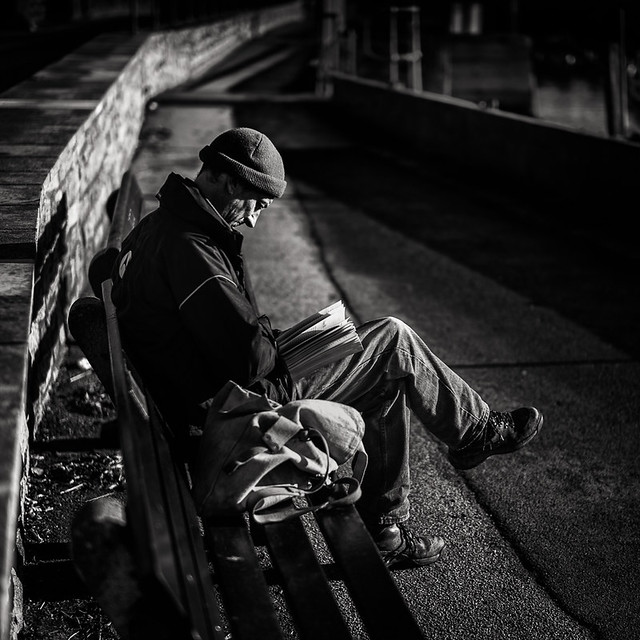
Following my one day workshop with Andy Beel in Bath recently, I have started to observe and then process my images differently. I would like to think that I am trying to approach my photography is a more artistic way. This ‘new’ style is also a result of my acquiring a Leica M Monochrom earlier this year, which when coupled with the 50mm f1.4 Summilux lens provides me with plenty of creative opportunities. The files it produces are quite superb and allow plenty of latitude in post processing. I have yet to fully appreciate all of its capabilities but the learning curve is a very good one! For a start, the one camera and one prime lens approach also means that I spend more time looking and taking pictures instead of zooming in and out, or swapping lenses. The fully manual controls also help to ensure I am thinking about the look I am trying to create. I haven’t perfected it yet, but manually focusing is getting much easier and more intuiative.

The shot featured in this entry was taken yesterday in the fishing village of West Bay in Dorset. I was attracted to the way the light fell on the man’s face and clothing as he sat in the winter sun by the harbour side, absorbed in the pages of his book. I guess he probably works in the fishing industry but found himself with time on his side. I have increased the contrast and darkened areas of the picture, so the eye is drawn to his profile which is sharp in comparison to the out of focus background. I also like the way the light is falling on the harbour wall as it disappears into the distance. I have added a ‘copper tone’ at 20% in Silver Efex which I think suits this image.


Thanks to everyone who has started following my blog recently.


The fisherman’s hut

Fisherman's trailer hut

Fisherman’s trailer hut

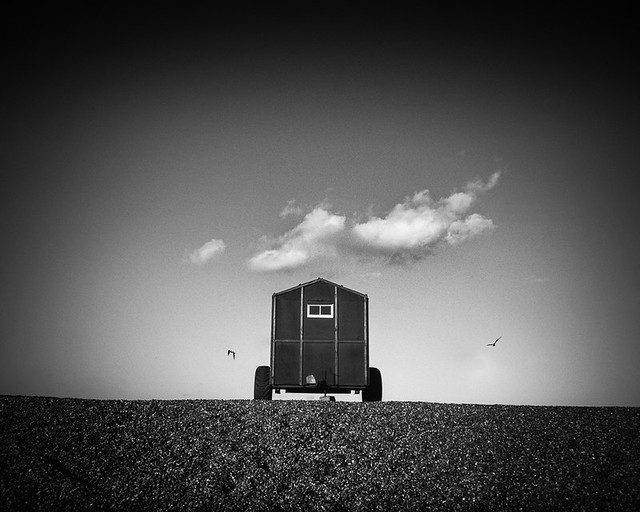
This hut on a trailer is not the most attractive, in fact from a purely aesthetic point of view some might describe it as plain ugly or just a shed on wheels. However from a photographic perspective I was drawn to the subject. I asked myself what it might be used for and did it ever move from its isolated position on the shingle beach at Weybourne on the North Norfolk coast.

When I took the shot It was a beautiful autumn day, with clear blue skies almost devoid of any interest but for the small cluster of clouds immediately above the hut and a couple of gulls as they flew above the shoreline. For me both the clouds and the gulls make the image. Without them the hut on its own would not be so interesting.


Thanks to everyone who has started following my blog recently.


I am not a wildlife photographer – The hare

The hare

The Hare


I freely admit to the fact that I am not a wildlife photographer. I don’t have the right equipment, nor do I have the patience to stay in one place long enough to take photographs of rare birds or other animals. I also acknowledge that I take an eclectic mix of subjects; the one thing they all have in common is that they are in monochrome.

However, if the opportunity presents itself then I am more than happy to take a wildlife shot. It rarely happens but it does give me pleasure when the result, in my opinion, is worth sharing on my blog.

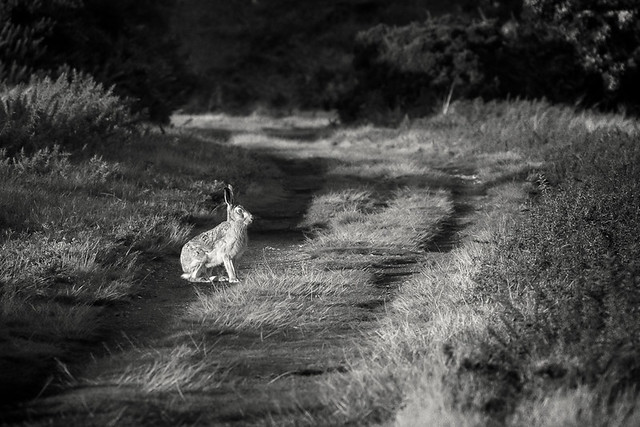
This image of a hare was taken whilst walking our spaniel across some heathland in Norfolk recently. I had my camera out as I was hoping to take some photographs of our dog, when my wife quietly drew my attention to a hare on a path over to our right. The hare sat in late afternoon sun just long enough for me to focus and press the shutter. The hare must have spotted us or our dog, probably both, before running away. A fleeting moment.

I do belong to a camera club and I might be tempted to enter this picture into a competition, but I know what the judge will say – “I wonder what it would be like in colour?” or “I wonder why the author has chosen to convert it into black and white?”

Well let me try and answer this question. For me photography is all about light, line, tone and texture, and colour in an image can so often be a distraction. Because of the time of day this shot was taken, the colours are vibrant, with a mix of strong autumnal yellows and greens. Although the hare is bathed in sunlight, the colours are too much of a distraction and as a consequence the eye does not rest happily on the main subject, which is of course relatively small in the frame. In monochrome the hare stands out, the line of the path is a clear compositional element and most importantly for me, the light and contrast in the shot is there for all to enjoy.