Posts tagged ‘Leica’

Light out of Darkness

In the past few days I have been reading ‘Steeple Chasing – Around Britain by Church’ by Peter Ross. I am now about half way through the book and I am thoroughly enjoying both the content and the well written word. I can highly recommend it.

In the first chapter titled ‘Darkness’ two short passages spoke to me and in so many ways succinctly described my own feelings when visiting churches.

The first and I quote – “And so, as I grew older, I found myself drawn back – not to pray necessarily, but to sit for a bit, to poke around, to get in out of the rain. I began to appreciate the wisdom of John Betjeman’s words: ‘Church crawling is the richest of pleasures, it leads you to the remotest and quietest country, it introduces you to the history of England in stone and wood and glass which is always truer than what you read in books’”

In the second passage the author refers a visit to the Benedictine Abbey at Pluscarden in Scotland following the recent passing of his father. He writes – “…… it brought me a peace that I hadn’t felt for many weeks. I left far lighter than I had come. Was this a religious experience? I don’t know. Perhaps it was just being forced to spend long hours sitting in quiet. ‘It kind of gets inside you / The silence I mean,’ sings Linda Perhacs in her beautiful song ‘Chimacum Rain’, and old churches are like that. You are entering a building but really it is entering you.”

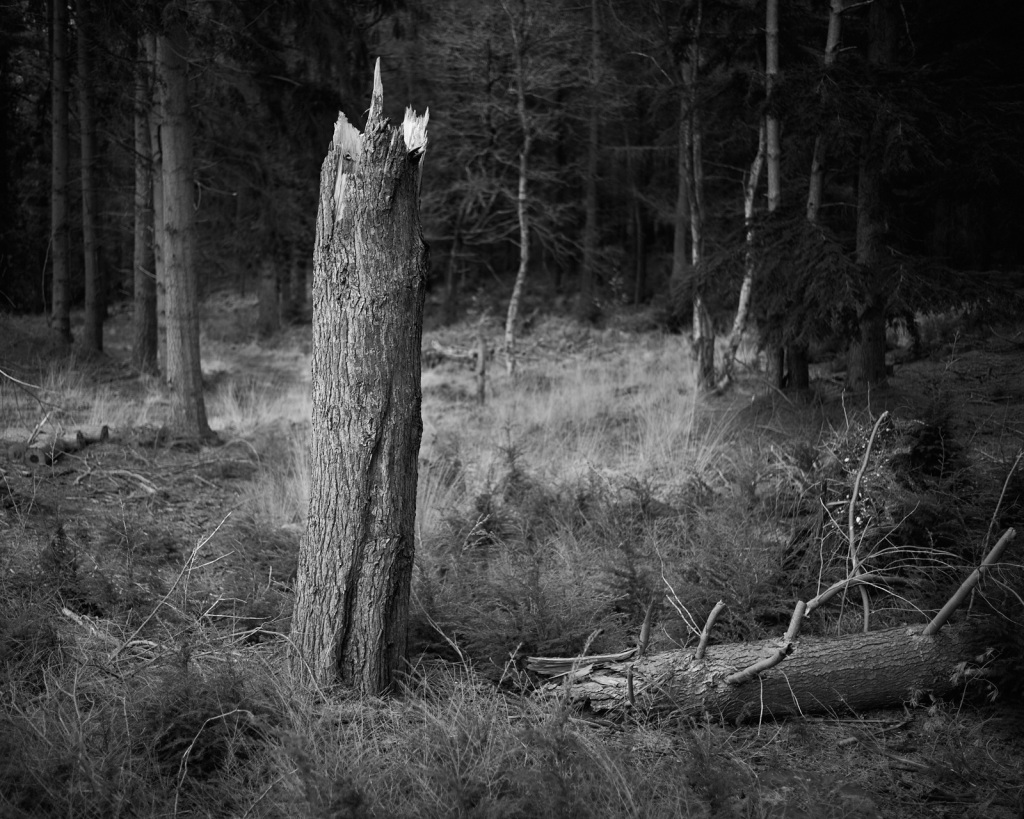
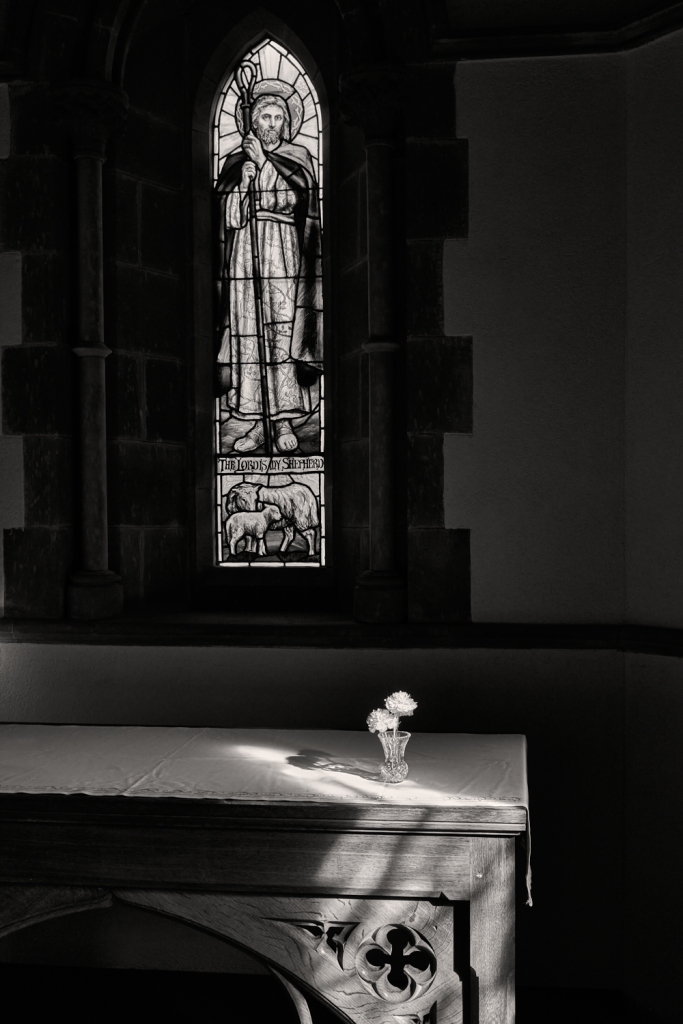
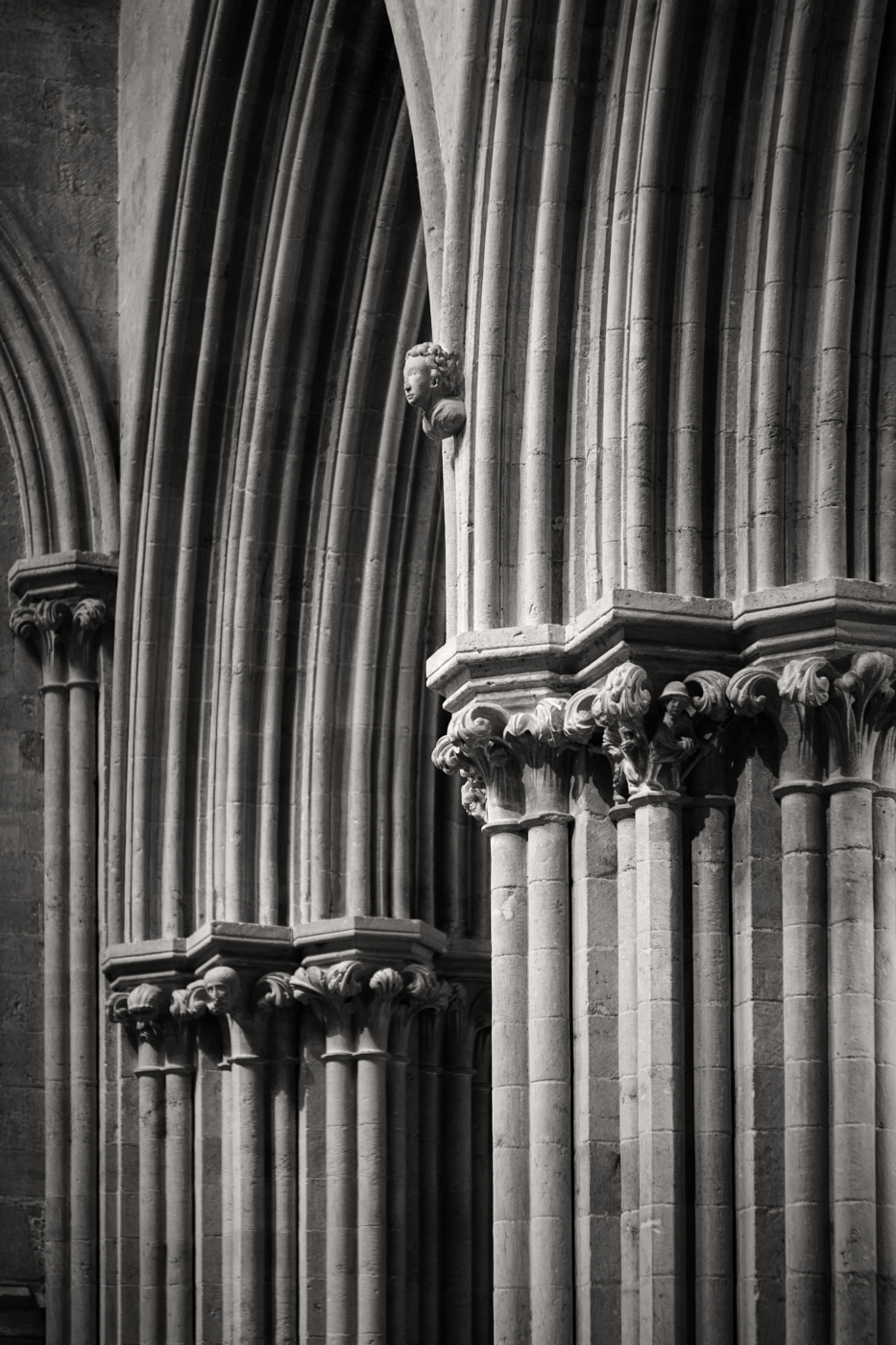
The six images shown here are a collection I have made over many years from visiting a variety of churches. I love to watch the light as it moves around, highlighting subjects which would otherwise be in virtual darkness. I endeavour to capture the feelings of stillness, of quiet and of solitude, prevalent in churches but not quite so easy to find elsewhere.

Perhaps it goes without saying that in the Bible the metaphorical meaning of light and darkness is often used to compare good and evil.

In John 1:5 “The light shines in the darkness, and the darkness has not overcome it.”

Read more

Revisiting the majestic Wells Cathedral ….. to capture some details

Columns which line the nave

If anyone was to ask me to name my favourite Cathedral, it would be a choice between these three: Wells in Somerset, Chichester in West Sussex and St Davids in Pembrokeshire. Pushed to say which would come out on top and I would have to say Wells Cathedral. Why? It has a very special atmosphere born out of the quite majestic architecture and the extraordinary detail of its design. The history and its setting in what is a small city just adds to its appeal.

Last week my wife and I enjoyed a short holiday in Somerset. We were staying about 10 miles north of Wells so another visit had to be included in our itinerary of places we wanted to see. I have been fortunate to visit and photograph the cathedral previously, but this time round I decided to concentrate on some of the details, which to me tell a story about the building and sum up very nicely why it means so much to me.

I could spend hours and hours in the cathedral and never be bored finding other compositions so another visit is very much on the cards. Until then here are a selection captured last week and if you would like to read my other blog entries about Wells Cathedral here are the links are below.

A Monochrome Masterclass and a visit to Wells

A quote by St. Francis of Assisi reminded me of Wells Cathedral

The Chapter House – making amends for a missed opportunity

Carved stone detail and pillar near the west door
Read more

‘Lost Glove’ – photo titles or even some Haiku perhaps?

dew on hand of wool
posts and wire in mist belong
cold fingers missing

I don’t know what you think but when it comes to giving a photograph a title it can be something of a struggle. At best a title can enhance the image; at worst it can be bland and add nothing at all. Some are purely factual which can at least inform the viewer, but these lack any artistic merit. I have even read a few titles and to be perfectly frank they were a distraction and it would have been much better to have let the image stand on it’s own two feet. There are of course occasions when the photographer feels the need not just to give the photograph a title but also a very lengthy description, which somehow almost becomes more important than the image itself.

All of this got me thinking, particularly as I have almost certainly been guilty of poor and uninspiring titles, overlong descriptions, the list goes on…….

I can’t profess to be a great lover of poetry but I do see a definite connection between the art of photography and writing poems as a creative art. What if the two were combined? Well it’s hardly the most original idea but I thought I would give it a try. 

One of the simplest forms of poetry is Haiku, a Japanese poem of just seventeen syllables on three lines – five on the the first line, seven on the second and five on the last line. Traditionally the poem evokes images of the natural world. There is no requirement for rhyme and whilst the number of syllables on each line has changed over time I thought I would stick with the original guidelines. I like the minimalist approach and the strict parameters prevent verbosity – something I could be accused of in this post!!

So below the photograph is my very first attempt at a Haiku verse combined with one of my ‘Chichester Harbour’ project images. ‘Lost glove’ is an apt, albeit unimaginative title, but I think the verse adds a little something extra. Masters of this form of poetry would probably mock the result, but I enjoyed linking words to an image. Will it be something I will use again? I can’t answer that but I’m pleased to have had a go. Your thoughts as always would be most welcome on both the image and the words!

It’s great to have my Monochrom back!

A couple of months ago I discovered I had a problem with my Leica M Monochrom. In essence a new sensor was required. You can read more about the issue by clicking here.

Just over a week ago I returned the loan camera to The Leica Store, Mayfair in London and collected my trusty camera; fully serviced and with a new sensor, all at no cost to me. The service had been excellent and I have nothing but praise for the way the whole thing was handled.

It’s strange but the loan camera just wasn’t the same; perhaps the feel of the shutter was slightly different, but for various reasons it was hardly used in the 8 weeks my camera was away in Germany.

Delighted to have the Monochrom back in my hands, I went down to Chichester Harbour and took a few shots – nothing special; more of a test to see that the camera was behaving itself , which it definitely is!


Do click on any image to see a larger version which will open in a new window.

An eye for detail – just one reason why I love the Leica Monochrom

I have now been using a Leica M Monochrom for eighteen months or so and there are many reasons why I have grown to love this camera. It was a fairly steep learning curve switching to a camera which has no colour sensor – each pixel only records luminance resulting in a black and white file with any number of shades of grey in between.

The fact it is rangefinder with its split frame manual focusing mechanism was an added hurdle for me to get over. Initially it was difficult enough to focus a still subject let alone a moving one, as is the case here. Even more challenging when using the 50mm Summilux f1.4 nearly wide open. The depth of field is so narrow I would be the first to say that a little bit of lady luck is required to get the main subject of the picture in sharp focus. When it happens though, you can jump for joy because the level of detail captured is quite extraordinary.

I very much doubt this image would win any prizes and I have used it simply to illustrate a particular point; and that is quite simply the level of detail or resolution captured by this camera.

For reference the final image (at the bottom of this post) is a fairly mild square crop of the original RAW file which has been processed in Lightroom 5. There are some adjustments but principally the addition of contrast, clarity and a tone for effect, but no sharpening. I repeat no sharpening.

The original image is shown below with just the processing applied and no crop.


Un-cropped image


Next is a much more detailed crop. You can now see the exceptional level of detail captured by the Leica Monochrom.


A tight crop


If you are yet to be impressed, below is an even tighter crop. The number of eyelashes can almost be counted and if you look closely veins are visible in the eye itself. If nothing else this image confirms my good fortune when I focused on the eye.


An even tighter crop


And by way of a reminder the final image which is how I imagined the picture might look when I pressed the shutter. I knew I wanted the eye to be at the centre of the viewers attention, but the photograph also needed to include part of the leather harness to add context and another element of interest. The harness also confirms you are looking at the horse’s head in profile and not straight on.


The finished photograph


As I said at the outset there are many reasons why I love this camera. It can be a frustrating and quirky tool at times, but get to know its ways, and I defy any photographer not to be impressed by the quality of file it can deliver when coupled with an equally exceptional fast Leica lens. It has a purity and a simplicity to its operation which places the photographer in complete control. You need to consider every step, every setting but the rewards are more than worthwhile.

I would strongly urge you to click on each image to view a larger version. This post is all about ‘detail’ and it’s only by looking at a bigger version that you will truly appreciate the output of the Leica Monochrom.