A few weeks ago Leica released a firmware upgrade for their SL cameras, specifically v6.1.0 for the SL2-S. One of the principal issues this update addressed was the ‘Magnification via joystick’. I had missed this very useful function, and this was re-enabled in the update. It’s a big improvement to how the camera operates, particularly when using manual focus lenses, which I do all of the time.
Installing firmware updates are something of a nuisance but I had no hesitation in immediately downloading the new version and proceeded to update the camera.
Unfortunately in my haste I forgot to save the profile for all my camera settings. Whoops – I knew straightaway that I would need to reconfigure all my favourite settings, and the configuration of the function buttons etc, etc. I couldn’t help thinking ‘What a pain…….!’
However this mistake did give me the opportunity to review how my camera was set up. As a result I configured the camera quite differently and in my view it is all the better for it. Whilst muscle memory plays a part and will have to be re-learned, the new setup will soon become familiar. It should speed up the operation and give me easy access to almost everything I need without needing to enter the main menu. ‘What a joy……!’
For reference I did spend a little time preparing an ‘idiots guide’ which I could refer to in the future should the need arise. Of course I didn’t need to label the aperture ring or on/off switch but there is a little OCD in all of us! Should I change any of the settings in I’ll update the chart.
I should add that I shoot ‘fully manual’ so my settings won’t suit everyone, but they work me and being selfish that’s all that matters.
My Set-up for the Leica SL2-S
How a camera is set-up will differ from one photographer to another and no two set-ups will be same. All I can say is that it is well worthwhile investing some time into how you want to configure your camera. After all to get the most pleasure from your photography you don’t want menus and poorly laid out controls to get in the way of making a good photograph.
The days seem to go so quickly that I find to hard to believe that a month has passed since I took my first steps along the Jubilee Trail. You can read about Walk One here.
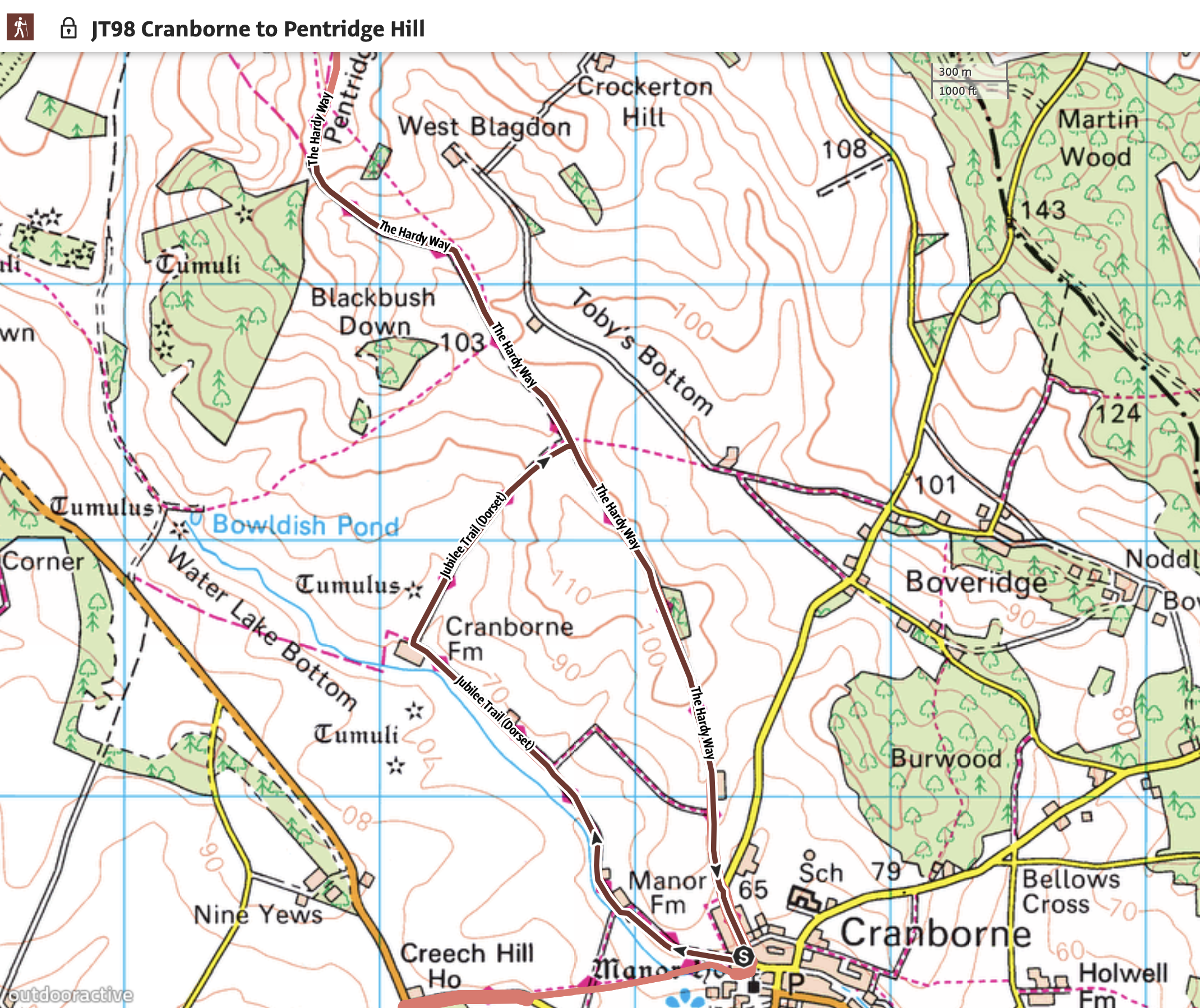
I decided for my second planned walk that I would effectively continue where I left off, albeit that I would be starting in Cranborne, walking out to Pentridge Hill and returning along the Hardy Way back to the village – a distance of 5.2 miles. I am fully aware that in walking terms this isn’t very far but as I mentioned in the first post I want to take time to absorb and appreciate the landscape as well as finding compositions and releasing the shutter to record what I see.
In many ways these posts, and there will be 32 in total, are as much a travelogue and as they are a photographic experience. Given I have only just completed the second walk it may well take me a year or more to finish the 90 mile trail!
I left the village of Cranborne at precisely 10 o’clock just as the church bells chimed on the hour, and for a short time they drowned out the bird song coming from the trees around me. The sun shone which was in stark contrast to the previous day which had been wet. After all the rain, the gravel path made for good walking but I anticipated there would be muddy sections somewhere along the route.
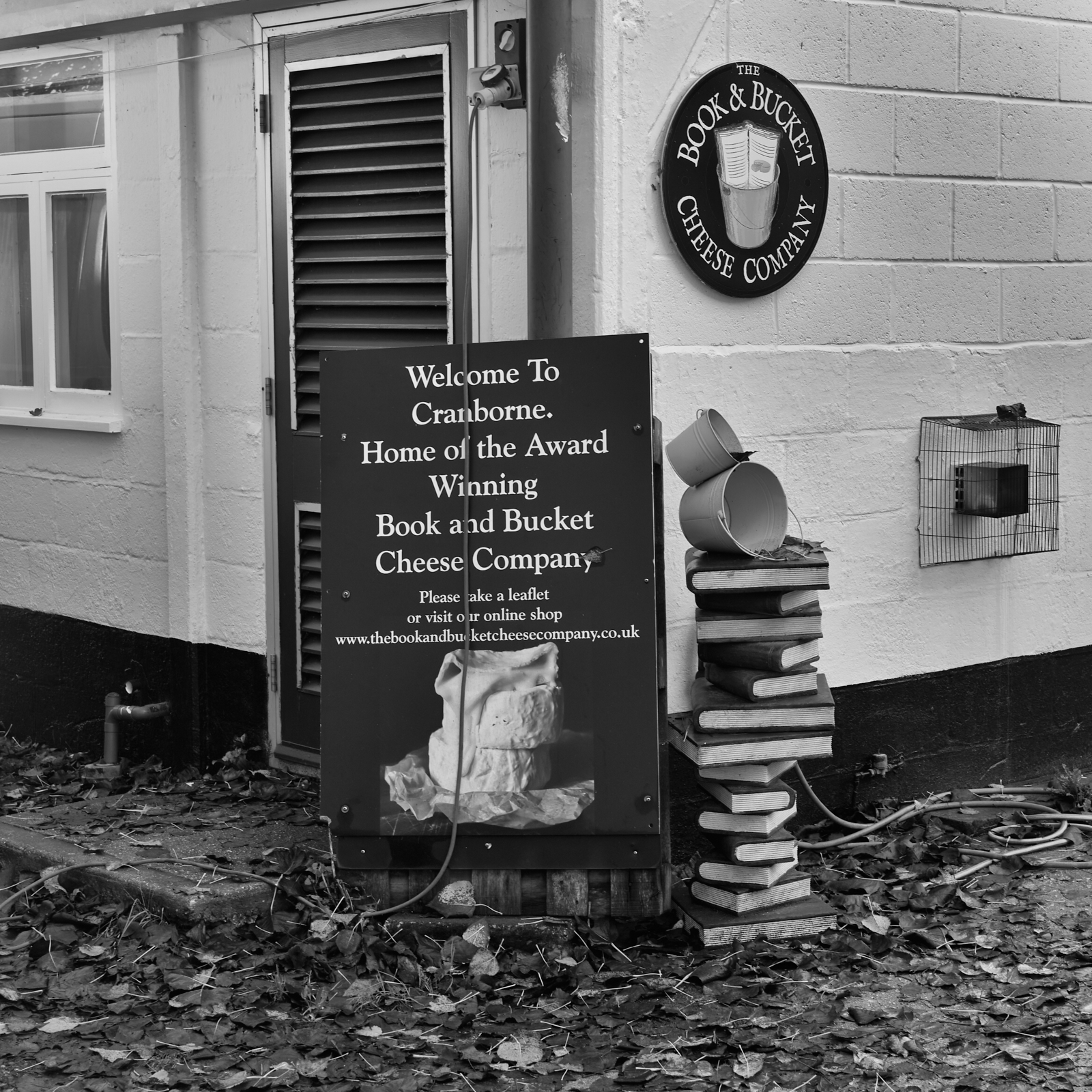
I soon reached Manor Farm and couldn’t help but notice the signage for The Boot and Bucket Cheese Company. I am a big fan of cheese and I had not come across this artisan food-maker before, so I made a mental note to go on their website when I returned home. I knew it wouldn’t be very long before one or two of their products would be on a plate with complementary biscuits and a glass of red wine.
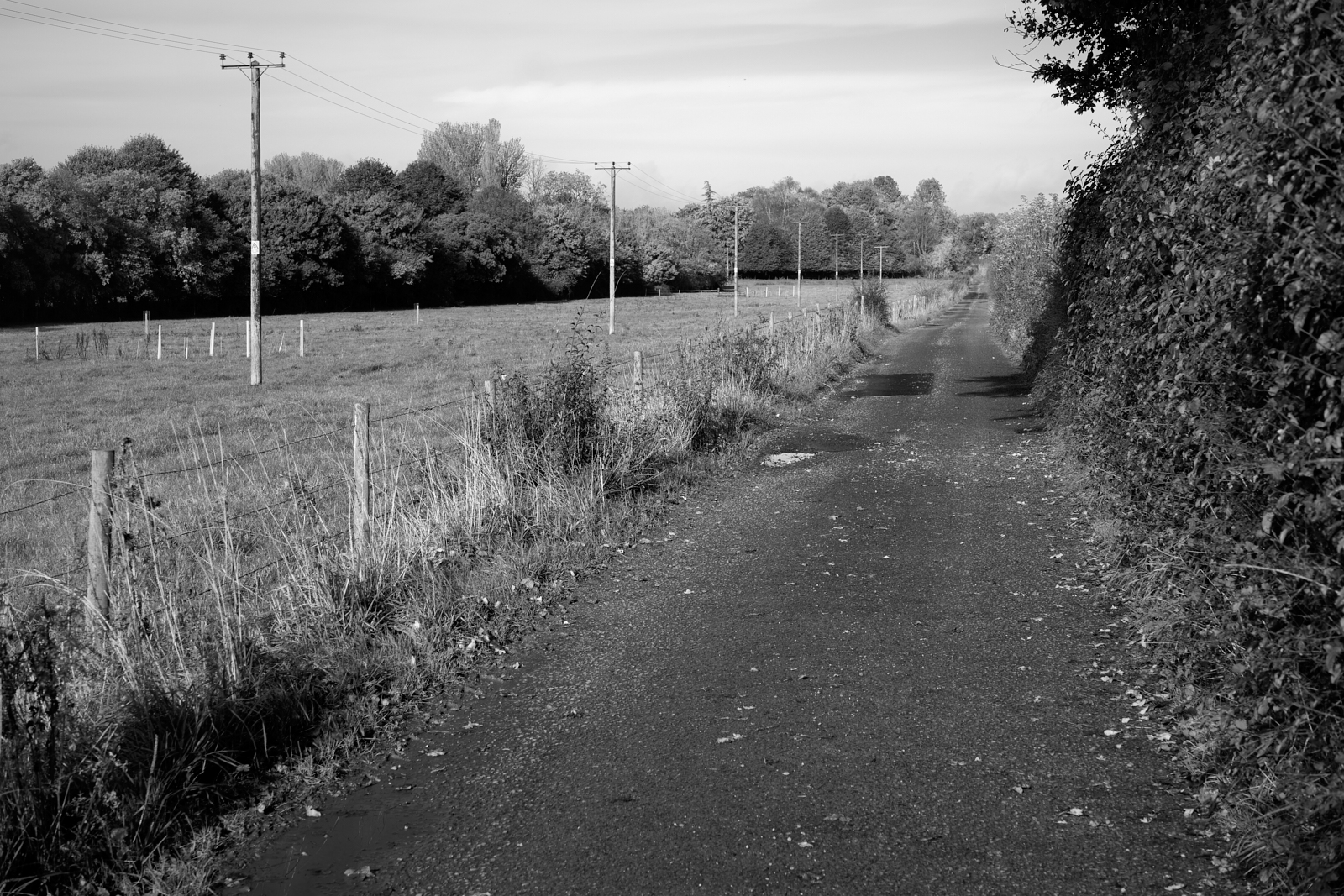
I passed Manor Farm and the gravel track gave way to tarmac. A surprisingly well maintained road given it only served Cranborne Farm ahead. Two people appeared in front of me, grey hair, one stick and the ubiquitous black labrador. I soon overtook them, said good morning as I did so, and continued along the trail. Pasture land lay to my left, a post and wire fence preventing the curious cattle escaping, telegraph poles as far as my eye could see and a flock of maybe seven or eight white wagtails for company.
Heading north west the mid morning sun was directly behind me and my long shadow led the way. I turned to see if I was still being followed but the two dog walkers must have turned around, continued putting the world to rights, as they made there was back to Cranborne.
After 35 minutes and 1.3 miles, I turned right at Cranborne farm, still on the Jubilee Trail, and began a gentle ascent. I had chosen another beautiful, dry autumnal day and the temperature was rising. I had packed a waterproof jacket, but I was convinced it wouldn’t be required. In fact it wasn’t long before my gilet joined the waterproof in my backpack and I was down to a single layer. Neither saw the light of day until the end of the walk. I couldn’t have wished for better conditions.
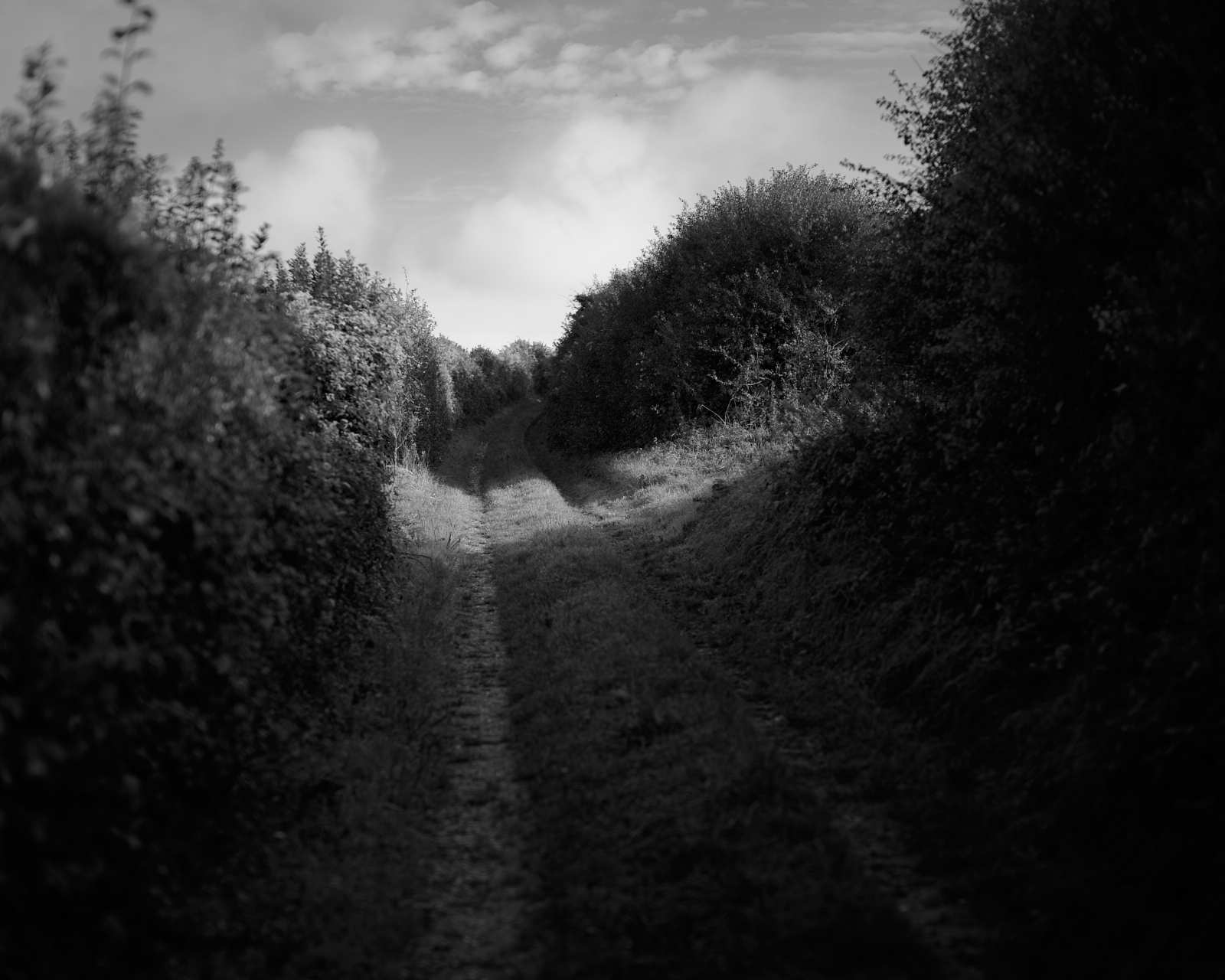
Leaving the farm behind me, tarmac had been replaced by a typical farm track, with tractor ruts either side of a wet grass central reservation. Lined by hedges which are great for wildlife but they did mean my view of the surrounding countryside was inhibited. Although there were some muddy sections, the ground was surprisingly good given how wet it had been recently. I felt for all arable farmers who must have had a very difficult time bringing in the harvest and would now be struggling to plough and cultivate the land ready for seed drilling and next year’s crop.
Every so often, the sun would give advanced notice of a gap in the hedgerow and the hidden landscape would be revealed. At one point I could see Penbury Knoll, which I had visited in ‘Walk One’ although I wouldn’t be going quite that far today. This route would take me to the lower slopes of Pentridge Hill where I would turn round and head back to Cranborne. The path was nearly all uphill from now on. The good news is that it would be all downhill on the way back.
Although I had yet to see or hear any pheasants, it was evident that sections of the farmland would be used for game shooting. Strips of land had been left for cover and there were many pheasant feeders dotted around the fields. Game shooting divides opinion but for those in favour it does generate another income stream for landowners and gamekeepers.
I arrived at my next turning point. It was marked on the map as Jack’s Hedge Corner. I enjoyed a good view of the countryside and then realised from looking at the map that I was looking down on Toby‘s Bottom. ‘Oooh Matron’ I said to myself, which will only make sense to those of you who are familiar with Kenneth Williams and the ‘Carry On’ films of the 1960’s and 70’s. Joking aside these are names which are surely linked to people from the past, in particular Jack as there were hedges in all directions.
I stopped to take a few pictures and as I made my way up the hill I thought I could hear voices. My hearing isn’t perfect but the voices got louder and it wasn’t long before I knew that my ears hadn’t been deceiving me, as a group of retired ramblers came into view. A few moments earlier I had only been thinking how this had felt like a quiet place of solitude negating any need to go to places like Scotland and the mountains. I could escape people here in my home county. The ramblers had broken the silence of nature and place, and selfishly I hoped they would be continuing their walk along a different path. I pressed on to put some distance between me and them. I make no apology but I prefer to be on my own.
The slopes of Pentridge Hill lay ahead and a buzzard flew over Blackbush Down. As it turned, the underside of its wings were caught in sunlight, revealing the beautiful pattern of its feathers. The distinctive mewing and screeching on the wing echoes the sound of a cat like call. It circled out of view, its cry falling away in volume as it did so.
Apart from the bird of prey calling there were no more voices to be heard; I assumed they must have turned right at Jack’s Hedge Corner and I rambled off in the opposite direction.
After an hour and 35 minutes I had covered 2.9 miles, and had arrived at the point which I had left the Jubilee Trail a few weeks ago. It was time to turn round and retrace my steps taking in the view across Cranborne Chase. Before doing so I reached into my bag for a drink and half a sandwich, something to refresh me. It was only 11.40am so too early for lunch and I envisaged having the rest back in the village followed by a flat white and maybe a slice of cake at the Cranborne Garden Centre by way of a treat.
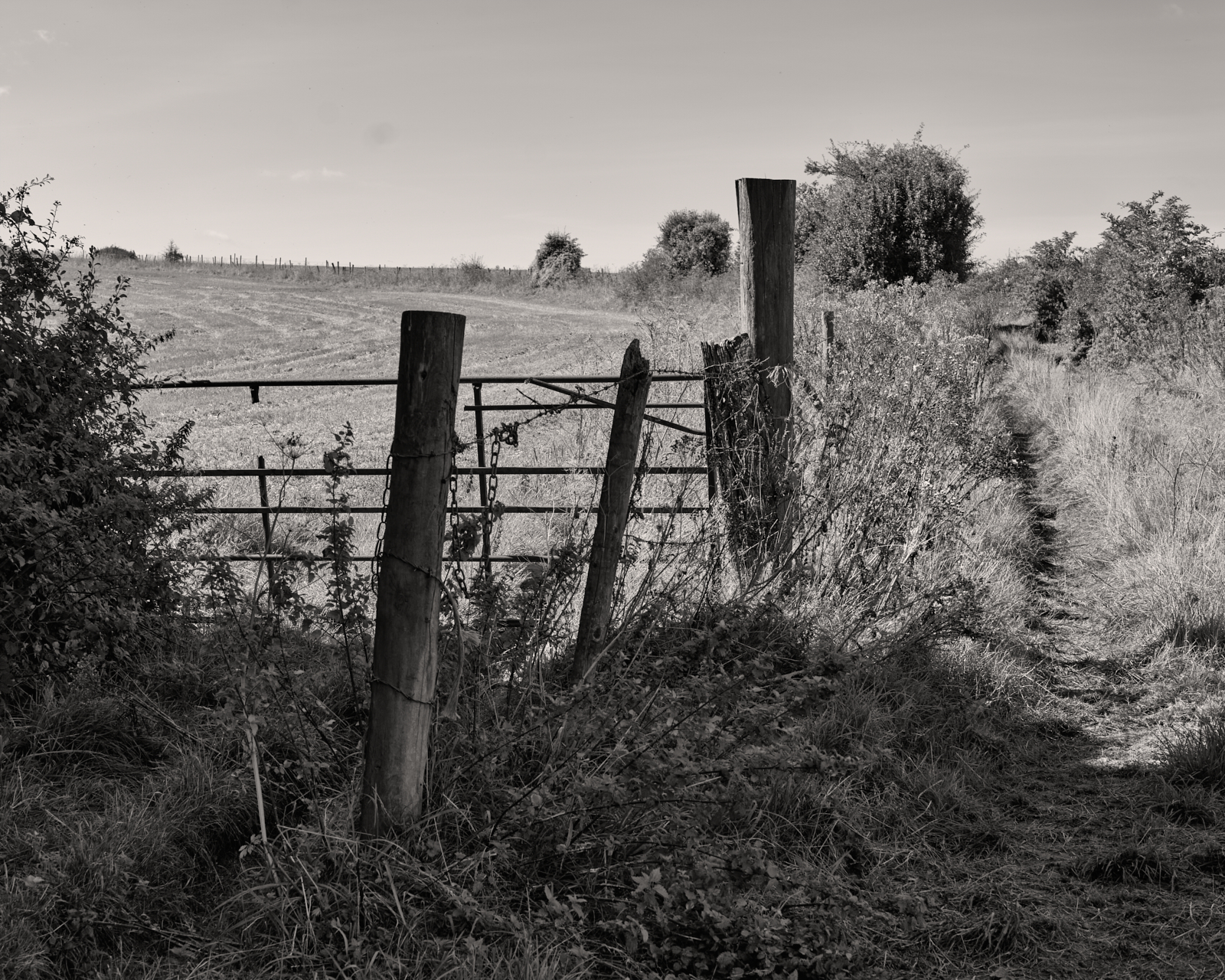
I soon arrived back at Jack’s Hedge Corner. By then the sun had moved round and was now illuminating the gate post which made for a much better composition.
This was also the junction to continue straight ahead and follow Hardy’s Way back to Cranborne. ‘Jack’ had without question been very active as the path was lined by tall hedges on both sides of the track and for long sections any view was completely obscured. However I was grateful the sun was still shining, but in some respects I was now looking forward to the end of the walk.
As I descended I had rather hoped there might be a view of the village, perhaps even the church tower but it was not be. Thinking the tall hedgerow would be a permanent fixture for the rest of the walk I was pleased when I came across a pair of double gates to my right and the countryside I had been missing for the past half a mile or so suddenly came into view. I stopped, rested my hiking stick against the gate and admired the scenery. I heard the buzzard again but this time it wasn’t visible, but there was no mistaking its call.
It was at this point that I gave some thought to the camera equipment I had in my bag. My Leica SL and 50mm Summilux lens was all I had used. I had three other prime lenses so why was I carrying all of them? I guess there will be times when I will resort to using them but for the majority of images 50mm is all I need. It is though something to consider for future walks.
The bridleway returned to tarmac once again so I knew the village and the end of the walk couldn’t be that far away. I reached a road and on the corner a finger post confirmed what I already knew; the car would be in sight very shortly and lunch would be my reward.
It’s just before 1 o’clock and I’m back where I started; 5.4 miles according to the App on my iPhone. Before heading to the cafe there was one more place to visit – the church of St Mary and St Bartholomew. There were only a few spaces to park outside the church and a ‘no parking’ cone immediately by the church gate reduced the number of options. A small pick up took up another space with its driver sitting behind the wheel.
I approached the church but unfortunately it was closed for the day. A notice on the door informed me that a funeral was due to take place. This made sense of the parking cone and I could only conclude the grave digger was waiting to complete his work after the service had finished.
As I drove to the cafe the vicar was walking to the church with a small black leather case in his hand. There were two mourners in traditional dark attire at the garden centre filling time over a drink and I suspect retelling tales of the dearly departed. A sombre end to the day but a reminder how grateful I am to be alive, to walk, to see and to hear the beauty of God’s creation which I had witnessed that morning.
I left the garden centre at 2pm and heard the church bells chime again.
My trusted twisted hazel walking stick and stag horn handle
It’s late summer in mid September 2024 and the start of my ‘pilgrimage’. To place one foot in front of another for the entire length of the Jubilee Trail in Dorset, a total distance of 90 miles. Not all in one go I hasten to add, but in separate walks which would cover the length of the trail. The trail starts in the north west of the county near Forde Abbey on the border with Somerset, and concludes on the border with Hampshire in the north east, close to the village of Martin. Some of the routes will be circular in nature, others will be out and back along the same path, whilst those closest to home will allow my wife to drop me off and then pick me up later in the day. I don’t intend walking each section in order but rather like a jigsaw puzzle each walk will in time complete the picture.
The 90 mile Jubilee Trail
In preparation I have researched and created routes for all the walks – there are 32 in total – and they cover a distance of more than 180 miles. Some are quite short, less than 3 miles in one case, but none are more than 8 miles, as there will be detours along most of the routes. I have described this journey as something of a pilgrimage as it will give me time to contemplate, to explore, to get to know and truly appreciate the beauty of the Dorset landscape. I wish to visit all 34 churches which are either on the trail itself or are very close by, but just as importantly I want to take my time to immerse myself in the landscape, and to make photographs of each individual walk.
This is the first walk and I thought it appropriate if it was at one end of the trail, so I chose to start in the east. As well as imagery, I will include a map of the route and a description of the walk and my thoughts along the way.
So here we go!
Sillens Lane car park to Pentridge Hill and PentridgeVillage
After a flat white coffee at home I put my camera bag, walking boots and hazel hiking stick in the car and drove the 28 miles to the small car park at Sillens Lane which lies close to the village of Martin; the most westerly village in Hampshire. Much to my surprise I arrived to find a crowded car park but there was one space available although the next visitor might not be quite so lucky. ‘RingGo’, a parking app, requested a voluntary car parking fee of £3 for the day to help maintain the area. It’s a small price to pay, even if I did key in the wrong registration number on the app! I must have had other things on my mind.
A couple of signs provided information about Martin Down Nature Reserve and alongside these boards was a wooden bench in memory of Ronald Bolt 1918 – 2003. I assumed this must have been his favourite spot to admire and walk in the landscape. I very much doubted he needed the signage to tell him why he should love an area which was so special to him.
I prepared to set off and there were a couple of pathways I could choose from. Despite having the ‘Outdoor Active App’ on my smartphone I still managed to pick the wrong track, but this was easily rectified when I reached Bokerley Dyke, a scheduled monument. The earthworks are about 3.6 miles long, and are thought to have originated in the Bronze Age or early Iron Age. In its time it was an important cultural and political boundary. It marks the actual starting point for the Jubilee Trail but to my surprise there was nothing else to signify the beginning of trail, nor its end if someone had walked its length from West to East. No signage no way-marks, nothing.
I headed in a south westerly direction alongside a coppice with a field of cattle on my right. After a short time I stopped briefly to tuck my trousers into my socks to discourage any ticks that might be lurking in the vegetation awaiting their next blood thirsty meal. I also put my down jacket in my rucksack as I was already warming up. The forecast was for dry weather with sunshine, but it actually turned out to be a beautiful day and much warmer than I had anticipated.
With the coppice now behind me an old and rusty farm gate lay ahead with a well trodden track leading off to the right. At the time it seemed obvious to me that this was the path and it wasn’t necessary to open the gate into the field. There were no signs to inform me otherwise so I my instinct took charge. Later on I would find out that my instinct was incorrect and I had made the wrong choice.
Decisions, decisions
It wasn’t until I reached the track which lead from Whitey Top Farm that I realised my mistake, so I doubled back a short way until I found a wire and barbed fence which I could clamber through and rejoin the trail. After this minor navigational error the rest of the route was quite straightforward.
It was now midday and getting much warmer. I don’t much like the heat so I wouldn’t have wanted it to much hotter. I was only 1.4 miles into the walk but some liquid refreshment was needed. The first part of this walk had been a steady incline and the views of Cranborne Chase were starting to reveal their beauty. So too was some of the wildlife. Above me a kestrel hovered in the air sighting its prey on the ground below. I looked down and a few wasps emerged from a hole in the chalk track, a nest I assumed. Later and for a brief moment a hornet circled my ankles but no sooner had it arrived than it left, flying out of sight and not to be seen again. I was grateful as their bite is far from pleasant, although I am told they are not aggressive creatures, they just look that way.
I crossed a field of wheat that had recently been harvested with many a grain still lying on the ground providing plenty of food for rooks, pigeons and other birds.
A recently harvested field with the promise of shade ahead
A few trees lay ahead offering a little shade from the sun which continued to shine brightly, as I made my way through a gate and on to Pentridge Hill, which in turn would lead me Penbury Knoll and a place to rest for a simple packed lunch. For the first time on the walk I met another person; a horse and rider to be exact. We greeted each other, said it was a beautiful day and went our separate ways.
Onwards through the gate and on to Pentridge Hill
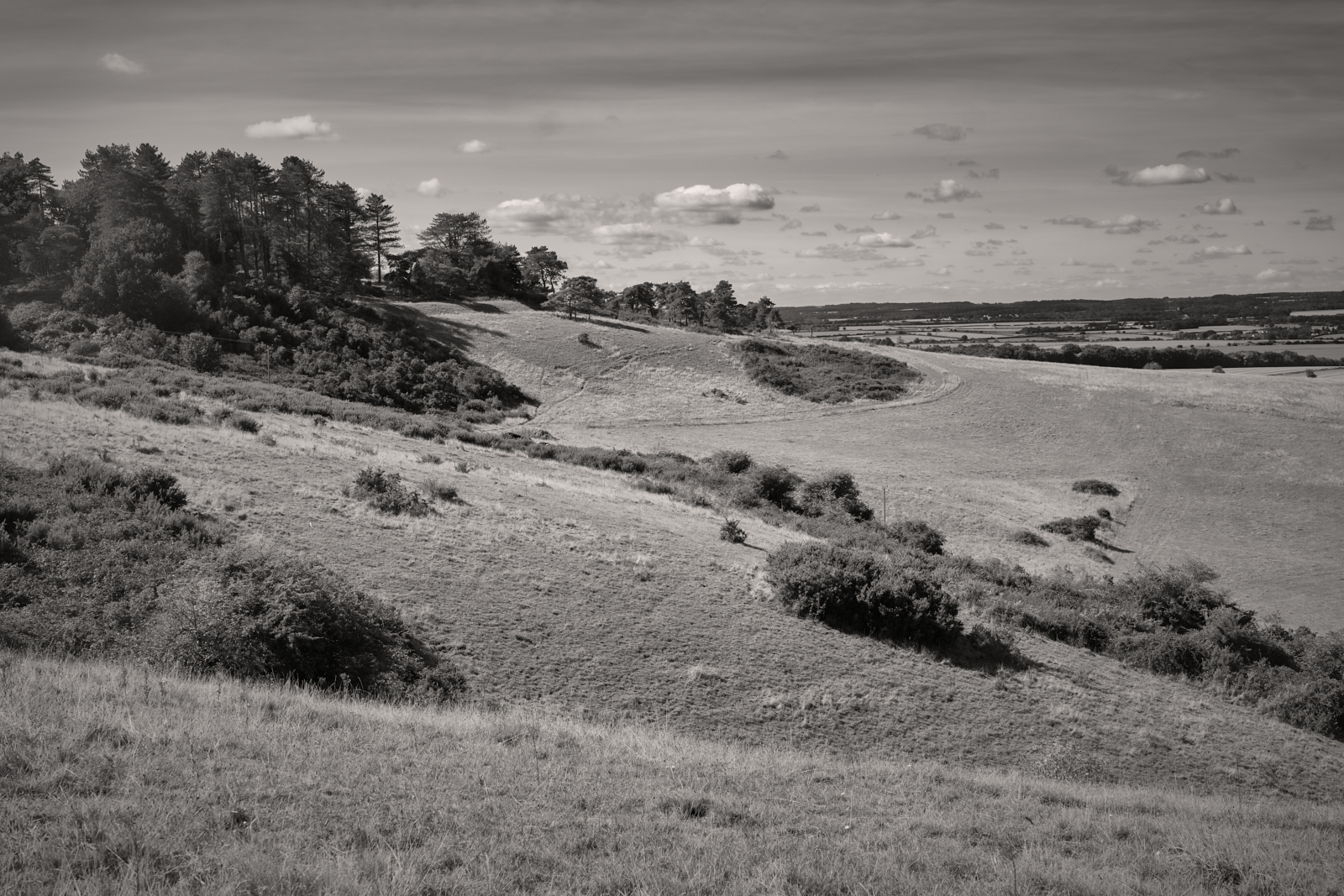
Looking towards Penbury Knoll with Cranborne Chase in the distance
The fallen
I reached the trig point at Penbury Knoll, the highest point on the walk and a very fine place to stop for a while and admire the surrounding scenery. It wasn’t difficult to find a shady spot, sit down, lean my back against a tree trunk and rest my feet and legs. I hadn’t walked that far but I am not as young as I used to be. It was exactly 1 o’clock so definitely time for some lunch and to spend time taking in the far reaching views. As I munched on my marmite and cheese baguette I saw a red kite twisting, turning and gliding on the thermals above Pentridge Down. It was a great display. As I watched this bird of prey, a gentle wind blew and in the shady setting of old oaks and tall conifers I cooled down and slowed down.
The view from Penbury Knoll
A few minutes later and the kite re-appeared from below my feet, exploring the chalk downland, then wings started beating as it stopped to retain its position in the air. The wings halt their movement and the kite quickly dives out of view, maybe it was heading towards my next stopping point – the village of Pentridge and the church of St Rumbold.
Before I leave this lovely serene spot, I swallow a single tablet prescribed to help reduce my high blood pressure. I wonder which is more effective, a drug or taking exercise and being in the landscape?
It pays to slow down and to stop, to photograph and count my blessings.
A fine place to stop and admire the landscape – Penbury Knoll
I came out of the shade to rejoin the trail and the sun, but I was now refreshed and eagerly awaiting what lay before me. The path took me south and gently downhill towards Blackbush Plantation before turning sharp right and continuing the descent across grassland and cultivated fields. I had now left the Jubilee Trail and joined the Hardy Way, another long distance path across Dorset and Wiltshire which takes in places associated with the author and poet Thomas Hardy. At over 216 miles in length I will leave that trail for another day.
The descent begins down the Hardy Way
The approach to Pentridge Village
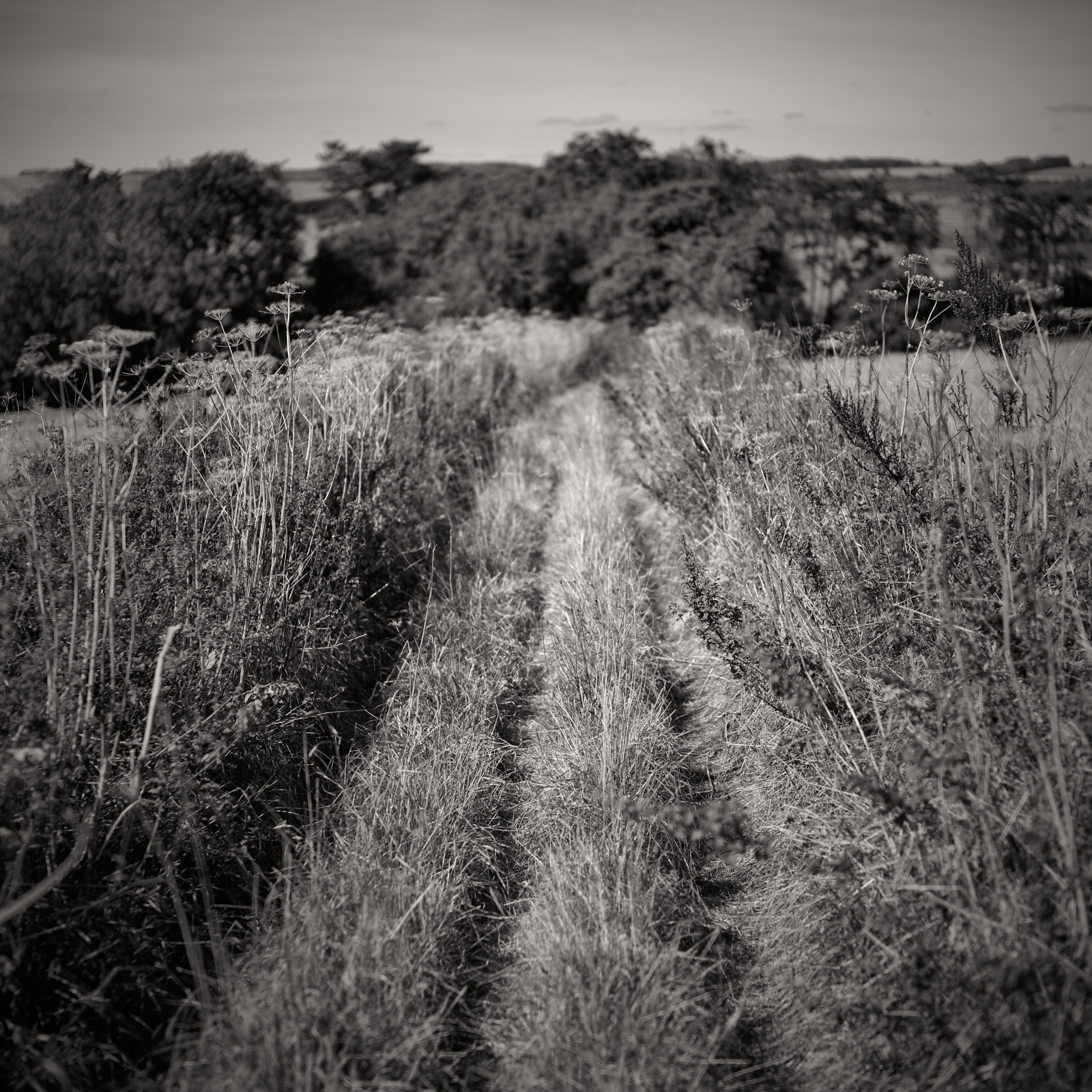
The farm track lined with dried grasses and wildflowers, almost skeletal in nature, soon led me to Pentridge, a tiny and pretty village made up of mainly detached houses with a mix of tiled roofs and thatch.
I made my way to the church, to find the churchyard like others rather untidy but that’s the way of things today. Churches are now encouraged to leave some areas left untended to encourage wildlife.
Pentridge Church of St Rumbold
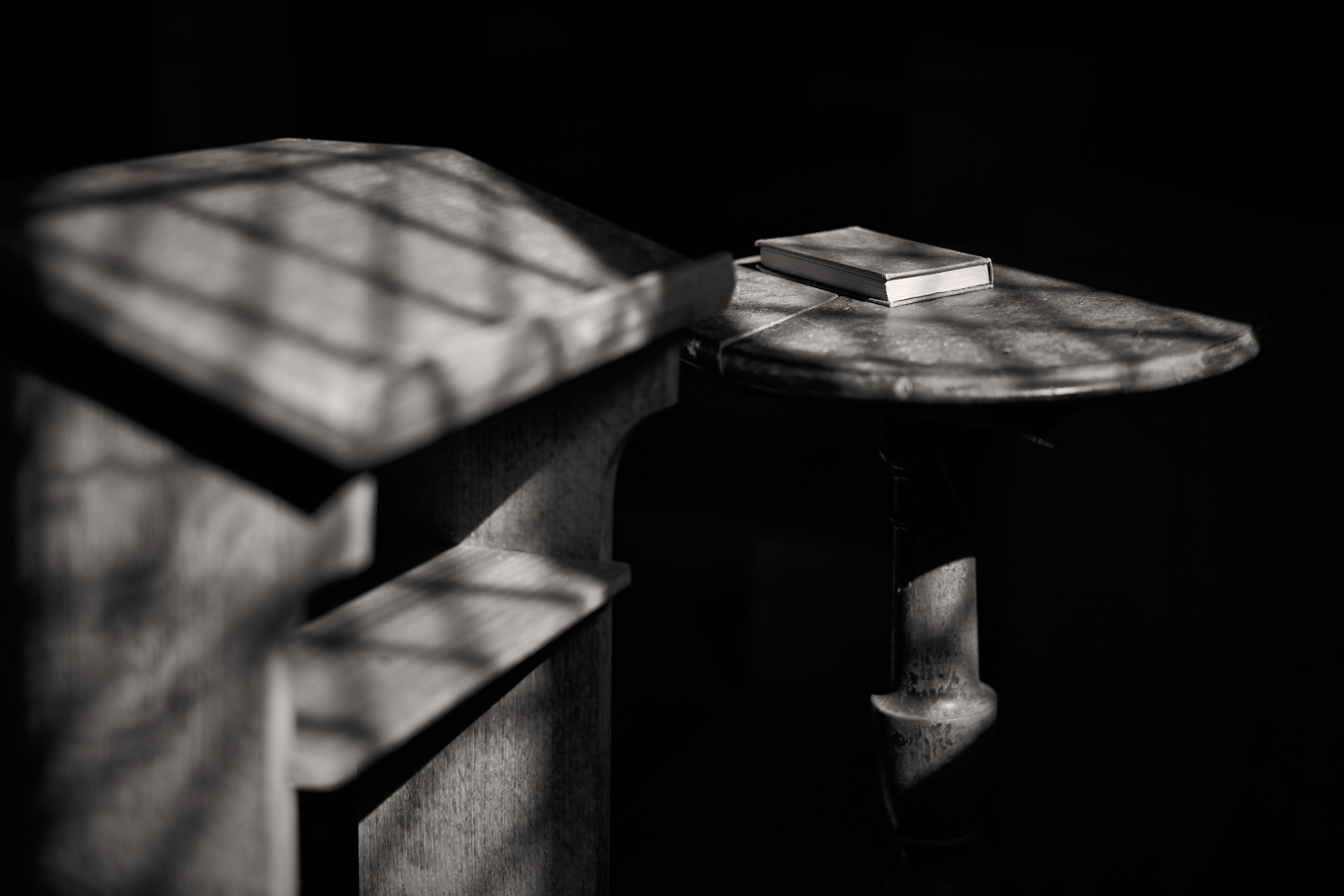
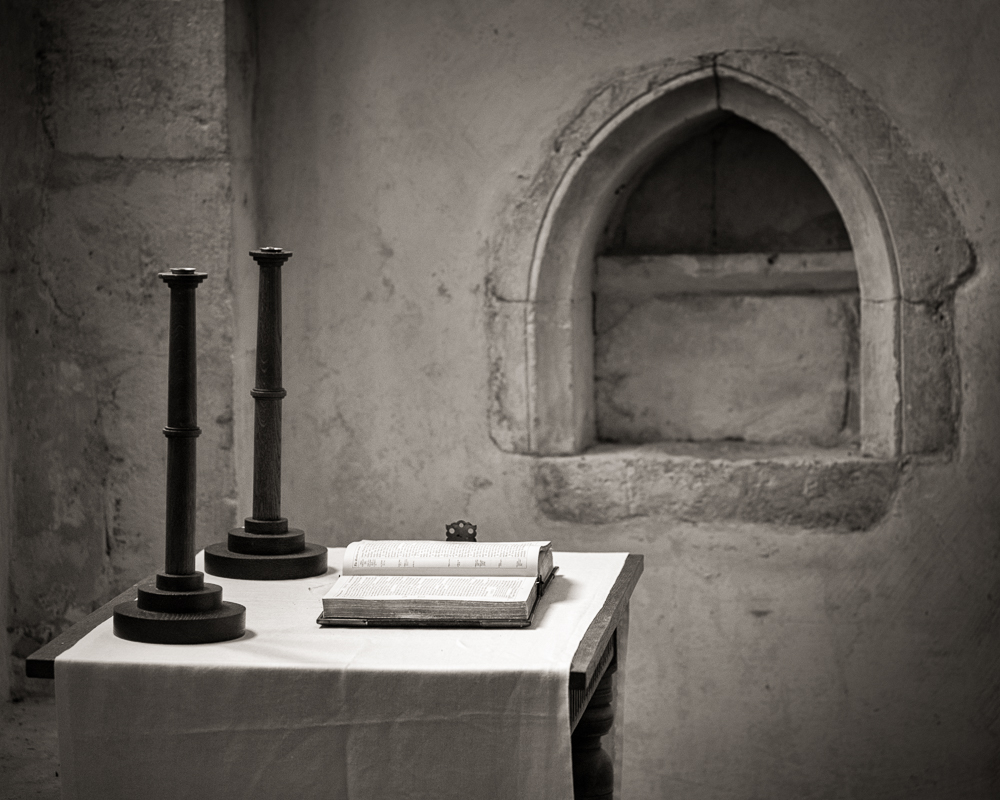
To my delight the door to the church opened and I stepped inside and was greeted by the sun working its magic through the leaded light windows. It was wonderful and I captured the light and the darkness with my camera. I always consider images of this nature to be very fortuitous as they only present themselves when the light is at a certain height and is cast in a particular direction. I just happened to be in the right place at the right time. Divine intervention possibly?
The Book of Common Prayer
The light and the shadows
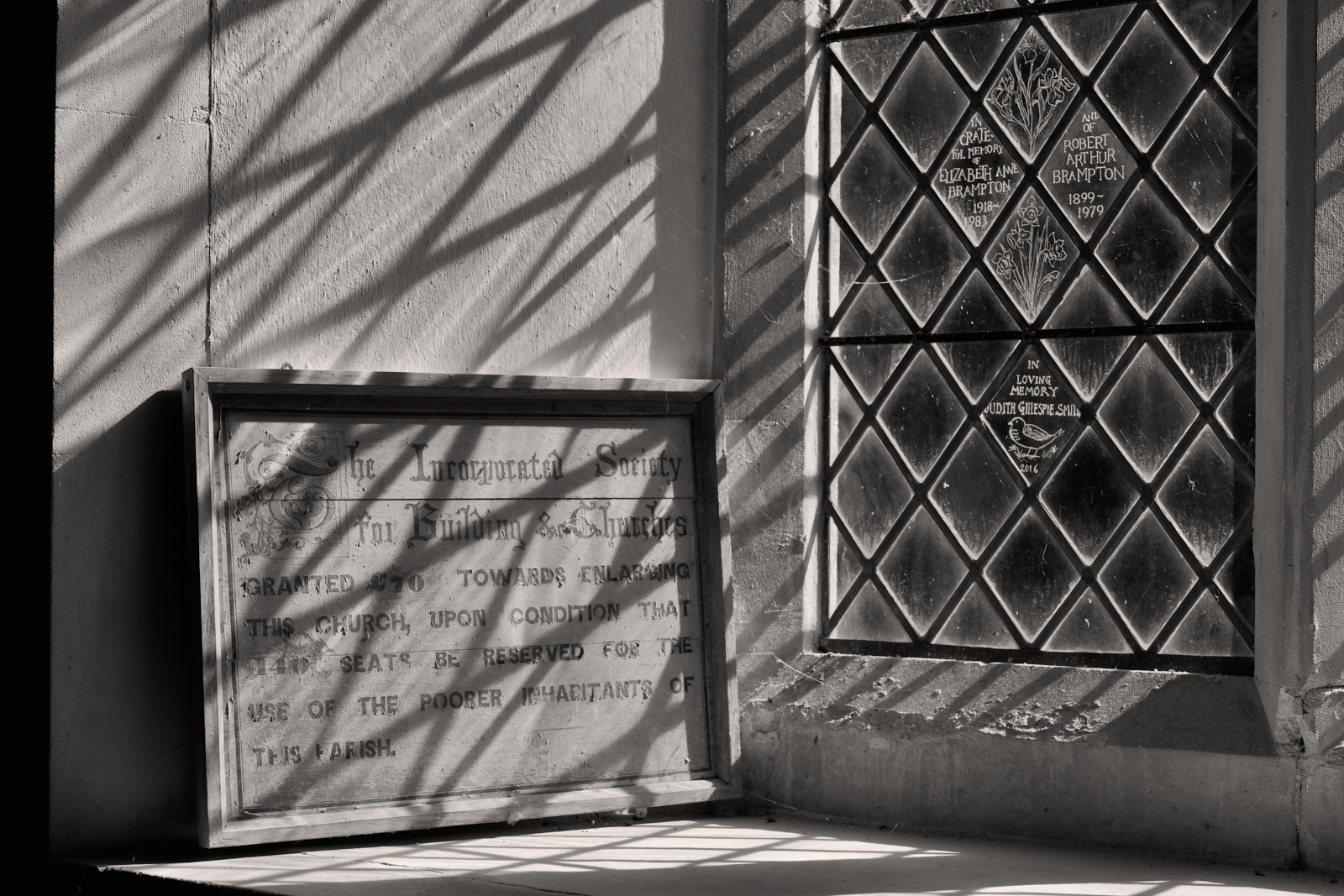
Having taken these two photographs I spotted a sign in one of the stone window reveals. Unfortunately it wasn’t dated but the notice confirmed the grant of £70 for an enlargement to the church on condition that 140 seats were reserved for the poorer inhabitants of the parish. How times have changed I thought to myself. Today a Communion service is only held once a month at St Rumbold’s and I doubt if the number of parishioners attending would break into double figures. I wondered how long ago it might have been when all the pews were packed with both the rich and the poor?
140 seats reserved for the poor
I left the church and departed the village, up a stony lane towards Whitey Top Farm and the last ascent of the day. As I approached the farm two seemingly rather aggressive dogs ran towards me, barking loudly as they did so. Fortunately there was a strong fence between them and me but nevertheless I was pleased when I had passed them by.
Back on the Jubilee Trail before returning to the car
I turned left and rejoined the Jubilee Trail and then descended back the way I had come earlier that day, through the shade of the coppice before entering open ground back to the car park. I checked my navigation app and I only had a third of a mile to walk before completing the first of thirty two walks exploring the Jubilee Trail. It had been a joyous walk of 6.2 miles and the weather could not have been better.
I only saw two other people, the lone horse rider and one other walker; a woman on her own at Penbury Knoll. By the time I noticed her, she had walked past me with her back now facing me. She hadn’t stopped to admire the view, nor say hello but I wasn’t offended, as I like it on my own. The solitary experience of just me in the countryside, alone with my thoughts, whilst enjoying nature and the beautiful landscape appeals to me.
It wasn’t long before I saw my car parked in the near distance, the number of cars had diminished considerably.
I drove home excited at the prospect of my next encounter with the Jubilee Trail.
A couple of years ago I published a post titled ‘Switching from Leica to Fujifilm….well not exactly’. In summary I explained how I had decided to move away from a Leica camera body in favour of Fujifilm, albeit that I retained three Leica M lenses, so that I could continue to use them with a lens adapter on Fujifilm X series cameras. I won’t repeat the content of that post here, but do click on the link above if you would like to understand the background before reading the rest of this entry.
Fujifilm XT3 with 10-24mm wide angle zoom lens
Back to the current day. Why have I reverted back to Leica? What prompted me to do so and what equipment do I now use? I hope my answers to these questions will be of interest to you and may even assist you when you are choosing your own photographic gear.
When I invested in a Fujifilm XT3, I had anticipated that I would be able to enjoy the best of all worlds. I bought some zoom lenses to cover a wide range of focal lengths (10 – 24mm f4, 16 – 80mm f4 and 55 – 200mm f3.5 to f4.8). The Fuji has an APSC cropped sensor, so this gave me the equivalent range of 15mm to 300mm based on a 35mm full frame sensor. It would cover every eventually or so I thought. I still had my Leica M glass of course (35mm f1.4, 50mm f1.4 and 90mm f2.4) which on the XT3 gave me three fast prime lenses with focal lengths of approximately 52mm, 75mm and 135mm (in 35mm terms). What more could I want? Well for starters a very large camera bag and a strong back if I was to carry all of this gear around at the same time, however this was only the beginning of my deliberations.
Knowing I couldn’t practically or physically take everything on a photo outing I had to make certain decisions at home. Zoom lenses, or just the primes, or a combination and if so which ones? The answer would always come back to what I was hoping to see and potentially photograph. Sometimes I would have a good idea which made the selection process easier, but on other occasions the choice was less straightforward.
When I did choose the prime lenses I soon discovered the drawbacks. Firstly I didn’t own a wide angle M lens. I had traded in a Zeiss 18mm M lens in favour of the Fuji 10 – 24. Even if I had kept it the 18mm would only be the equivalent of a 27mm field of view with the crop sensor. Secondly none of the Fuji zoom lenses were that fast for low light conditions nor would they give me a shallow depth of field. Don’t get me wrong they are excellent lenses but like any zoom lens they have their limitations as to how they can used. Thirdly the shallow depth of field on a crop sensor does not behave in the the same way as it would on a full frame sensor. I had also grown accustomed to taking advantage of the depth of field scale on the M lenses. I have always enjoyed manual focusing, they give me a sense of complete control and if I wanted to resort to setting the aperture and lens to cover a certain focal range I could do so very easily and I would rely upon the result. This was no longer true when paired with the XT3 crop sensor. Some of the magic had gone from using the superlative M lenses.
50mm lens showing the depth of field scale.
By now you can probably begin to sense my growing frustration. The final nail in the coffin came when I began considering the true nature of my photography. What are my favoured genres and subjects. More importantly what images am I trying to make? Were these aspects of my photography hindered by my camera equipment and if so what changes were desirable?
The more I thought about this the natural conclusion soon became clear. The answer was of course a resounding yes, I was being held back. I was no longer able to make the images I really wanted. Take for example my church photography. To evoke the feelings I am after in a photograph I often use the lens wide open at say f1.4 to give me a shallow depth of field or soft background. The effect can be quite subtle as in the picture below, but it’s there and an important element of the image as far as I am concerned. Shooting wide open not only gives me the ‘look’ I want but it also allows me the freedom to work hand held without having to ramp up the ISO. I don’t have to rely on a tripod, which can be cumbersome and awkward in the confines of a small church.
North Stoke Church, West Sussex
My other love is the great outdoors whether that be a landscape, old farm buildings or a dramatic scene but I am not one to favour the type of picture captured by an extreme wide angle lens, nor a long telephoto lens for that matter.
The picture below was a spontaneous capture of an atmospheric scene which soon passed as the wind got up and the reflections in the water disappeared.
Isle of Lewis, Outer Hebrides
In summary then, if your camera equipment is hampering your style and you are no longer truly enjoying using the equipment you have, then it may be time to ask yourself a number of questions – What should I do about it? What can I change to improve both process and outcome? Above all what images do I want to make? Affordability will of course be a consideration and I recognise I am fortunate when it comes to setting a budget.
Leica SL2-S with 50mm F1.4 Summilux lens (I put black tape over the Leica badge – it’s more discreet)
As I said earlier I have now reverted back to Leica as my main camera of choice but which model? Towards the end of last year I purchased a Leica SL2-S along with another Leica M Lens – the Super Elmar 21mm f3.4. I had previously owned the original SL Type 601, but the SL2-S is an altogether better camera not least because it now has in body image stabilisation. It is faster in use and whilst the sensor is still only 24mp (a sweet spot as far as am concerned), noise control at high ISOs is excellent. In some ways I regret parting with the first SL, but I have learnt from the experience. When compared to the Fuji XT3 I prefer the way the SL2-S handles. It fits my hands perfectly. The customisation of the function buttons gives me easy access to make quick changes when necessary and the menu in my opinion is less complicated to use than on the Fuji. Oh and I mustn’t forget to mention the superb EVF which makes manual focusing an absolute breeze. Combined with the Leica M glass the resultant DNG image files are excellent and are very good to post process. All in all it is a joy to use.
From left to right 21mm, 35mm, 50mm and 90mm.
In conclusion my ‘go to’ equipment is now the Leica SL2-S camera body paired with the 21mm, 35mm, 50mm and 90mm primes. I guess I am a purist at heart and trying to mix a Fuji camera body with Leica glass was never going to work, well not for me anyway. I truly love prime lenses and the artistic choices they give me, not to mention the joy I experience every time I use them. They suit my style of photography, they are like old friends. When I tried to change the relationship I had with them they reacted accordingly!
Not only has my passion returned for the equipment I possess, but I no longer have to use a large camera bag. The beauty of the M lenses is their compact size. Yes they are quite heavy (as is the camera itself) but I can easily carry the camera and a lens (normally the nifty fifty) with one or more of the other three lenses and a few accessories in a shoulder bag. On longer walks I will still use a camera back pack, but I now have more room for refreshments, extra clothing etc. It works well and most definitely suits my needs. I don’t have tricky decisions to make concerning which lenses to take out with me.
I accept that with this setup I don’t have access to an extreme wide angle or the reach of a long telephoto but as I have already explained my eye doesn’t see the world in that way. Changing lenses happens more frequently but that is no bad thing, it slows me down and makes me think more about compositional choices. Fortunately these four lenses all share the same filter thread – 46mm – which also makes my life easier when using filters etc.
The chances of me being able to make images that please me have improved and even if I don’t capture anything worthwhile then I will have enjoyed the process anyway.
In a nutshell isn’t that what being a photographer is all about?
A misty rural scene – typical of the images I like to make in the countryside
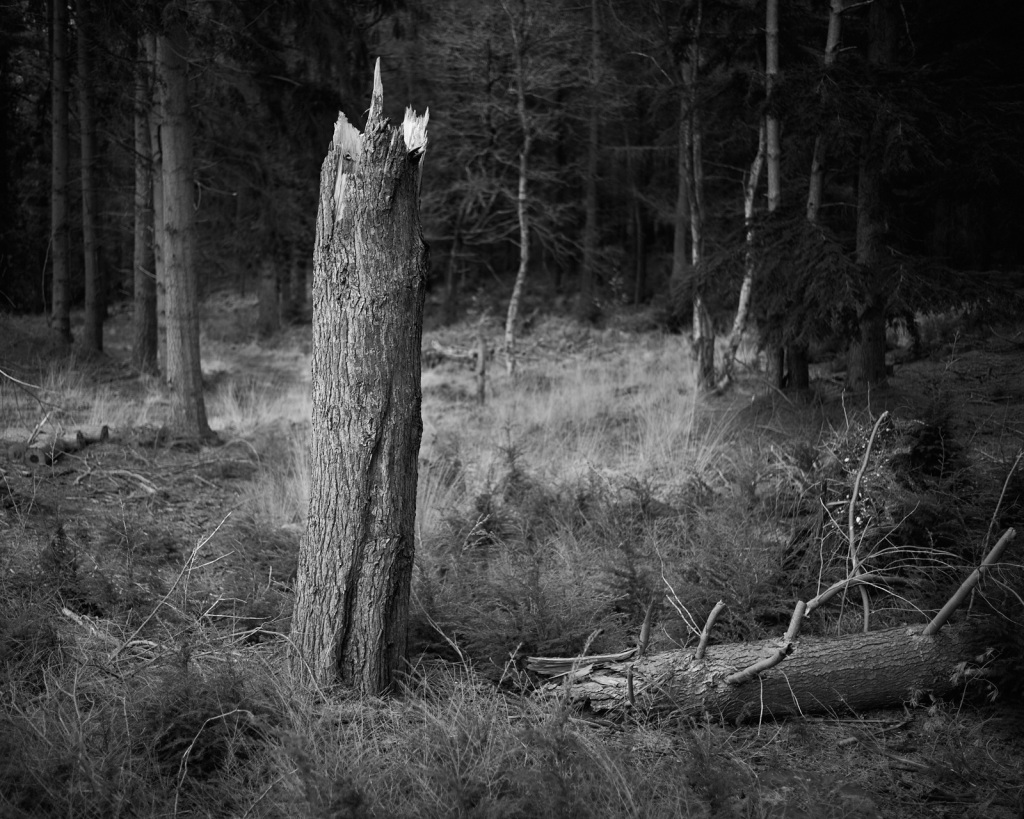
There are occasions when a spontaneous outing with minimal photographic equipment can prove to be a rewarding experience. This may also be true if you visit a location with no specific intention of what it is you are going to photograph. You begin with no expectations, so hopes of capturing that pre-visualised image cannot be dashed. You accept the weather and light for what it is. The search for subjects to photograph may be slow but with a little patience compositions may start to reveal themselves. One image can lead to another and then another. Before you know it a theme develops and a small body of work comes together.
This happened to me some weeks ago. I had a couple of hours to spare but the light was flat and I didn’t want to travel very far. I went to an area of forestry and heathland not far from home. I was not that familiar with the landscape and didn’t expect a particularly productive time but I would enjoy the exercise even if the camera didn’t get much use.





















 alan frost photography