Posts tagged ‘black and white photography’

Exciting new challenges in the year ahead – including my first exhibition

There are many reasons why I am looking forward to this year. In early April I have been invited to present an evening talk to my local camera club; something which I have not done before. Later that same month I will be traveling to The RPS Headquarters in Bath with a panel of fifteen images for an assessment in the hope that I will be granted an Associate Distinction of the Royal Photographic Society. And finally towards the end of the year in November, I will be exhibiting my work for the first time.

All of these events come with their own set of challenges and as the year progresses I expect to share my thoughts as I plan and prepare for each one.

Perhaps the most exciting but also the most daunting of the three, is the exhibition, and fortunately I am not alone. There are a total of six photographers who have formed a group called The Image Circle. A WordPress site was published at the end of last year, so do visit that site to find our more about the group and to see the work of the other photographers.

The exhibition is to be held in the main gallery at The Oxmarket Centre of Arts in Chichester, West Sussex, starting on Tuesday 14th November and finishing on Sunday 19th November. The group will be getting together on a regular basis between now and then, as we all have to decide what work to exhibit, how it should be framed and presented, and what can be done to best promote the event as we naturally wish to attract as many visitors as possible.

Although the exhibition is still many months away, I know how quickly the time will pass, so early preparation is key. Perhaps the most important decision for me to make at this stage is what work do I wish to exhibit? Should they be images from my current portfolio or new work which has yet to be taken? Should there be a specific theme? How many pictures do I display and how should the work be framed and hung? Many questions and in my mind some of the answers are becoming a little clearer.

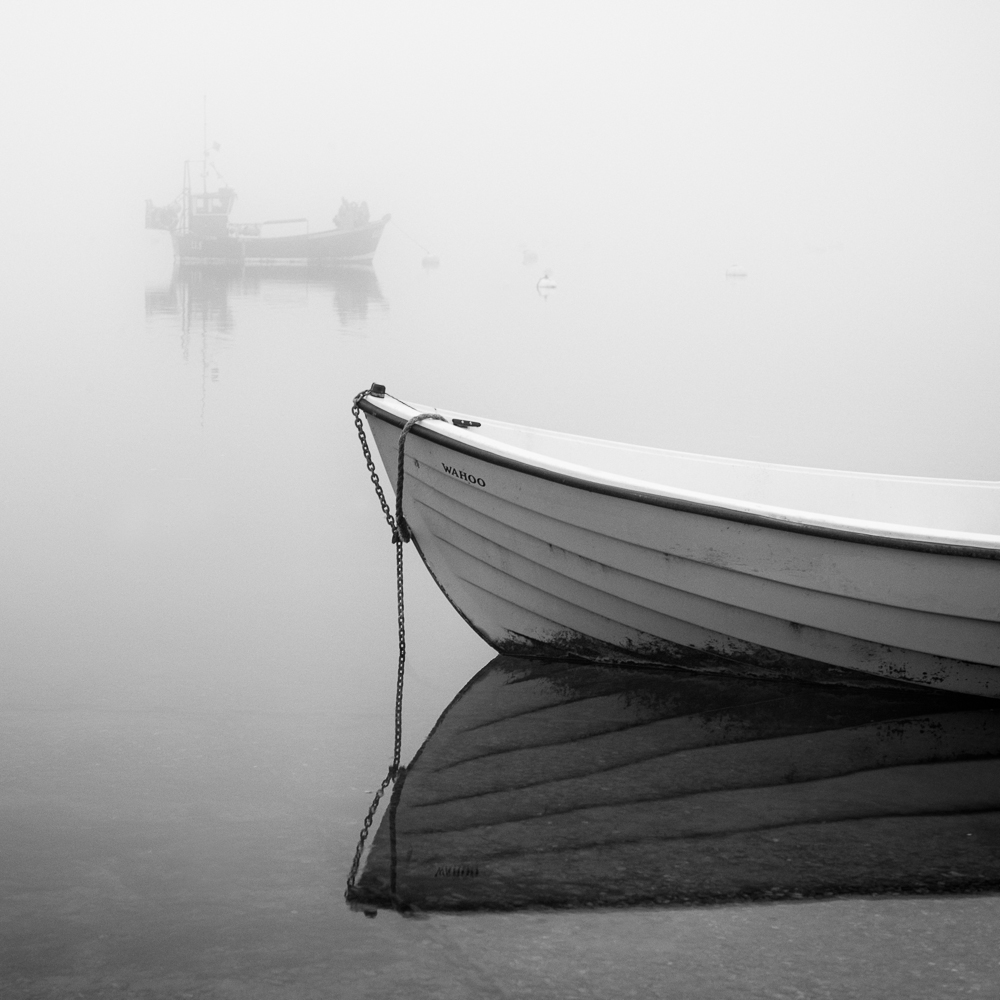
As I write, I have reached a decision to exhibit a new body of work which will be taken in and around Chichester Harbour. It will be my vision, a personal portrait of this rather special Area of Outstanding Natural Beauty which is close to where I live. All the photographs will be in monochrome and likely to be square format. The process of making images is already underway and a recent photograph accompanies this post.

Plenty more to consider and do in the weeks and months ahead, but 2017 is certainly a year I am looking forward to with great anticipation.

Early morning at Dell Quay

early-morning-at-dell-quay-1

Looking back through my last few posts it is evident that I have been doing more colour work recently. This has not been intentional and I am enjoying the variety, but monochrome is still my first love.

This image of Dell Quay, taken early one morning a few days ago, when the tide was very low, reminds me of why black and white photography is favoured not just by me but so many photographers. The artistic interpretation of a scene holds greater possibilities in mono than it would in colour. I enjoy the whole process of increasing or reducing contrast in certain areas of the image; thereby creating mood and atmosphere in the picture,  whilst providing a sense of depth and a focal point of interest.

Like so many images this one really needs to be viewed large as there is in fact a lot of detail in the scene. The masts in the boat yard, the three sailing boats to the right and a lone person standing on the jetty. There are also a few swans in the water and a gull flying into the frame from the right hand side. I have yet to print this photograph but I am looking forward to doing so. Do click on the image to enjoy a larger version.

Dell Quay forms part of Chichester Harbour in West Sussex. Designated an Area of Outstanding Natural Beauty, it is popular with sailors, birdwatchers, walkers and artists; in fact anyone seeking some relaxation in some truly beautiful and unspoilt surroundings.

A favourite image and a favourite camera – is that possible?

st-botolphs-hardham-1-of-1


I was asked recently if I had a favourite image which I had made? In all honesty I don’t think I do, although there are a number which I could name in a top ten. I do though remember reading that someone else when asked the same question replied – ‘The next one I am going to take.’ I rather like this response as it suggests a desire to constantly improve, believing that your next photograph will be better than the last and all those in your back catalogue. It also infers that the last image taken must be a favourite for at least it’s tangible and not a figment of the imagination – or is it? I’ll come back to this question later, as it’s relevant to the photograph in this post.

As far as a ‘favourite camera’ is concerned, well that’s easy for me to answer. It’s my Leica M Monochrom which I have been using for the last couple of years. It’s built like a tank, feels so good in the hand and the simplicity of its controls put me in complete control. It doesn’t have a multitude of programmable buttons, nor pages and pages of menus, which only serve to confuse, and nor does it come with a manual which might take the best part of a week to read, let alone understand. More importantly though the Monochrom together with the exceptional Leica lenses produces the images I am seeking to achieve with post processing and careful printing. The next incarnation of the Leica M Rangefinder must be just round the corner but I think its unlikely I will want to upgrade. The Monochrom has many idiosyncrasies, but I love it and the cost of upgrading is quite likely to be prohibitive anyway.

Given my feelings towards the Leica Monochrom, I am not that interested in the latest camera technology although to digress for a moment I was intrigued to learn about a new camera being developed by a company called Light. The camera is called the L16 and has the appearance of a large mobile phone, but instead of one lens and sensor there are 16. On pressing the shutter the camera software combines all the exposures from each of the sensors to produce one image. According to their website this can be up to 52 megapixels in size, with low noise and covering a focal range equivalent of 28mm to 150mm. The depth of field and other adjustments can be manipulated in post processing. Is this the future of camera technology, I don’t know, but nothing stays the same, so it will be interesting to see what happens when it actually hits the streets.

Back to the question I posed at the end of the first paragraph and indeed to the photograph in this post. It was taken a few days ago at St Botolph’s Church in Hardham, West Sussex. I had visited the church previously and noticed how the light was falling on the altar. I had taken some shots that day, only to find that my composition was not quite right, nor had I used the correct exposure settings. There were too many blown highlights. I decided to return, knowing in my mind the image I wanted to make. I knew which lens would give me the composition I wanted (28mm) and the likely exposure settings required to produce a malleable and workable file for post processing. I knew the time of day when the light would be in the right position, so I arrived at the church in plenty of time to get ready. The sun wasn’t as bright as it had been a day or two earlier but this proved to be a good thing. As it turned out I only had a couple of minutes to take the shot before the sun moved round and no longer illuminated the scene as I wanted it.

A favourite image or not, I like this photograph, as it will always remind me that it can be worth revisiting a location to take a particular shot that you have already pictured in your own mind.

Here are two more entries about St Botolph’s Church at Hardham.

Churches Project no.4 – St Botolph’s, Hardham, West Sussex

Thwarted by the flower arrangers at Hardham Church


Churches Project no 18 – St Botolphs, Botolphs, West Sussex

st-botolphs-1-of-6

A gate and pathway lead up to St Botolph’s Church


The Church of St Botolph’s stands in a small hamlet to the south of Steyning, in West Sussex. It lies close to the River Adur and is virtually on the South Downs Way, so many walkers stop to take a rest and enjoy the peace and solitude of this ancient building. It’s a lovely setting with just a few houses for company, although 700 years ago it was at the heart of a bustling port and crossing place of the river. At one time it was known as St. Peter de Vetrie Ponte (St Peter of the Old Bridge). The church has its origins in Saxon times and is believed to date from 950. Large parts of the original church can still be seen today including the tall chancel arch and the south wall of the nave. This is another church maintained and cared for by The Churches Conservation Trust, so whilst still consecrated is rarely used for worship.


st-botolphs-5-of-6

A simple cross in a window in the Saxon south wall of the nave.


st-botolphs-3-of-6

Organ stops


st-botolphs-4-of-6

A large Crucifix hangs on the chancel arch which dates back to Saxon times.


st-botolphs-2-of-6

Looking up at Christ with the ancient Saxon wall as a backdrop.


A note for regular readers – I am very aware that I have not posted an entry relating to my ‘Churches Project’ for at least a couple of months. That doesn’t mean I have lost my enthusiasm; to the contrary, my desire to visit and photograph these historical and remote places of worship is just as great as it has ever been. Time though is limited and the summer months are not necessarily the best time of year to take exterior photographs, as the lighting can be very harsh. I am sure the autumn and winter will rectify the situation and normal service will soon be resumed!

As always do click on any of the images to view a larger version which will open in a new window.


Attending an Advisory Day with The Royal Photographic Society


Ever since I gained a Licentiateship (LRPS) with The Royal Photographic Society back in 2012 I have had the desire to work towards the next distinction; an Associateship. For the past year or so I have been putting together a panel of prints which I hope might achieve the required standard. My proposed panel includes the above image.

As part of this process The RPS strongly advise attending an Advisory Day, where your panel of 15 images together with a Statement of Intent can be presented to Panel Members of The RPS. They give advice on whether or not your work is ready for submission or if more work is required. If the latter, they will give an indication in their opinion as to what needs to be addressed. This can vary from major changes or just a few minor tweaks.

On Sunday I attended an Advisory Day at the headquarters of The RPS in the lovely city of Bath and presented my panel, with I have to say, a certain amount of trepidation. There are a number of other photographers in the same room and the RPS panel members can quite rightly be constructively critical of a person’s work; after all that’s the very reason for attending. Nobody likes criticism in front of others but there is little point going for an Assessment only to fail by some margin, and many do apparently.

My panel is based around my ‘Churches Project’ and was entered in the Conceptual and Contemporary Category. I am pleased to say that it was well received and considered to be a strong panel worthy of submission, subject to changing three out of the fifteen photographs. It was considered these three were slightly weaker images when compared to the others and I agreed. One picture was changed at the Advisory Day from a selection of other prints I had taken with me, so that just leaves me with the task of sourcing two other prints, which hopefully shouldn’t be too difficult. I believe the Statement of Intent, the technical quality, printing and presentation are likely to meet the required standard but you can never be sure. I have to say I was very relieved and pleased with the feedback.

I have already booked a place for my Assessment in April next year, so I have a little while to wait to find out whether or not my panel will qualify me for an Associateship. There can be no guarantees but my fingers are crossed and I will of course report on the outcome in roughly six months time.

In the meantime here is a quote taken from the RPS website regarding the standard required for an Associateship –

“ARPS (Associateship) – images of exceptional standard and a written Statement of Intent (what you hoped to achieve). This is a significant step up from the LRPS.  At this stage creative ability and personal style (what makes your work unique to you), along with complete control of the technical aspects of photography must be evident.  It is at this level that you can first choose to submit your work to a particular specialist category.”

You can see a Gallery of my LRPS Panel by clicking here.