Posts from the ‘Photography’ category

Early morning dew in Snowdonia – one from the archives

20151028-L1004287-Edit

Having posted a few images taken in Pembrokeshire recently, I thought I would return to a Lightroom folder named Snowdonia, which I visited back in November 2015. I stumbled across this photograph which I had never processed before. It had just been sitting on my hard drive but I am rather glad I found it.

I remember the morning it was captured. The tree was backllit and the early morning light glistened on the heavy dew which had formed on the grasses overnight. The dark background was the perfect foil for the solitary tree.

There is always the temptation to process images soon after they were taken but there is also an argument that you should let images mature, untouched for many months and then return to them at a later date before processing. Something which was dismissed at the first edit, is re-discovered and what a pleasure this can be. Not only finding a ‘lost’ image, but in the process remembering the visit, the location and the conditions…….. a very worthwhile exercise in my view.

Pembrokeshire – A ‘letterbox’ view

L1000301-Edit

As I write this post the sun is shining and Summer is almost here but these four images depict a very different time of year. They were all taken on the same day back in February. Some may say a typical late winters day in Wales, when nobody in their right mind would be out with their camera. Mist, drizzle and poor visibility. However these conditions can be ideal for the monochrome photographer.

In all cases the native 3 x 2 crop of the 35mm sensor included too much sky, and with little or no interest in this part of the picture I have cropped each image to what might be described as a ‘letterbox’. The aspect ratio is about 3 x 1, but what really matters is whether or not the crop works compositionally, and I believe it does. Photography is often about what you choose to exclude from the frame to strengthen a picture, not just about what is included already.

In the first shot taken at Newgale Sands, I focused on the foreshore which has softened the figures, the sea and distant rocks. This has helped to emphasize the misty conditions. The couple and their dog are an essential part of the image. The provide scale and as they are the only people on the beach they serve to reinforce the fact that the weather was so poor keeping most sensible people indoors, but for dog walkers and photographers!

L1000306-Edit

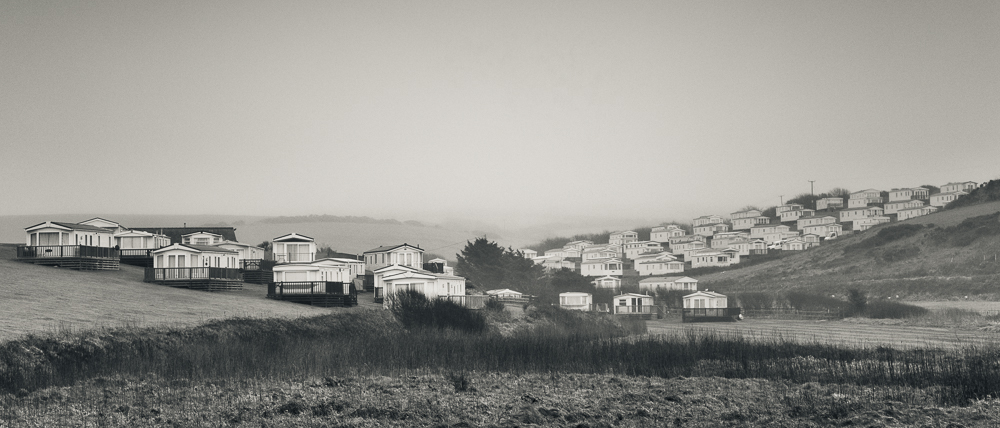
After taking the first shot I looked behind me only to find a swathe of mobile homes which overlook this section of coastline. Very quiet at this time of year, and only coming to life when the weather improves and the holiday makers return.

L1000338

Moving further along the coast I stopped at Little Haven. Conditions remained the same and this time I wanted to capture the tidal movement of the sea. Resting the camera on a wall I used a ND filter to give me  a slow shutter speed, about 1.6 seconds. Several exposures where necessary to give me the look of the movement in the sea water I was after.

L1000365

Finally a shot of what I assume is a farmhouse taken at Marloes. A typical dwelling in this part of the world but what appealed to me was the telegraph poles and how they could be used to create what I think is a pleasing composition.

Each picture looks better larger, so do click on an image to view a larger version which will open in a new window.
 

Marloes, Pembrokeshire – soft proofing in Lightroom

Marloes

If you read my blog on a regular basis you will probably have noticed that although I work almost entirely in monochrome, rarely are my images in ‘pure’ black and white – in other words they are toned. Either with a single colour, or more recently I have used a split tone where the highlights are toned with one colour and the shadows are toned with a different colour. This split tone is easily applied in Lightroom and the balance between the two tones can also be adjusted.


Screen Shot 2017-05-31 at 18.06.17


Whilst I like the effect of split toning it does present me with a new problem, and that is one of printing. I very much enjoy the process of printing; in many ways it’s the rightful conclusion to everything that has gone before it. In the past printing a ‘pure’ black and white photograph was fairly straightforward from my point of view. The fact that my monitor wasn’t properly calibrated (good but not great) didn’t matter hugely to me; I could produce a perfectly acceptable print by observing the histogram, processing accordingly and adjusting the contrast to achieve the look I was after.

With split toning, however subtle the effect, I am now printing a ‘colour’ image, so what I see on the screen and how that image is produced in print becomes much more critical. The choice of paper (and there are now so many excellent photographic papers), use of the appropriate colour profile for printing, as well as having a correctly calibrated monitor, now all play a more important part than they did before.

For these reasons I started exploring the soft proofing panel in Lightroom which forms part of the ‘Develop’ mode. It is easily opened by pressing ‘S’ on the keyboard. From here you can select the colour profile for the paper you wish to use and select either perceptual or relative as the intent. From here Lightroom will create a virtual copy of the image with the colour profile and intent embedded. The name of the file/copy will include a reference to the colour profile, which is a very convenient feature for future reference. This is an invaluable benefit and one that Lightroom makes so easy. Depending on how the image changes its appearance in soft proofing you can go on to make the usual processing adjustments to the contrast, clarity, exposure etc so that the image reflects how you want the photo to be printed. By choosing a matt paper colour profile I found the proof copy was much ‘flatter’, it lacked contrast when compared to the original image. In processing I added back more contrast to the proof copy.


I do not own a device for calibrating my monitor and perhaps that is something I should acquire in the future. In the meantime I did use the Display Calibratior Assistant on my iMac and whilst not a precise tool, I have been able to calibrate my monitor to more closely represent what comes out of the printer.


There is no question that I still have more to learn regarding printing and with two exhibitions on the horizon this year; one in July and one in November, I am very keen to make a decision on my choice of paper and be able to produce consistent results. More test printing is required. I also know that Photoshop has a soft proofing feature and in time I may look into this as well but for the moment Lightroom seems to be a very straight forward way to achieve the results I am wanting.

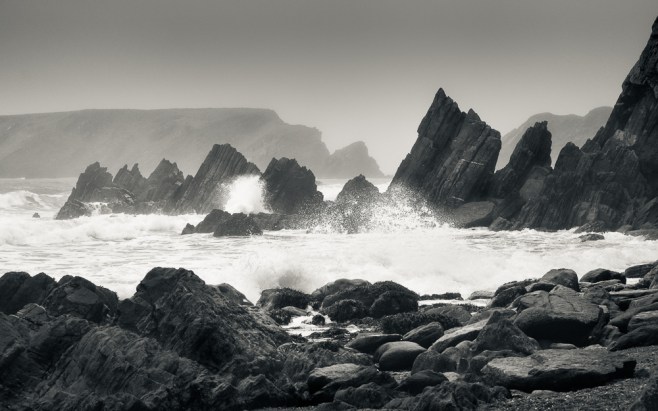
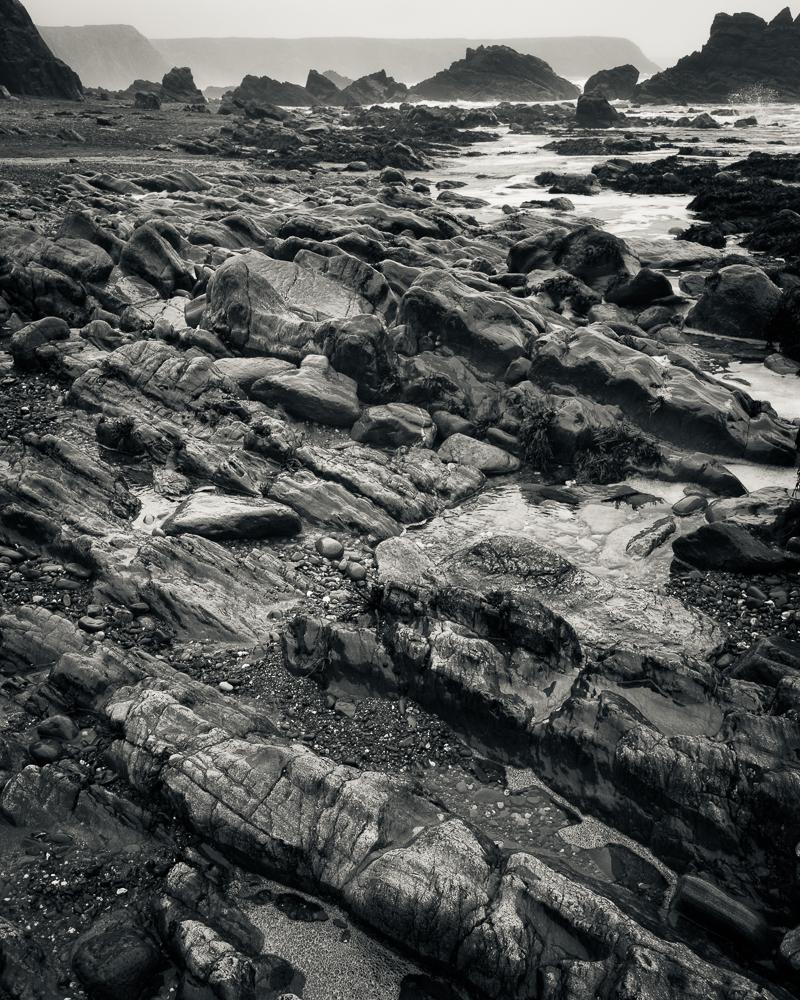
I shall leave you with a few more images of Marloes in Pembrokeshire, Wales. Fortunately when I visited this location earlier in the year, the height of the tide was just about right – ideal conditions for some dramatic coastal photography.


Please note that I am using Lightroom 5 and I am not using the most recent operating system on my iMac, so the screen grabs may look different. To be frank I am not a great one for always upgrading to the latest software. If it works then I don’t feel the need to automatically change anything. I do realise this might get me into trouble one day but for now I’m very happy with what I’ve got and it works for me!

Isolation on the Isle of Mull

The Isle of Mull on the west coast of Scotland is a very beautiful place. The landscape is varied; mountains, sea lochs, forests and wonderful sandy beaches are all to be enjoyed. It is also rich in wildlife and whilst I am not a nature photographer there are times when I would have liked a long lens in my bag. Eagles, otters, red deer, seals and an abundance of bird life are all to be seen if you have the patience and know where to look.

The island is a sparsely populated place and the single track roads with passing places slow the traveller down – the pace of life is just as I like it. Apart from Tobermory, which is the only town, there are a just a handful of hamlets and the remaining dwellings  are well separated. Solitude is easily found on Mull and this feeling of isolation is depicted in the three images shown here.


The first shot is of a single storey cottage in Ardtun on the Ross of Mull. The tall grasses in the foreground have been thrown out of focus, and if you were to crop away the top third of the image you would be left with a very abstract picture and it would be hard to make out the true subject matter. I particular enjoy this effect.


The second image is of a white rendered house, set all on its own at the foot of a mountain range which includes Ben More – the only Munro (a mountain in Scotland over 3,000ft) on the Isle of Mull. Fast moving clouds render the mountain range and the middle ground with a combination of light and dark shadow areas. Waiting for a cloud to darken the immediate backdrop around the lone dwelling has highlighted the mail focal point of the shot and isolation is very evident.


The third image in this short series shows an abandoned caravan of which there are a number on the Island. Surrounded by overgrown grasses, an interesting ‘s’ line is formed by the stone walling and the post and wire fence which leads your eye to the horizon and back again to the caravan. The strong winter winds will eventually destroy what’s left of a now forgotten temporary and isolated home.


To best appreciate these pictures please click on each one in turn to view a larger version which will open in a new window.

Tree reflections in Loch Maree

Loch Maree in the region of Wester Ross in the North West Highlands is the fourth largest freshwater loch in Scotland, being some 12 miles long and a maximum width of about 2.5 miles. Arguably it’s also one of the prettiest lochs too, playing host to over sixty islands both large and small. Some of the Scots pine trees on these islands are estimated to be over 350 years old.

This particular image was taken from the shore near Slattadale forest and in the far distance the mountain of Slioch is clearly visible.

I did have to wait some time for the wind to drop and the ripples in the water to subside, to capture the reflections at their best; but if you have to watch and wait, then it’s no great hardship in such a beautiful location.