Posts tagged ‘woodland’

Bracken – when an overriding instinct prevails


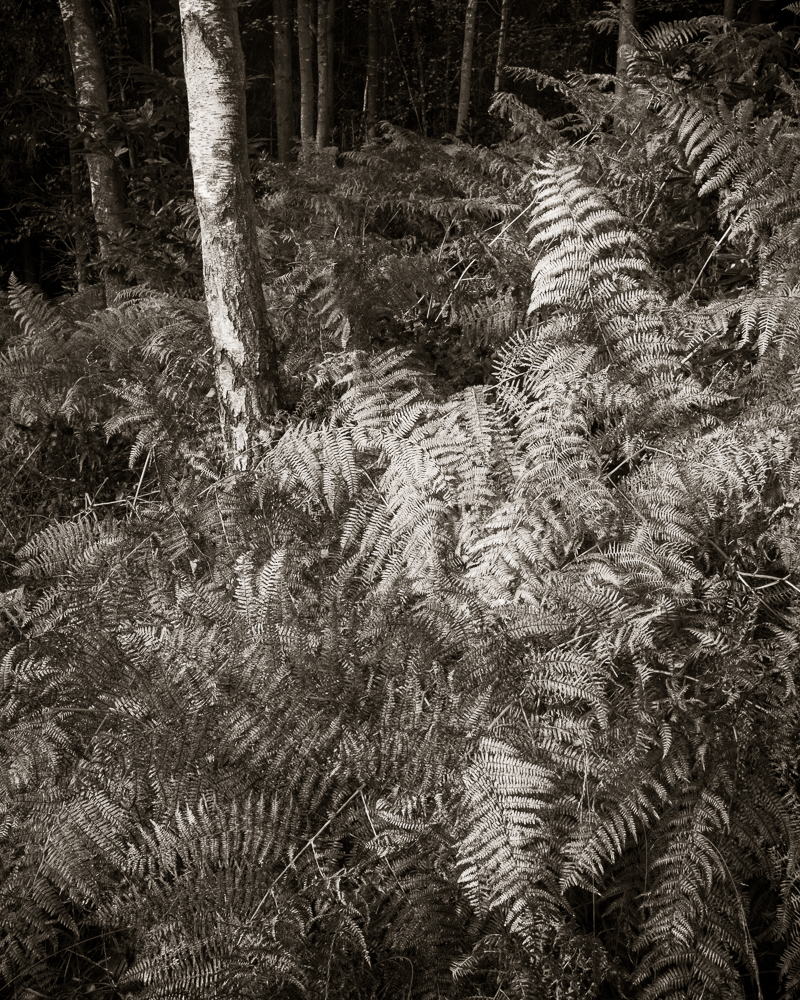
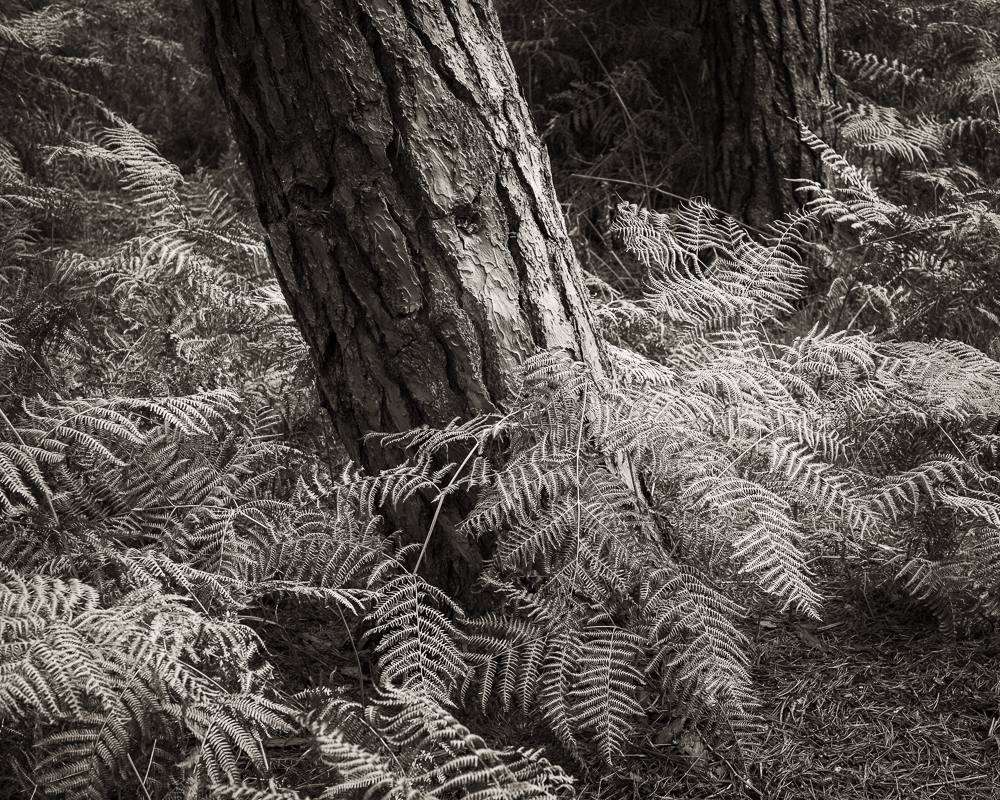
As hard as I try I can’t break out of my comfort zone. Whenever I find myself in a beautiful location which is full of colour, my instinctive monochromatic mind gets the better of me. As I explore the autumnal woodland of Arne Nature Reserve, near Wareham in Dorset I have a perfectly acceptable colour subject in front of me but in visualising and later processing the image I soon strip away all the colour, and work on a black and white conversion, and here is the result. A shot of ‘Bracken’ in amongst conifers.

I am not colour blind but I do seem to see the world in black and white and of course all the shades of grey in between. I am drawn to a pleasing composition, shapes and lines, strong textures and different tones. I believe my creativity improves once the distraction of colour is removed from the frame. I start to see things more clearly and whilst you cannot tell by looking at an image on a screen, a well printed black and white image on a suitable photographic paper is hard to beat.


Do click on the image to view a larger version and truly appreciate the level of detail in this shot.

……


The ancient yew trees of Kingley Vale – nature’s cathedral or a place of ghosts?

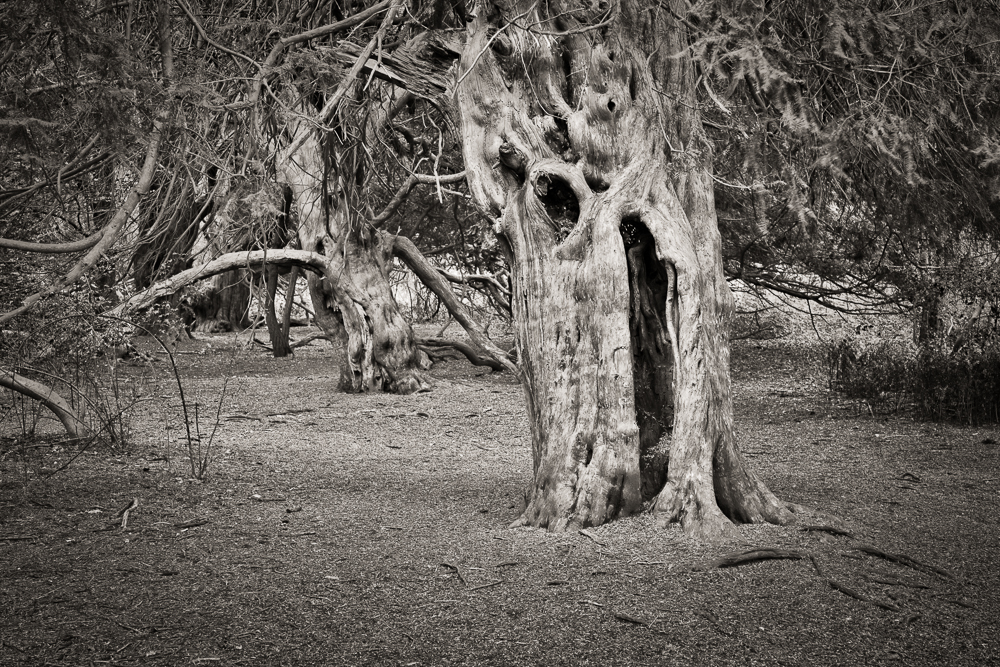
The ancient yew trees in Kingley Vale Nature Reserve in West Sussex is a sight to behold and is perhaps one of the finest groves of its type in Western Europe. These magnificent trees are thought to be 2,000 years old which would mean they are some of the oldest living things in Britain. The gnarled bark of the twisted trunks and the contorted, arched branches which reach down to the woodland floor are beautiful, but also eerie in their sometimes almost ghost like appearance.

The grove has been likened to a cathedral. It’s dark beneath the canopy with shafts of light occasionally breaking through. The trunks represent pillars and the branches form arched trusses supporting the trees’ canopy or the roof of a cathedral. This comparison is not without foundation as yew trees are planted in churchyards. Trees, particularly long lived yews were worshiped in the days before Christianity.

Photographically I found it difficult at first to find strong compositions and the light was also a challenge. You can probably imagine how dark this yew tree grove would be, even in the summer. However as soon as the sun broke through, the scene was transformed into one of high contrast making it all but impossible to capture the true essence of this location. Although these frames were all taken when the sun was obscured by cloud I still had to avoid strong highlights where gaps appeared in the foliage. After about an hour the sun emerged for the remainder of the afternoon. There was far too much contrast and the camera and tripod were packed away for another day.

Although I have walked around Kingley Vale on many occasions, I have not photographed these trees before. I would like to do so again as familiarity with any subject allows your eye to see different ways of photographing something which you may have tried to capture many times before. But weather conditions, the time of day, the changing light of the seasons and countless angles of view for different compositions allow you to return again and again. I am sure that I will find new ways to observe, to interpret, and to appreciate a subject which perhaps I thought I already knew.

For anyone wishing to visit Kingley Vale Nature Reserve there is a car park at West Stoke, a small hamlet to the north of Chichester in West Sussex. The footpath to Kingley Vale is clearly marked and it will take you about 20 to 30 minutes to reach the Yew Tree Grove. Have fun!

Inspired by the Master photographer, John Blakemore – and my 300th post!

20170426-L1020338-Edit

Woodland on Ulva

I am a keen collector of books about photography and naturally the vast majority are by authors whose work I greatly admire. I find both the written word and the images can be inspiring, often providing little pearls of wisdom which might just help my own photography.  One such person is John Blakemore, a true master of the craft of black and white photography. Born in 1936 in Coventry, England he has been practicing his art since 1956, and in that time has built a portfolio of work which of its type is unlikely to be surpassed. Much of this work has now been archived at the Library of Birmingham.

He is probably best known for his landscapes and still life photographs. He is widely acknowledged as one of the finest monochrome printers, using the zone system to make some truly beautiful images – his use and control of tonality in a black and white photograph is quite superb.

I only have one of his books, titled – ‘John Blakemore’s Black and White Photography Workshop’. Whilst much of what he has to write relates directly to the traditional darkroom, his thoughts on tonality and printing can equally be applied to the digital darkroom as well. The book contains many of his best known photographs and if like me, you wish to improve your knowledge of black and white photography, this book is well worth adding to your collection.

So how did this book inspire me? How could his approach be applied to my own work?

One area where I have always struggled is trying to photograph woodland. From a composition point of view I find the subject matter very challenging. You could say I find it hard to see the ‘wood from the trees’, an old cliche perhaps but in my case a very true one. Even when the composition looks right I haven’t known how to process the image in a way which I find pleasing.

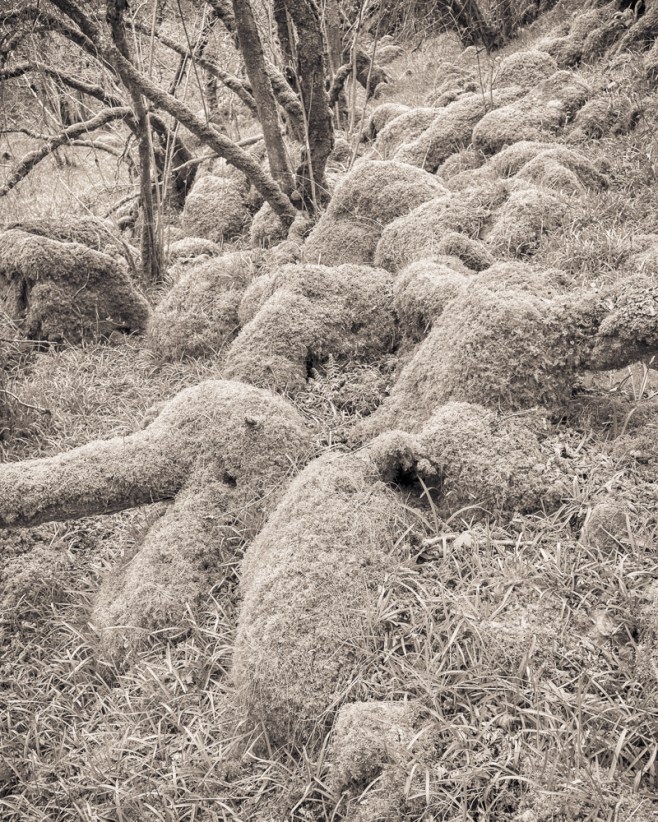
Recently I started reading through John Blakemore’s book and I came across a number of woodland landscapes which I very much liked. I enjoyed their treatment and this encouraged and inspired me. Having studied these images more closely I selected a few frames taken on my recent trip to Scotland to see whether or not I could emulate the ‘look’ of his work and process my pictures in a similar fashion.
 

20170426-L1020341-Edit

Boulders of Moss, Ulva


The tone curve in these four photographs is very different to the outcome from my normal processing methods and as a consequence this set of images work for me. Whilst there is a full range of tones, the mid-tones dominate each picture. Strong darker tones are my usual style, resulting in an image which has far more contrast. The images in this post are much softer and more restful to the eye. As a result I believe the viewers attention is held for longer so that the composition, the texture and form is more readily appreciated. A high contrast image can be quite punchy and dramatic but the eye can quickly tire when looking at an image of this type. These are far more subtle images and an approach I can see myself using again in the future. I will also be interested to see how they print on various types of paper.


20170429-L1020664-Edit

Eas Fors Waterfall, Isle of Mull


20170507-L1030047-Edit

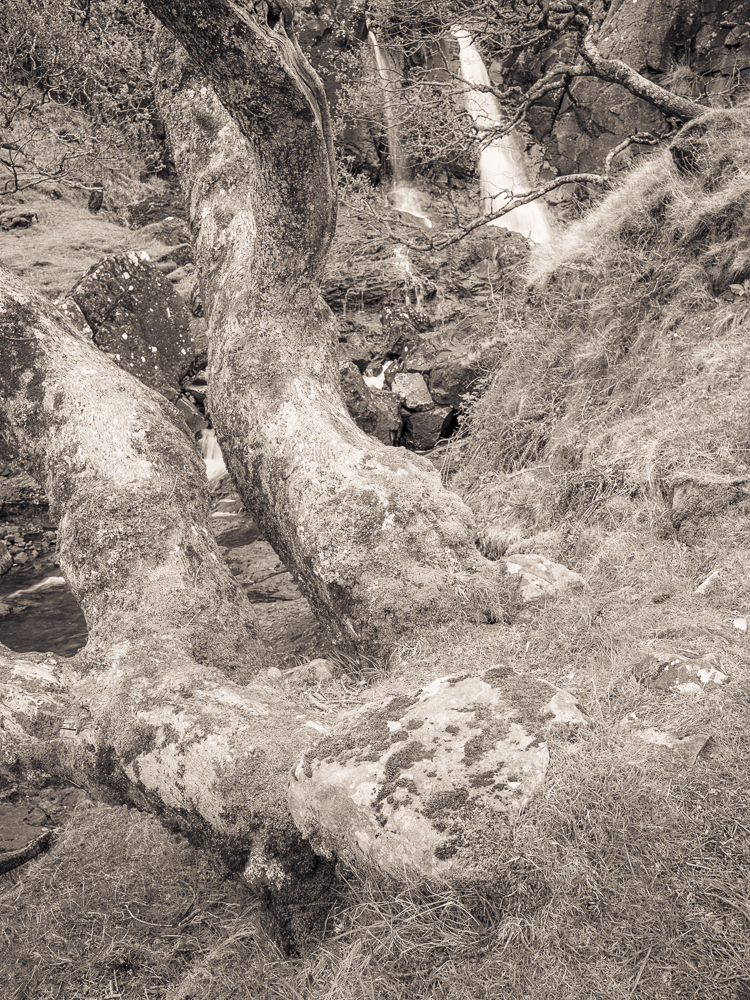
Tree by a stream, Wester Ross


Your feedback and comments are very welcome and as this is my 300th entry, it’s an opportune time for me to thank all my followers who read, like and comment on my work. It’s very much appreciated and it’s one of the reasons I will continue sharing my images and thoughts in the future.

Lastly my thanks to John Blakemore for his inspiring approach to this art form.

As always these images are best viewed large, so do click on any one of the photographs and it will open in a new window.
Shelter in Piddle Wood

Woodland shelter

Woodland shelter


When I am out walking in the countryside I always hope to stumble across something which catches my eye and in my view is worth photographing. I always seem to struggle in woodland areas but when I saw this dilapidated woodman’s hut made of corrugated iron it caught my attention.

The scene itself was made more interesting by virtue of the large puddle of water which provided some reflections, not only of the shelter but also the spindly trees. The line of stones gave me a good lead in to the hut and I like the overhanging branch which helps to frame the main subject of interest.

Yes, the hut has seen better days and I would guess has not had a particular purpose in life for quite some time, but photographically speaking this is what makes it all the more interesting – well it does to me anyway.

Creative use of depth of field in Snowdonia

Sunlit fern

Sunlit fern


It was not until the summer of last year that I finally decided to go full frame, and purchased a second hand Leica Monochrom. I had previously used APS-C (Nikon) and Micro 4/3rds (Olympus) cameras. One of the principal reasons for my decision was the potential to use minimal depth of field more creatively in my work. The combination of a full frame (35mm) sensor, coupled with a large aperture, has given me photographic opportunities which were simply not possible before.

However just blurring the background doesn’t necessarily giving a pleasing result. The out of focus areas are still important to the overall appearance of the image. Blurred shapes, tones and arrears of light of shade still influence how the image is viewed, even though the eye may initially be drawn to the main subject of the picture which is in sharp focus.

The main photograph I have included in this entry is I think a good example of what I am trying to say. Taken on my recent trip to Snowdonia, the bright early morning sun was shining on small area of bracken in a wooded glade, whilst a path in the middle ground weaved its way down to the waters edge of Llyn Dinas.  I tried to visualise how the background elements of the image would be rendered when out of focus and whether or not the shapes of the trees would enhance the overall composition. You can of course try and visualise what the image might look like if everything had been in focus. I didn’t take a shot with a small aperture opening so I cannot make this comparison. My feeling is that there would be too much going on. The foreground and background would be fighting for attention. By using a narrow depth of field I have been able to isolate the sunlit fern which is the principle point of interest. The blurred background informs the viewer about the setting, complimenting the main subject and enhancing the overall appearance, but in my opinion it is no longer a distraction.

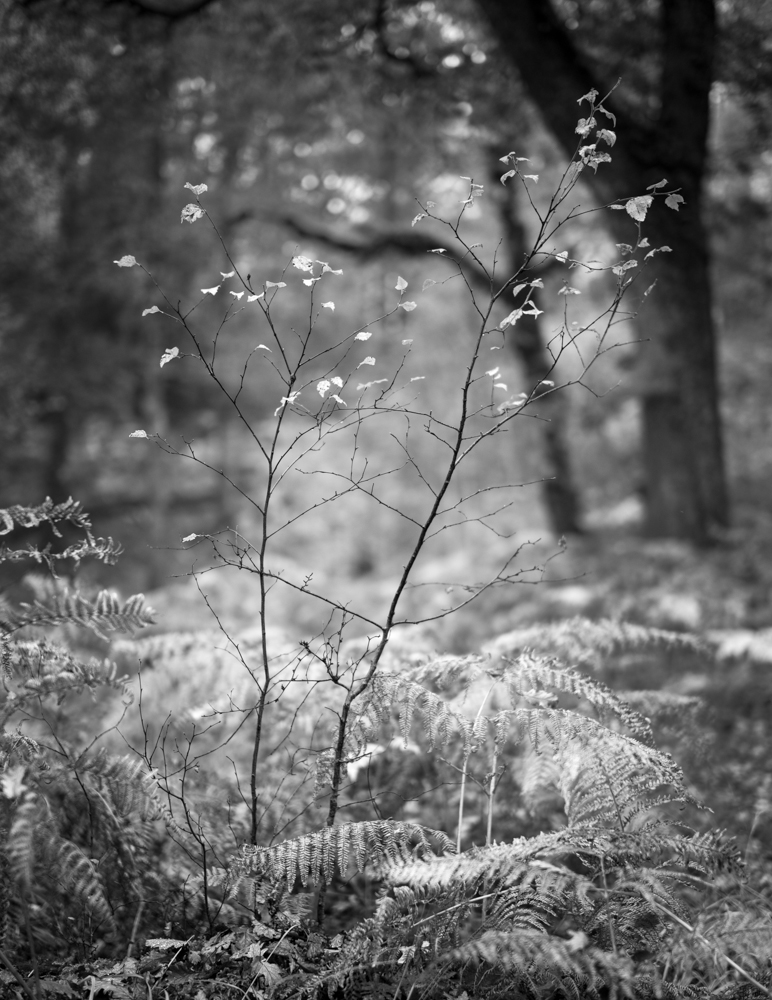
Here is another example – This image was taken in the woods near Capel Curig.


Autumn saplings

Autumn saplings


I am not saying there isn’t a place for landscape images which are very sharp from front to back. I take a good many myself, but increasingly I prefer to shoot wide open (50mm at f1.4) and by doing so I add another dimension to the composition, which until last year was not possible.

Click on either image to view a larger version which will open in a new window. By doing so I think you will appreciate the photograph just that little bit more.