Posts tagged ‘Pembrokeshire’

St Eloi’s, Llandeloy ….. let the story unfold

There are times during a church visit when the building or a particular object ‘speaks’ to me, and when it does I like to spend time exploring that subject. To look for different compositions but more than that to try and tell a broader message, a story which lies behind the images – or in other words the reason why I was drawn to the subject in the first place.

This is the first of a two part post on St Eloi’s, Llandeloy, Pembrokeshire in Wales. Tucked away it’s about 8 miles inland from St David’s Cathedral an altogether different and famous religious building which will attract many thousands of visitors. I doubt whether St Eloi’s will attract a couple of hundred people through its ancient doorway in a single year.

The principal subject for this entry is the book of prayer open at The Communion and sitting on an old prayer stand. Judging by the dirt it’s hard to know how long these two pages have been exposed to the light and not been turned.
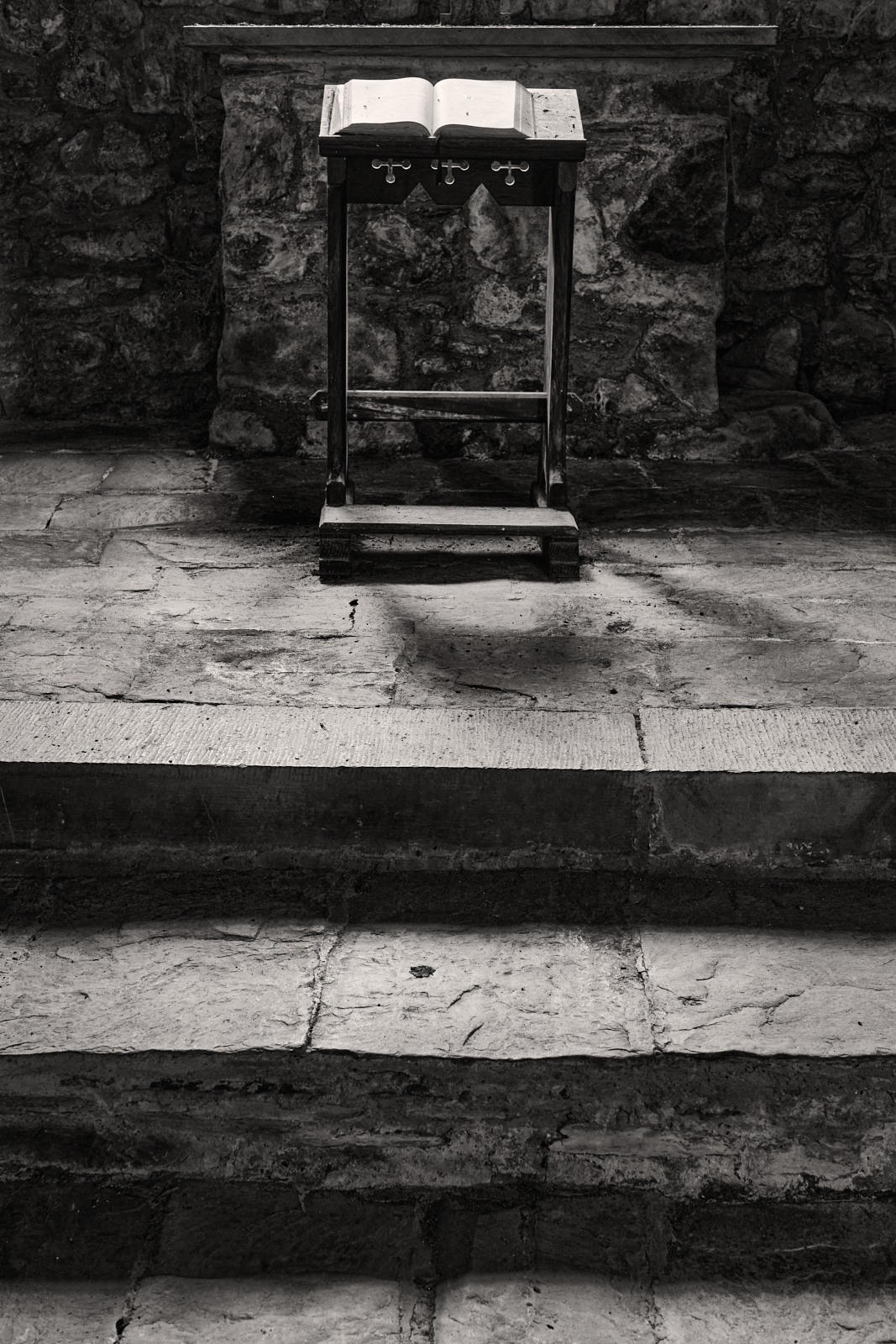
Moving back, the prayer stand itself is revealed, as well as the uneven stone floor and steps. An altar top is just visible. The light falls on the prayer book and a faint shadow of the stand on the floor suggests a window opening above.

Changing the angle of view reveals a simple pew set off to the side, room enough for two or maybe three parishioners.

The image below arguably shows the whole scene. A plain metal cross stands on the stone altar top. It is in fact a side altar or bye-altar, which is subordinate to the central or high altar to be found in another part of the church. The window reveal is shaped by the incoming light shining on roughly hewn stone. Also clearly visible are what I assume to be mice droppings. It would appear that this church isn’t used or cleaned on a regular basis.

Taken at face value each picture is purely descriptive in its nature, however there is another narrative.

I find it sad to witness but these photographs depict an ongoing and wider problem as fewer and fewer people attend church and consequently more and more churches will fail and become redundant. Places of historical and architectural merit. Spiritual places often playing host to works of religious art, and certainly places which are full of memories from centuries past.

Charitable institutions have been formed to save and care for these special buildings. One such charity is the Friends of Friendless Churches, which not only look after St Eloi’s but work to rescue and protect more than 60 other churches of all denominations across Wales and England. However they rely heavily on donations and volunteers, an uphill struggle at any time.

On the one hand I feel a sense of joy that these churches are being preserved for future generations but on the other hand I cannot ignore a feeling of melancholy, as past times are remembered but hopefully will never be forgotten. Future generations should be able to witness for themselves the important of these sacred places.

This is the first post following my recent visit to St Eloi’s in early June. You will be able to read the second post in the next few days.
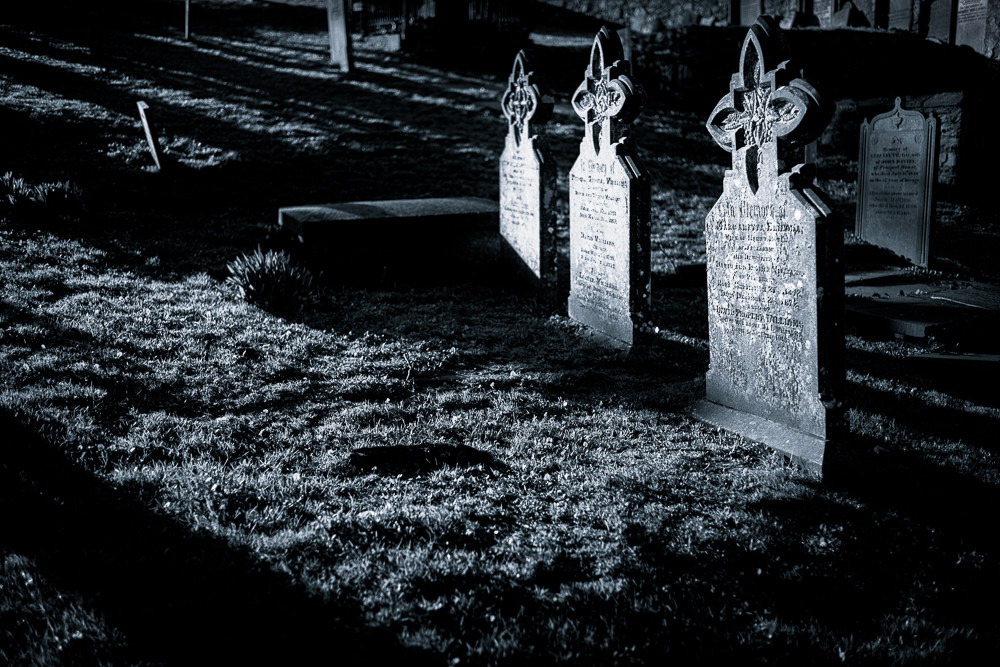
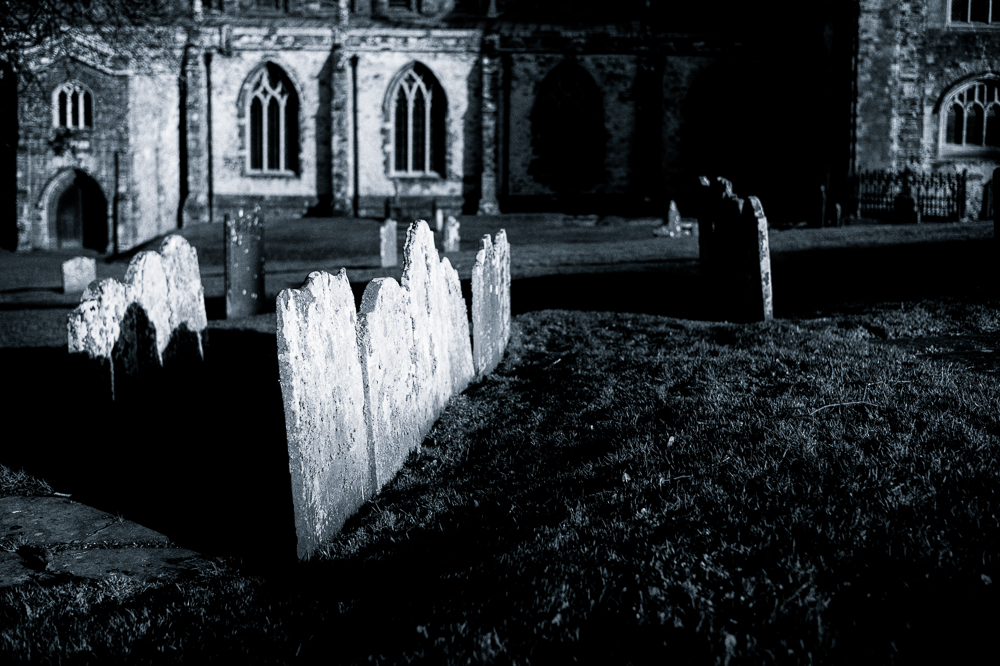
St David’s gravestones – light on the dearly departed

Photographers are drawn to many things. Decay in its various forms is a favourite, churchyards can be another. Without question though we are always drawn by the light, so when you combine old gravestones and shafts of early morning light, a certain fascination starts to develop in the photographer’s mind and it’s very hard to resist taking a few frames.

This set of three images were all captured In the churchyard which surrounds St David’s Cathedral in Pembrokeshire in Wales.

After a hearty breakfast in preparation for the day ahead, the early morning winter light was illuminating the headstones of the dearly departed and long shadows were being cast across the ground. Far from my usual style I used a ‘cool tone’ which you may or may not like but I think it suits the subject matter rather well. Do please comment and let me know what you think.

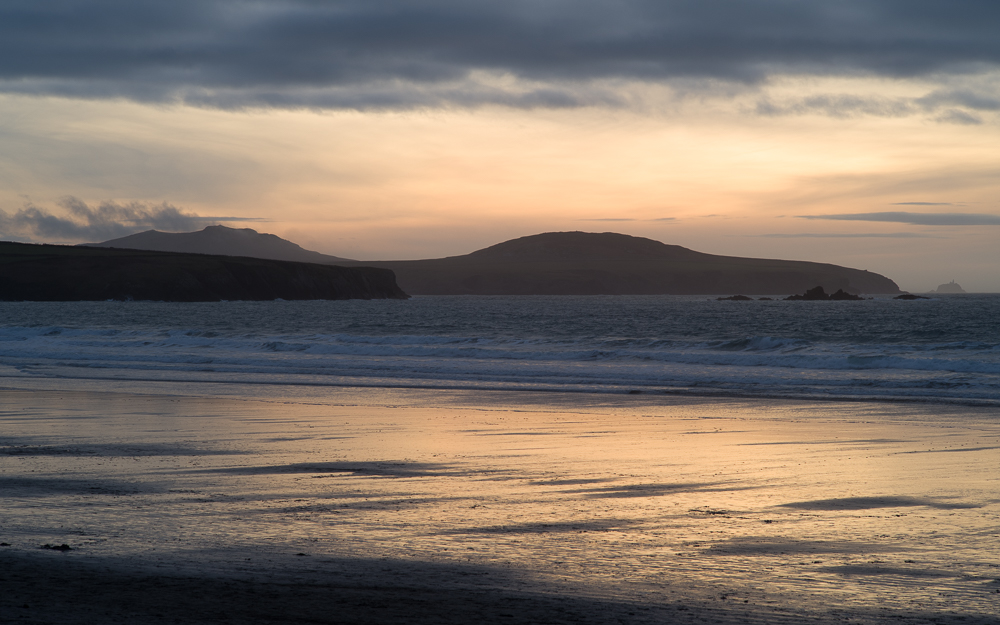
Whitesands Bay – The magical Golden Hour

17.09.47 – The Golden Hour begins


In the past couple of months I have been making more use of my Instagram account (@arfrost) and on it my profile reads – ‘A monochrome photographer with occasional colour lapses’. I think this sums up my approach to photography rather well, and this post is just that, a lapse into colour.

For many landscape photographers the ‘Golden Hour’ at the beginning or at the end of the day is one of the most popular times to be out with a camera. This set of images demonstrates rather well the reason why it can be a magical experience. The colour of the light is constantly changing and arguably the longer you wait, the greater the reward is likely to be.


17.24.03 Showing Potential


All of these images were taken from more or less the same position, looking out over Whitesands Bay in Pembrokeshire back in February this year. The first frame was taken at 17.10hrs and the last at just before 18.00hrs, a difference of just 50 minutes.


17.44.46 Jogger at dusk


17.54.10 Forty five minutes after the first frame


17.58.11 The Magical Golden Hour


As well as the glorious colour palettes the inclusion of people and in some cases their dogs as well, adds human interest to three of the five images, which appeals to me.

If you happen to find yourself in a wonderful location when the day is drawing to a close, and assuming you have the time to sit or stand and just wait; then there is no greater pleasure than to enjoy the ‘Golden Hour’. Whether you have a camera with you or not, the experience is hard to beat.


Pembrokeshire – A ‘letterbox’ view

L1000301-Edit

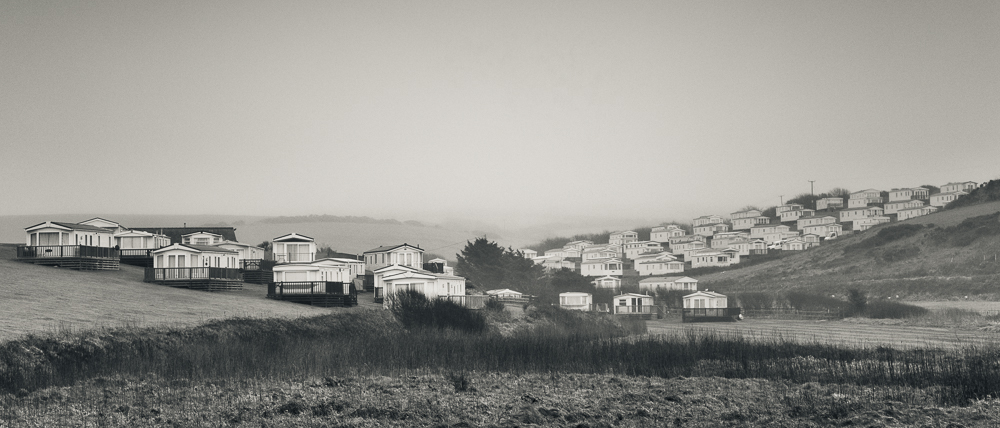
As I write this post the sun is shining and Summer is almost here but these four images depict a very different time of year. They were all taken on the same day back in February. Some may say a typical late winters day in Wales, when nobody in their right mind would be out with their camera. Mist, drizzle and poor visibility. However these conditions can be ideal for the monochrome photographer.

In all cases the native 3 x 2 crop of the 35mm sensor included too much sky, and with little or no interest in this part of the picture I have cropped each image to what might be described as a ‘letterbox’. The aspect ratio is about 3 x 1, but what really matters is whether or not the crop works compositionally, and I believe it does. Photography is often about what you choose to exclude from the frame to strengthen a picture, not just about what is included already.

In the first shot taken at Newgale Sands, I focused on the foreshore which has softened the figures, the sea and distant rocks. This has helped to emphasize the misty conditions. The couple and their dog are an essential part of the image. The provide scale and as they are the only people on the beach they serve to reinforce the fact that the weather was so poor keeping most sensible people indoors, but for dog walkers and photographers!

L1000306-Edit

After taking the first shot I looked behind me only to find a swathe of mobile homes which overlook this section of coastline. Very quiet at this time of year, and only coming to life when the weather improves and the holiday makers return.

L1000338

Moving further along the coast I stopped at Little Haven. Conditions remained the same and this time I wanted to capture the tidal movement of the sea. Resting the camera on a wall I used a ND filter to give me  a slow shutter speed, about 1.6 seconds. Several exposures where necessary to give me the look of the movement in the sea water I was after.

L1000365

Finally a shot of what I assume is a farmhouse taken at Marloes. A typical dwelling in this part of the world but what appealed to me was the telegraph poles and how they could be used to create what I think is a pleasing composition.

Each picture looks better larger, so do click on an image to view a larger version which will open in a new window.


Marloes, Pembrokeshire – soft proofing in Lightroom

Marloes

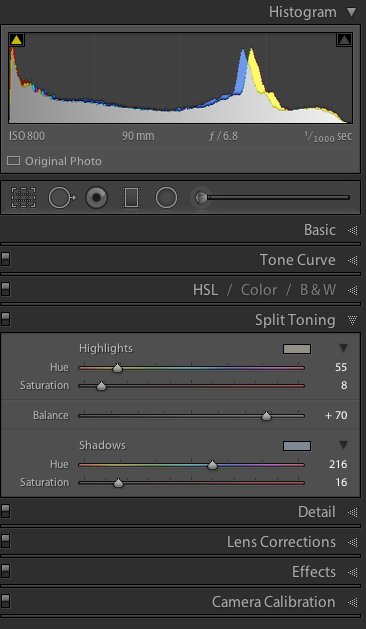
If you read my blog on a regular basis you will probably have noticed that although I work almost entirely in monochrome, rarely are my images in ‘pure’ black and white – in other words they are toned. Either with a single colour, or more recently I have used a split tone where the highlights are toned with one colour and the shadows are toned with a different colour. This split tone is easily applied in Lightroom and the balance between the two tones can also be adjusted.


Screen Shot 2017-05-31 at 18.06.17


Whilst I like the effect of split toning it does present me with a new problem, and that is one of printing. I very much enjoy the process of printing; in many ways it’s the rightful conclusion to everything that has gone before it. In the past printing a ‘pure’ black and white photograph was fairly straightforward from my point of view. The fact that my monitor wasn’t properly calibrated (good but not great) didn’t matter hugely to me; I could produce a perfectly acceptable print by observing the histogram, processing accordingly and adjusting the contrast to achieve the look I was after.

With split toning, however subtle the effect, I am now printing a ‘colour’ image, so what I see on the screen and how that image is produced in print becomes much more critical. The choice of paper (and there are now so many excellent photographic papers), use of the appropriate colour profile for printing, as well as having a correctly calibrated monitor, now all play a more important part than they did before.

For these reasons I started exploring the soft proofing panel in Lightroom which forms part of the ‘Develop’ mode. It is easily opened by pressing ‘S’ on the keyboard. From here you can select the colour profile for the paper you wish to use and select either perceptual or relative as the intent. From here Lightroom will create a virtual copy of the image with the colour profile and intent embedded. The name of the file/copy will include a reference to the colour profile, which is a very convenient feature for future reference. This is an invaluable benefit and one that Lightroom makes so easy. Depending on how the image changes its appearance in soft proofing you can go on to make the usual processing adjustments to the contrast, clarity, exposure etc so that the image reflects how you want the photo to be printed. By choosing a matt paper colour profile I found the proof copy was much ‘flatter’, it lacked contrast when compared to the original image. In processing I added back more contrast to the proof copy.


I do not own a device for calibrating my monitor and perhaps that is something I should acquire in the future. In the meantime I did use the Display Calibratior Assistant on my iMac and whilst not a precise tool, I have been able to calibrate my monitor to more closely represent what comes out of the printer.


There is no question that I still have more to learn regarding printing and with two exhibitions on the horizon this year; one in July and one in November, I am very keen to make a decision on my choice of paper and be able to produce consistent results. More test printing is required. I also know that Photoshop has a soft proofing feature and in time I may look into this as well but for the moment Lightroom seems to be a very straight forward way to achieve the results I am wanting.

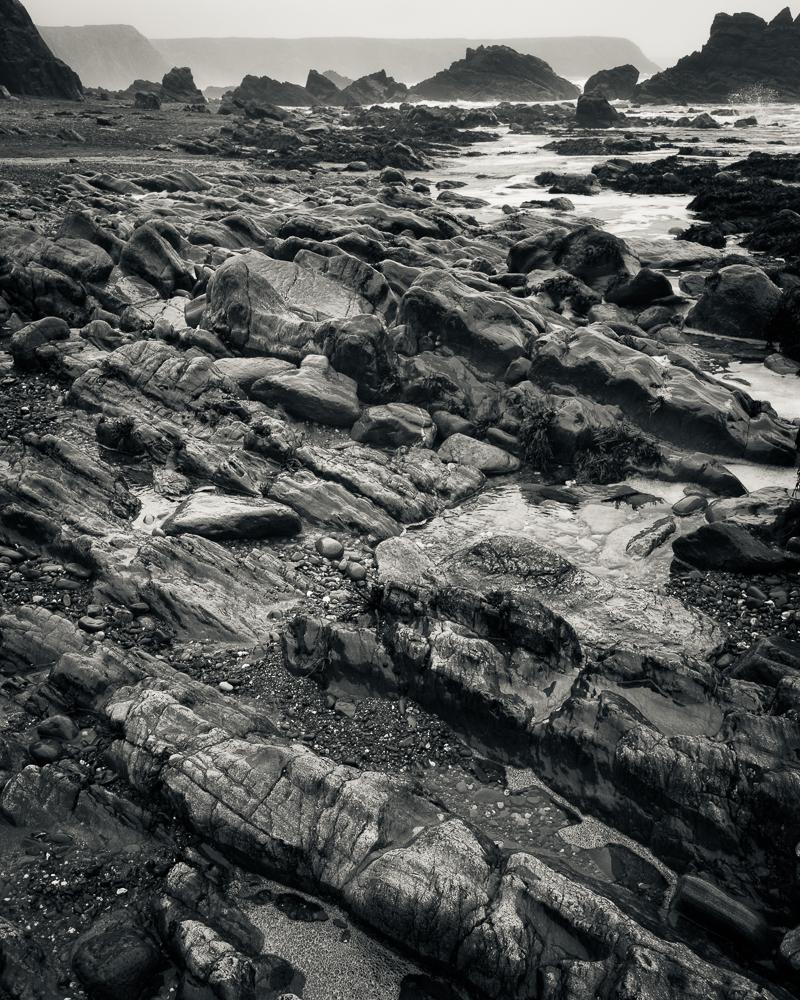
I shall leave you with a few more images of Marloes in Pembrokeshire, Wales. Fortunately when I visited this location earlier in the year, the height of the tide was just about right – ideal conditions for some dramatic coastal photography.


Please note that I am using Lightroom 5 and I am not using the most recent operating system on my iMac, so the screen grabs may look different. To be frank I am not a great one for always upgrading to the latest software. If it works then I don’t feel the need to automatically change anything. I do realise this might get me into trouble one day but for now I’m very happy with what I’ve got and it works for me!