Posts tagged ‘monochrome’

The Church Defender

Church Defender

Church Defender

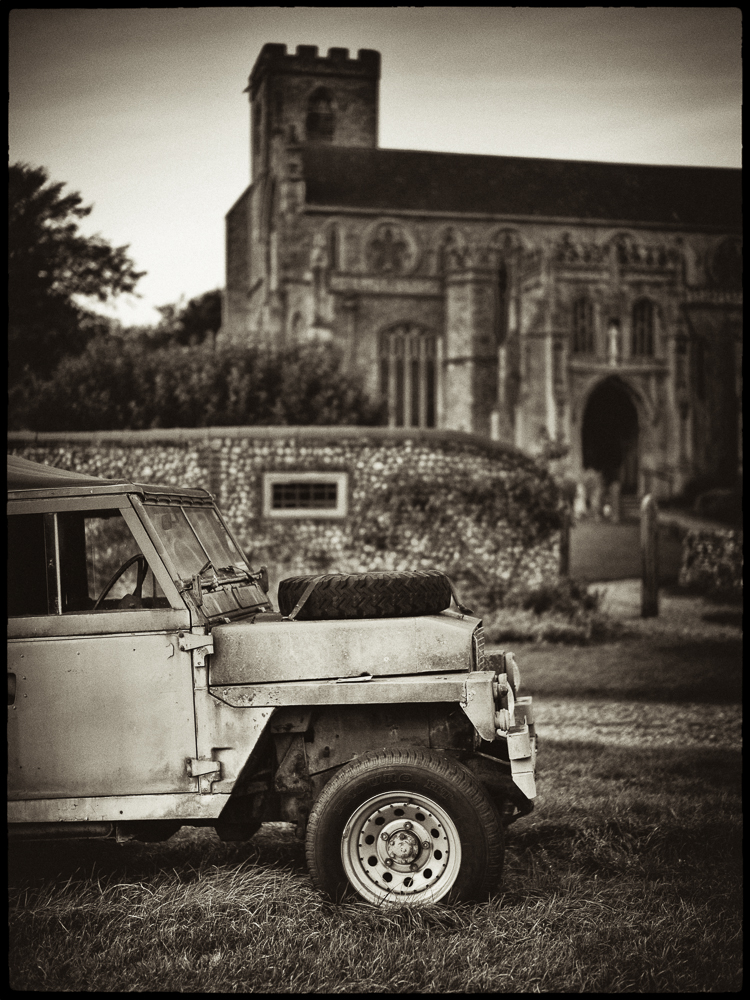
In time to come it might be quite hard to put a date against this photograph.

The Church in the background, which is dedicated to St Margaret, is in Cley Next the Sea on the North Norfolk coast and was built in the early to mid 1300’s. The vehicle parked on the grass verge is of course a Land Rover, built much later but many are still going strong today. I would guess this is a Series 1 model – which first came into production in 1948 and later became the Land Rover Defender. I am no expert and if anyone can confirm whether or not this is the case then do please comment. An iconic vehicle which went out of production after 68 years, the last one rolled off the line on the 29th January 2016.

I like the timeless quality to this shot. Both the subject and the treatment evoke memories of days past even though it was taken less than two years ago in October 2014.

Cley Next the Sea is arguably best known for its windmill, which can be seen for miles around and overlooks the salt marches of this beautiful but wild part of the English coast. There are links to a couple of earlier posts featuring Cley windmill below.

Last light of the day on Cley Windmill

Cley Windmill – Decisions, decisions


Transient light – when mono works as well

Transition in mono

One of the joys of blogging are the comments that are made and these are of particular benefit to me when they offer constructive suggestions about an image. Yesterday I posted a colour image called ‘Transition’ in a post entitled ‘Transient light – when only colour will do’. One of the comments I received came from John Dominick, a friend and fellow photographer, who said he would like to see a mono interpretation. This came as something of a surprise to me, as it had never crossed my mind to convert the photo into black and white. Given that I have almost exclusively been working in mono for the last few years, you would have thought it would have been my default approach, and not just dismissed without consideration.

I am therefore very grateful to John for planting this idea in my mind as the mono version (converted in Silver Efex) in my opinion works just as well. It’s a very different image now, there is more drama and atmosphere in the shot but this aspect of black and white photography has always appealed to me.

Having made this second image it has made me think about combining or blending in Photoshop both the colour and black and white versions to see what can be created. This is my task for today and I shall aim to post a third version of ‘Transition’ tomorrow.

I always try and reply to comments and in this example respond to any constructive ideas put forward. Thank you as always for your feedback, it’s most welcome.

Alone on The Cobb

Alone on The Cobb

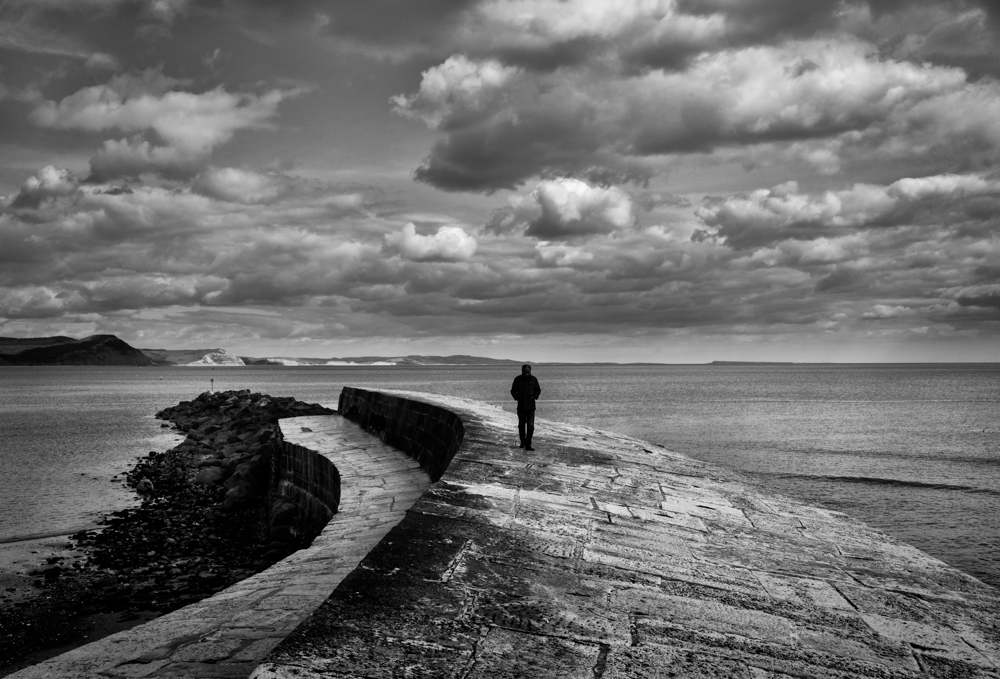
The Cobb at Lyme Regis in Dorset is an old stone curved pier forming a large harbour. Some 870ft in length there is an appreciable slope to the upper section with a sheer drop on one side into the sea. The lower promenade on the harbour side is better protected from the elements, but far less spectacular.  On the horizon are the dramatic cliffs of the Jurassic Coast but I would advise stopping to take in the view. There is a notice informing anyone who wishes to walk along The Cobb not to do so in high winds. It’s easy to see why. Even on a clam day walking along the slope of The Cobb can be a little unnerving. This location was of course made famous in the 1981 film ‘ A French Lieutenant’s Woman’ featuring Meryl Streep.

A popular and much photographed scene, the inclusion of a lone figure walking on The Cobb not only adds human interest but also raises questions in my mind. It’s an image of solitude, coupled with the drama of truly spectacular location. The Cobb’s slope is clearly visible and the sea is clam. What are the thoughts going through the mind of the person in the picture? Is he enjoying an inner calm and peace or are his feelings of a very different nature? Perhaps he is simply enjoying the wonderful view on a beautiful Spring day? Questions but no answers, but hopefully an image which can be appreciated for a variety of different reasons.


Churches Project no.9 – Candlelight in The Priory

Candlelight in The Priory

Candlelight in The Priory

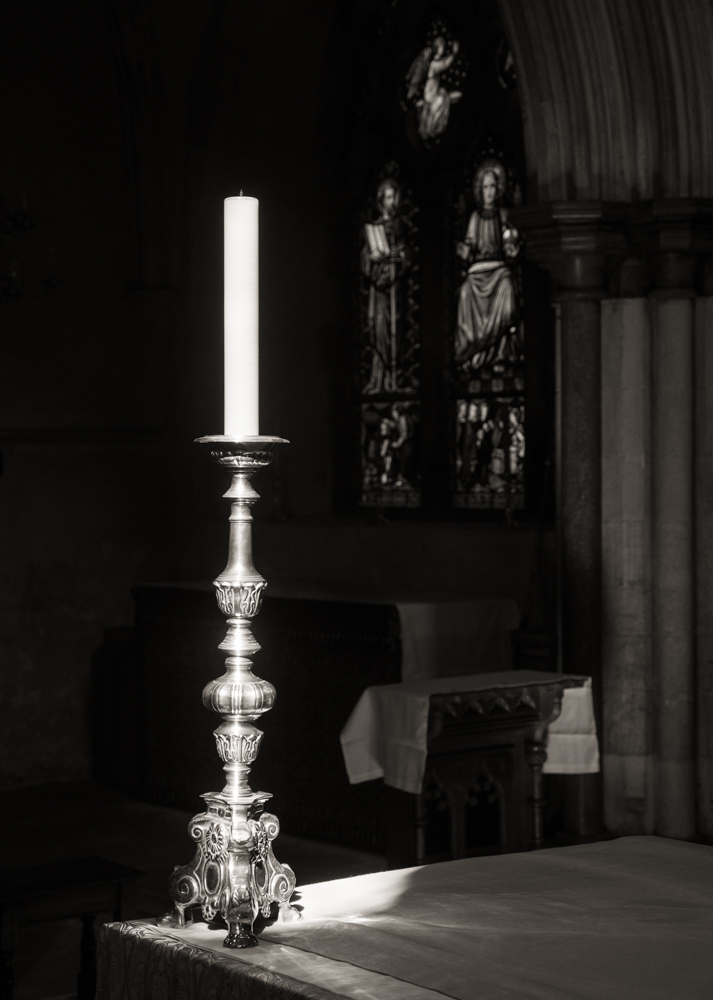
There are many reasons why I enjoy visiting and photographing churches and their interiors. Without question one of them is the unexpected play of light inside a church when the outside is bathed in bright sunshine. The way shafts of light come through the windows can be an absolute joy, as was the case just this week when I called into Boxgrove Priory. It’s a beautiful building which lies to the east of Chichester, and one I shall return to photograph again.

I had not visited the Priory for many years, in fact I think the last occasion was for a funeral. The church was empty so I was able to look around in complete freedom. After about twenty minutes I noticed the sunlight illuminating one of the elegant candlesticks on the altar. The light was very bright and I knew the background to the image would be quite dark if I correctly exposed for the main subject of the picture. I knew I didn’t have long to take the shot as the sun was moving round and the light on the candlestick would soon be lost. The stone arch and stained glass window give context to the picture but the main subject will always be the candle bathed in lovely spring sunshine.

Protection – Sand dunes at East Head

Protection

Protection

I seem to have spent a fair amount of time down at East Head in West Wittering recently. The sand dunes and large areas of beach when combined with ‘big’ skies  provide me with so many scenes to photograph. The low light at the end the day is a great time to be there; more so, if a weather front is just passing through. In this image the last rays of sunlight are illuminating the old and rickety dunes fence, one of the last of its type at East Head. There are now more metal posts and wires which are far less attractive from a photographer’s point of view.

These sand fences are put in place to protect the dunes from erosion by reducing wind speed across the sand surface and encourage foredune deposition. They also help to control public access, but for me they quite simply provide some excellent foreground interest in a photograph which is always going to be enhanced by a dramatic sky.

I read a quote by Ansel Adams the other day which read. “Sometimes I do get to places just when God is ready to have somebody click the shutter”. I think this might just have been one of those occassions.

Do click on the image itself to view a larger version.