Posts tagged ‘light’

Evening light over the Applecross Peninsular


There are times when I am out and about when a scene unfolds before me and stops me in my tracks. This happened a few days ago in Wester Ross in Scotland. The early evening sunlight came through breaks in the clouds to create glorious shafts of light and illuminated the middle ground. One problem; no camera on me to capture the beauty of the light. A cardinal sin for any photographer.

Fortunately I was only five minutes walk from the cottage where we had been staying. I rushed back, picked up my camera and some graduated neutral density filters. I knew I would need them to hold back the strong light above the mountain ridge; I just hoped that by the time I returned to a good viewpoint the ‘light show’ was still being played. It was, and I combined the 3 stop and a 2 stop graduated ND filter to balance the exposure. Even then the image required some careful processing to create the result you see here.

For the record I am looking towards Beinn Bhan, the highest mountain on the Applecross Peninsular in Wester Ross, Scotland.

Do click on the picture to view a larger version which will open in a new window.

A favourite image and a favourite camera – is that possible?

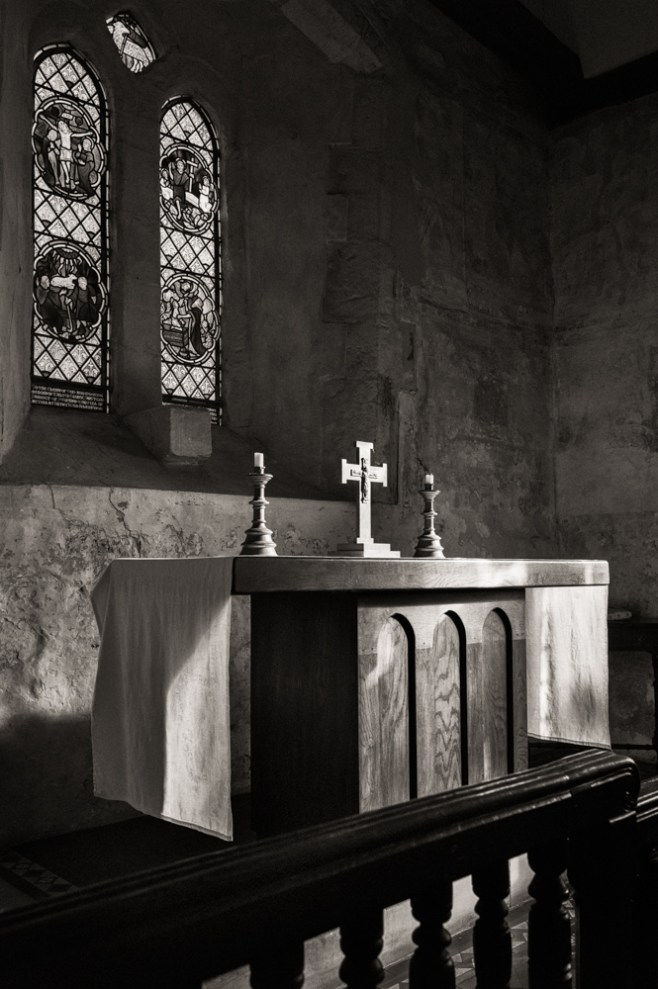
st-botolphs-hardham-1-of-1


I was asked recently if I had a favourite image which I had made? In all honesty I don’t think I do, although there are a number which I could name in a top ten. I do though remember reading that someone else when asked the same question replied – ‘The next one I am going to take.’ I rather like this response as it suggests a desire to constantly improve, believing that your next photograph will be better than the last and all those in your back catalogue. It also infers that the last image taken must be a favourite for at least it’s tangible and not a figment of the imagination – or is it? I’ll come back to this question later, as it’s relevant to the photograph in this post.

As far as a ‘favourite camera’ is concerned, well that’s easy for me to answer. It’s my Leica M Monochrom which I have been using for the last couple of years. It’s built like a tank, feels so good in the hand and the simplicity of its controls put me in complete control. It doesn’t have a multitude of programmable buttons, nor pages and pages of menus, which only serve to confuse, and nor does it come with a manual which might take the best part of a week to read, let alone understand. More importantly though the Monochrom together with the exceptional Leica lenses produces the images I am seeking to achieve with post processing and careful printing. The next incarnation of the Leica M Rangefinder must be just round the corner but I think its unlikely I will want to upgrade. The Monochrom has many idiosyncrasies, but I love it and the cost of upgrading is quite likely to be prohibitive anyway.

Given my feelings towards the Leica Monochrom, I am not that interested in the latest camera technology although to digress for a moment I was intrigued to learn about a new camera being developed by a company called Light. The camera is called the L16 and has the appearance of a large mobile phone, but instead of one lens and sensor there are 16. On pressing the shutter the camera software combines all the exposures from each of the sensors to produce one image. According to their website this can be up to 52 megapixels in size, with low noise and covering a focal range equivalent of 28mm to 150mm. The depth of field and other adjustments can be manipulated in post processing. Is this the future of camera technology, I don’t know, but nothing stays the same, so it will be interesting to see what happens when it actually hits the streets.

Back to the question I posed at the end of the first paragraph and indeed to the photograph in this post. It was taken a few days ago at St Botolph’s Church in Hardham, West Sussex. I had visited the church previously and noticed how the light was falling on the altar. I had taken some shots that day, only to find that my composition was not quite right, nor had I used the correct exposure settings. There were too many blown highlights. I decided to return, knowing in my mind the image I wanted to make. I knew which lens would give me the composition I wanted (28mm) and the likely exposure settings required to produce a malleable and workable file for post processing. I knew the time of day when the light would be in the right position, so I arrived at the church in plenty of time to get ready. The sun wasn’t as bright as it had been a day or two earlier but this proved to be a good thing. As it turned out I only had a couple of minutes to take the shot before the sun moved round and no longer illuminated the scene as I wanted it.

A favourite image or not, I like this photograph, as it will always remind me that it can be worth revisiting a location to take a particular shot that you have already pictured in your own mind.

Here are two more entries about St Botolph’s Church at Hardham.

Churches Project no.4 – St Botolph’s, Hardham, West Sussex

Thwarted by the flower arrangers at Hardham Church


Shadows of Light

Shadows of Light


In my last post ‘Shadows of the Wanderer’, the shadows referred to people or refugees, whereas in this shot made on the same day, shadows are formed by the strong sunlight as it pierces through the leaded light mullioned windows of the cloisters in Chichester Cathedral.

To emphasise these shapes of light I have increased the contrast, darkened the foreground, obliterating any detail in the flagstone floor whilst retaining  minimal information in the wall and around the windows themselves.

Do click on the image to view a larger version which will open in a new window.  

Transient light – when mono works as well

Transition in mono

One of the joys of blogging are the comments that are made and these are of particular benefit to me when they offer constructive suggestions about an image. Yesterday I posted a colour image called ‘Transition’ in a post entitled ‘Transient light – when only colour will do’. One of the comments I received came from John Dominick, a friend and fellow photographer, who said he would like to see a mono interpretation. This came as something of a surprise to me, as it had never crossed my mind to convert the photo into black and white. Given that I have almost exclusively been working in mono for the last few years, you would have thought it would have been my default approach, and not just dismissed without consideration.

I am therefore very grateful to John for planting this idea in my mind as the mono version (converted in Silver Efex) in my opinion works just as well. It’s a very different image now, there is more drama and atmosphere in the shot but this aspect of black and white photography has always appealed to me.

Having made this second image it has made me think about combining or blending in Photoshop both the colour and black and white versions to see what can be created. This is my task for today and I shall aim to post a third version of ‘Transition’ tomorrow.

I always try and reply to comments and in this example respond to any constructive ideas put forward. Thank you as always for your feedback, it’s most welcome.

Transient light – when only colour will do.

Transition

Transition


Photography is painting with light – and that light can be very transient in the landscape. The weather and consequently the light can change in an instant, so to capture these fleeting moments there has to be an element of good fortune.

This image was taken a couple of weeks ago in the beautiful county of Dorset. We were experiencing all types of weather that week; in fact it could be said we had all four seasons in just one day. Bright sunshine followed by clouds and then hail showers, turning the ground white if only for a short time. Hopefully the last blast of winter before the summer truly arrives. At this time of year we also see fields turn yellow as the vibrant colour of the oil seed rape crops burst into life. Combining these two key ingredients is potentially a recipe for some good landscape photography which can only be enjoyed in colour.

When I took this shot I was standing in sunshine, looking back across the rolling hills to the north of the county town of Dorchester. As we returned to our cottage I could see dark shower clouds moving in quickly from the west and as the rain fell on parts of the countryside it was lit by the sun. I quickly parked the car, got out, and walked very briskly to find a suitable position to take a handful of shots. Within a few minutes the special light had gone, but I knew I had captured the transient light and colour of the scene before me.