Posts from the ‘landscape’ category

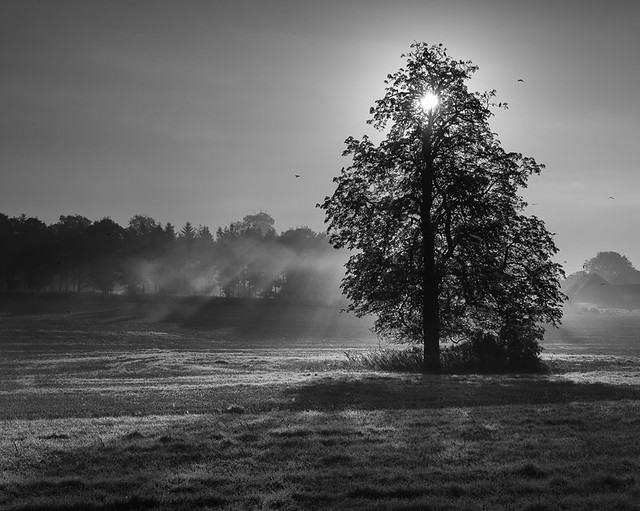
Morning glory

Burning off the mist

There are many occasions when my wife and I will take our dog for a walk in the beautiful countryside which surrounds us, when shortly into the walk she will say –

“Did you bring your camera with you?’

To which I will reply

“No, I haven’t.”

Almost inevitably a few minutes later a scene worthy of capture will present itself and I curse myself for not having bothered to pick up my camera and thrown it over my shoulder.

Many a missed opportunity, but this morning was the exception and I must learn the lesson to always have a camera with me. It’s an old cliche but a very true one.

Within five minutes of leaving our car we came across this scene. The sun was rising, the morning mist lifting and the dew on the ground added another attractive element to this autumnal scene. The birds flew around the lone tree in the field and the distant farm buildings to the right completed the composition. I took the shot and we continued our walk. I am guessing but I would think that five or ten minutes later the early morning mist would have been burnt away and this glorious view would have been lost.

For me this is a very special time of year and I am looking forward to the weeks and months ahead. Needless to say I will try and remember to have a camera with me at all times.

Taking inspiration from other artists – Chris Tancock

A few weeks ago I wrote about how I like to take inspiration from other artists – or to be more precise, how I like to enjoy the work of more accomplished artists and perhaps try and learn something in the process.

Today I just want to write a few words about the Welsh photographer – Chris Tancock, who describes himself as a rural documentary photographer as opposed to a landscape photographer, even though he takes photos of the countryside in which he lives.

I first came across his work when on holiday in Pembrokeshire in Wales a few years ago. His photographs were for sale in a gallery near St Davids and I found them particularly striking. The project was called ‘Quiet Storm’, and included a number of dramatic colour images of the Welsh landscape.

Later I found more of his work on the web, only to discover that he much prefers to work in black and white. Amongst his more recent projects are ‘Beating the Bounds’, ‘Off the Beaten Track’, ‘Farm’ and ‘The Dowrog’. I greatly admire his dedication to the work he produces. Beating the Bounds for example is a project spread over 5 years, where he walks the boundaries of 5 meadows, twice a day, every day, come rain or shine, observing and capturing the ever changing ‘story’ of the landscape he witnesses. The project is still incomplete but I am lucky enough to have the current version of his book called ‘Beating the Bounds’ which is published by Blurb.

20131230-_C300067.jpg

20131230-_C300070.jpg

20131230-_C300068.jpg

20131230-_C300069.jpg

I also have another book by Chris Tancock called ‘Wildwood’ again by the same publisher.

20131230-_C300071.jpg

20131230-_C300073.jpg

20131230-_C300072.jpg

To me these images are not what might be termed ‘classic’ landscapes, where the photographer has used a well established formula to arrive at the finished photograph. It is hard for me to put into words the ethos of Chris Tancock’s approach to photography, so to give you a flavour of his style I have included a quote from an interview with the magazine ‘Onlandscape’ in which he said –

“I don’t want to hurt peoples feelings, but I don’t like boulders in the foreground, sunsets in the background, diagonals in between them, repeated again and again and again, hunting the countryside until you find these things. What does it tell you about the landscape? Nothing. It tells you about composition and the photographer, it doesn’t tell you anything about the landscape, but they’re commercially viable. They are very easily read images. People forget we read images on different levels and an image like that has the reading age of a 5 year old, its the equivalent of a Janet and John book”. 

Strong, heartfelt words and perhaps the reason why his images are documentary in style. His photographs may not necessarily be called beautiful but they certainly tell a story about the landscape and the countryside in which he lives. Many have a mysterious quality about them, little details contained within the image which are not always noticed on first viewing. Personally I think there is a beauty about the them and I very much enjoy following his latest work which he posts on Pictify.

If you are interested in learning more about Chris Tancock and his individual approach to his work, then you can read the full interview with “Onlandscape’ here.

For now I shall continue to admire his work and try and learn something from his approach to this particular style of documentary photography.
Always grab the opportunity

Across Loch Eil
Across Loch Eil

There are occasions when a quickly taken shot can make for a pleasing image even if there is virtually no time taken to adjust the camera settings and compose the picture.

This photograph of Loch Eil in Scotland is a case in point. Back in 2011, I was travelling by train from Glasgow to Mallaig on the west coast. Having left the town of Fort William the train continues it’s journey taking in some spectacular countryside along the way. In fact this route is considered to be one of the finest railway journeys in the world. As the track passed alongside the Loch, the cloudscape and light across the water just had to be captured. I really only had time to turn the camera on, swiftly compose the shot through the window of my carriage and press the shutter. Although the train was not moving that fast, if I had taken the time to check or alter any of the settings on the camera, the opportunity to take press the shutter would have been lost several hundred yards back down the track, as this view soon disappeared behind a line of trees along the shoreline.

The image straight out of the camera was pretty poor. In particular the horizon was far from level and the exposure was definitely out. Fortunately I was able to straighten and crop the image and improve the overall tone in Lightroom. I think the final image is very pleasing. It may not be prefect and I know that had I been standing by the loch, with a tripod and time to move around, I would have composed and exposed the photograph differently. Nevertheless as a quick opportunistic shot taken through the window of a moving train, it still works for me, and I would rather have the image in my collection than  nothing at all.

Less is more when capturing the South Downs

Downland fence
Downland fence

It is hard to believe that two months have passed since I completed my walk along the South Downs Way and here I am still writing about the experience and the photographic lessons I learnt.

I guess that if you mention the South Downs to a bystander they will conjure up in their minds a wide expansive view of the Sussex Weald and Downland. Large vistas which are truly beautiful but incredibly difficult to capture in a photograph. It is perhaps one of the reasons so called ‘holiday snaps’ never quite do justice to the scene we witnessed. We are tempted to try and include everything we see in one photo and whilst it may be a good record of what we saw, it often fails as a photograph. It might lack a good composition, any form of focal point to draw the eye, be poorly lit or quite simply not truly capture the feelings that the photographer felt at the time.

I can’t deny that some of the images I took fell into the ‘large vista’ category but I was also mindful to look closer and try and simplify the landscape through careful composition, concentrating on just two or three key elements and in so doing try and capture the essence of the South Downs and not just the grand view.

So this entry includes a selection of images all taken from the South Downs Way, where less is hopefully more.

Field of curves
Field of curves
The straw bale
Straw bale
Lone cow
Lone cow
Downland field
Downland field
No shelter
No shelter
Dead tree
Dead tree
Gateway to the sky
Gateway to the sky

Twisted tree
Twisted Chanctonbury tree
Do these photographs capture something about the South Downs? 
Do they capture the feelings I experienced when I first saw and composed the image in the viewfinder? Do they do justice to the beauty of the area and its countryside? 
So many questions and of course I have my own answers and anyone viewing these images will have their own opinions. In the end they are the view I chose to take, my interpretation and my treatment. They give me pleasure and I hope others might just feel the same way.
Thank you for reading my ‘blog’ and do leave a comment if you have anything you would like to say.

Harvest time

The time to harvest the crops is upon us. It’s the season when farmers have to make the sometimes difficult decision as is to when is the optimum time to roll out the combine harvester, maximise the yield and not to risk a change in the weather, as this has the potential to do untold damage to the crop, not to mention their bank balances.

The South Downs are covered in fields of wheat and on a recent walk the threatening shower clouds started to form, although the rain never fell one me fotunately.

This post of just four entries captures for me something of the beautiful downland scenery at this time of year.

Harvest shower
Harvest shower

I was drawn to the scene below of the old tree and the flowing lines of the field which had recently been harvested. A week later I returned to the same spot and these distinct lines were no longer so clearly defined. The ‘decisive moment’ of landscape photography.

The harvest tree
The harvest tree

In the next image, which I have called ‘Harvest Enemy’, I have tried to capture the mood of a brewing storm which threatens the crop of wheat in the field below.

Harvest enemy in mono
Harvest enemy

I rarely process my work in colour but on this occasion I particularly liked the the contrast in colour between the field of wheat and the threatening sky. I also used a ‘letterbox’ crop instead of a ‘5×4’ crop which was applied to the mono version of the same RAW file.

Harvest enemy
Harvest enemy in colour
I love this time of year as the summer draws to a close and the more changeable weather of autumn starts to appear. Will I be drawn to more colour work to capture the wonderful autumnal colours?, This I don’t know, only time will tell. Whatever happens, I will be out with my camera doing what I enjoy most!