Churches in the landscape – South Stoke

In my last post (Idsworth Church) I touched on the topic of choosing a suitable subject which would inspire me for my panel of images for the ‘ARPS Distinction with the Royal Photographic Society. The choice is proving to be quite a challenge in its own right and this is before I start taking any photographs worthy of a submission. Fortunately I am not up against the clock and I will take my time. It’s a bit like a driving test and I would like to pass first time, so it will pay me to prepare properly and take as much time as I need before I apply for an assessment date. Between now and then there is likely to be long gap. The selection of a subject or theme is only the starting point. I will need to undertake a lot of research into my chosen topic, particularly if this involves travelling from one location to another, either at home or abroad. I am sure it will involve being outdoors and therefore I am also in the hands of weather and the changing seasons, which could very well determine the success or otherwise of each photographic session. In total the panel is made up of 15 images, which is quite a number when you consider they all need to be of the same high standard; work as a cohesive panel and all conform to the original brief. I will also seek the guidance and critical encouragement (hopefully!) from a suitable mentor or mentors.

Given that I have not yet jumped the first hurdle (the one called subject matter) for the moment its a question of exploring different ideas and seeing what may or may not work. I think I will know when I find a theme which inspires me; for without the passion and enthusiasm for the subject, how can I expect to produce a strong set images? In truth I can’t, so until that day comes the thinking and the search goes on.

One possibility is ‘churches in the landscape’ and with this in mind I thought I would head off for a tiny hamlet called South Stoke, which is to the north of Arundel in West Sussex and sits alongside the River Arun. I had never been to South Stoke before, although it is clearly visible from the train between London Victoria from the South Coast.

It was a typical winter’s day, the recent snow having been replaced by milder, grey and wet conditions. The church is very pretty but the image I had in mind when I studied the map, was of a church alongside the river, did not materialise. The church steeple was visible from the other side of the river bank, but other buildings and trees prevented a clear view of the church itself. However I was not going to leave the location without any images so here are a selection depicting the church and its immediate surroundings.

Winter light on the Arun

South Stoke Church
South Stoke Church

Trees by the River Arun
Trees by the Arun

Candelabra in South Stoke Church
Candelabra inside the Church

There was one bonus while I was there – a barn owl. I switched lenses and on its maximum focal length I took a shot. Frankly it was awful and not even worthy of an appearance on this blog. It did make me think how skilled and patient nature photographers have to be, to capture these beautiful birds in flight.

!function(d,s,id){var js,fjs=d.getElementsByTagName(s)[0];if(!d.getElementById(id)){js=d.createElement(s);js.id=id;js.src=”//platform.twitter.com/widgets.js”;fjs.parentNode.insertBefore(js,fjs);}}(document,”script”,”twitter-wjs”);

Idsworth Church – the return visit

A little while ago I decided to take a detour through the back roads of the West Sussex/Hampshire border. As I drove northwards from the village of Finchdean towards Petersfield, I spotted a church and a rather pleasing line of trees on the brow of a hill. I couldn’t stop on this occasion as I had passengers with me, but I vowed to return as I saw the potential for a photograph.

At the beginning of December I once again found myself in the same area and although it was quite late in the afternoon, I thought it might just be worth revisiting the location…..after all the light might just be right. To be honest I thought I had left it too late and although I took a few shots the sun was very low in the sky, hidden behind cloud, even though the clouds behind the church were broken. I waited a few minutes more before continuing on my journey home and it’s just as well I did. The sun fleetingly broke through, cast a shadow on the field in the foreground and lit up the church for one last time that day.  I did not use an ND grad which would have helped balance the exposure between the sky and what was now a dark foreground. Fortunately there was enough information in the RAW file to recover some detail in the shadows. The result is shown below.


Evening light on Idsworth Church


I am still of the opinion that there are more opportunities to be had from this location, so I shall be returning once more to Idsworth, but when I do, I shall make sure I allow a little more time. One – to take advantage of the best light; two – to find the most favourable viewpoint and three – to have ND grads etc to hand should I need them.

It has also made me wonder whether or not ‘churches in the landscape’ might be an appropriate subject for my ‘ARPS’ panel, which I would like to work towards during the course of this year. I think I need to do some more exploring first, visiting possible locations and seeing whether or not there is sufficient material locally. If not, I will need to travel further afield but this would make the task a little more challenging!

!function(d,s,id){var js,fjs=d.getElementsByTagName(s)[0];if(!d.getElementById(id)){js=d.createElement(s);js.id=id;js.src=”//platform.twitter.com/widgets.js”;fjs.parentNode.insertBefore(js,fjs);}}(document,”script”,”twitter-wjs”);

The first snow of winter

Here on the South Coast of England snow is a relatively rare thing but the weather forecast a few days ago told us of its imminent arrival and on this occasion their prediction came true. On Friday morning the snow started to fall and within the space of a few hours there was a thick blanket of the ‘white cold stuff’ covering the ground. Tempted to venture out, I decided to wait until the following day when the snow would no longer be falling and it would be easier to get around.

The presence of snow offers the black and white photographer so many opportunities. The grey heavy skies, bare winter trees all contrasting with the pure white snow. Whilst a ray of sunshine would not go amiss to boost this contrast even further, in many ways an overcast sky is easier to handle and adds to the atmosphere of the shot.

The images below were all taken with the Olympus EM5 and my new 12 – 35 Panasonic zoom lens which has a constant aperture of f2.8. This is the first time I have been out with this combination. All other ‘gear’ was left at home and I have to say in these cold conditions it was a real benefit to have just one lens on the camera. The thought of switching lenses, not to mention the need to take gloves on and off all the time, made for a more enjoyable walk and photographic experience.

Lone tree
Lone tree
Snow and ice
Field of snow and ice

Cow parsley
Cow parsley

20130119-P1190062-Edit.jpg
Skeleton of a tree
Grass in snow
Grasses in the snow

Winter tree
Tree in winter

!function(d,s,id){var js,fjs=d.getElementsByTagName(s)[0];if(!d.getElementById(id)){js=d.createElement(s);js.id=id;js.src=”//platform.twitter.com/widgets.js”;fjs.parentNode.insertBefore(js,fjs);}}(document,”script”,”twitter-wjs”);

Eigg revisted

In September 2011 I went on my first photographic workshop with Bruce Percy to the Isle of Eigg which is just off the West Coast of Scotland. Ever since I first visited this beautiful part of the world some thirty years ago, its always been a place I have wanted to return to, and to this very day, still do. So the opportunity some fifteen months ago to combine my relatively new interest in photography with a trip to the Isle of Eigg was greatly anticipated. It was a wonderful few days despite the fact that it was cut short by one day, because the weather closed in and the group feared that the Cal Mac ferry back to the mainland might not sail when scheduled. Despite this I still came home with several memory cards full of images.

Bruce was a great tutor and fun to be with. I love his work, which has now been published in two books – ‘The Art of Adventure’ and ‘Iceland – A Journal of Nocturnes’. But for his teaching and his inspiration I am not sure my photography would be where it is today. Thanks Bruce!

Although the title of this post might suggest that I have been back to Eigg, sadly this is not the case. One day I would love to return but for the moment I thought I would look back on some of the images I took whilst on the island and reprocess a few of them. I would like to think that my photography has come a long way since the workshop. At the time of my visit, I was almost exclusively taking colour images and not converting them to black and white. My knowledge of post processing in Lightroom and Photoshop was also quite basic and I had never heard of Silver Efex Pro which I now use all the time.

The fact that I am now looking at the world in monochrome is perhaps down to a black and white conversion of one of the photographs I took on the workshop. This image is ‘Sand Waves’ and can be seen by clicking on the link. I shall not feature it here because its already appeared in a  number of earlier posts. Looking back I guess the way I chose to process this photo was really the start of my love affair with black and white, and this has grown and grown in the intervening period.

So here are a few of the photographs I took on Eigg. They have all been processed in the past few days from the original RAW file. Its very interesting for me to compare these results with how I tackled the question of post processing over a year ago. I was pleased with the results then but in my view the latest set of images help me to understand the direction in which my photography is taking me. It’s exciting to learn and develop new skills which I hope and intend to build upon in the  year ahead.

Reflections in the sand
Reflections in the Sand

Fading light over Rum
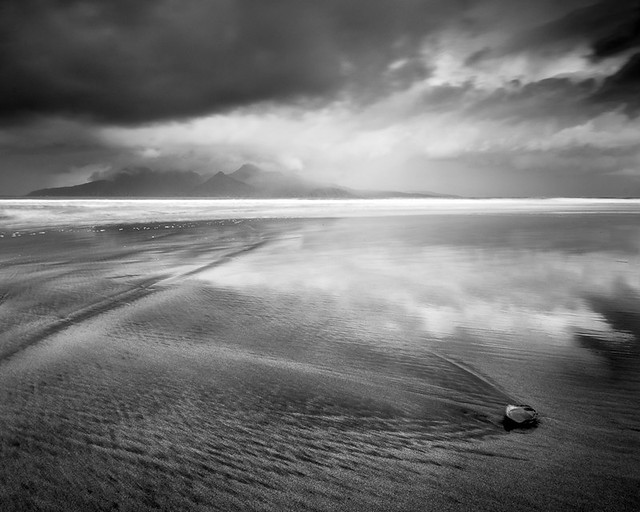
Solitary shell - looking towards Rum
Solitary Shell – looking towards Rum
Clouds over Rum
Clouds over Rum

In total I took over 600 images when I was on the Isle of Eigg. From this number the four photos above and two others, namely ‘Sand Waves’ and ‘Sea Swirl’ are the six shots I am most pleased with. A return of 1 in 100 shutter releases. What this has taught me  is that I need to try and pre-visualise the shot I am taking before releasing the shutter. Asking myself how it is composed, how do I deal with the exposure, do I need to use filters and lastly how will I post process the image? I therefore need to take more time before taking a shot. I would have to adopt this approach if using a film camera – in many ways the digital age has made us lazy…….we can click and click and click to our hearts content but that won’t necessarily produce a good image.

It reminds me of the saying and I quote –

‘Life is not measured by the number of breaths we take,
but by the moments that take our breath away’ 

!function(d,s,id){var js,fjs=d.getElementsByTagName(s)[0];if(!d.getElementById(id)){js=d.createElement(s);js.id=id;js.src=”//platform.twitter.com/widgets.js”;fjs.parentNode.insertBefore(js,fjs);}}(document,”script”,”twitter-wjs”);

Full frame or not full frame?

The new year is now well and truly with us and as I have already looked back on 2012, its now time to look forward to 2013 and make some decisions and plans about what I would like to try and do and achieve in the next twelve months. I will elaborate on my future objectives in another post but for now I want to write about my choice of camera equipment.

As far ‘camera gear’ is concerned the first decision to make is whether or not to go full frame. This has been playing on my mind for some time, really ever since some very capable full frame DSLRs came to the market superseding older models. Last year Nikon introduced two new full frame cameras, the D800 (and 800E) and the D600. Whilst Canon upgraded their 5D Mark II and introduced the 5D Mark III, as well as releasing the 6D. Since their launch the prices have started to fall, so I know I made the right choice not to do anything the day they first hit the streets. Besides it was only back in the Spring when my high regard for the Olympus Micro 4/3rds system became a reality and I bought the E-PL3, shortly to be followed by the Olympus OMD EM5. For me both cameras, but particularly the EM5, produce great results and given that I do not want to print larger than A3 or possibly A2, why would I need a full frame camera and all that extra weight, not to mention the added expense? Providing you couple the best lenses for the Micro 4/3rds system with the EM5, then for a humble amateur who only shoots for pleasure and not for profit, I am very happy. I ought to add that there are some stunningly good lenses for this system and I am confident that more will be released by both Olympus and Panasonic in the future.

On the subject of new lenses, Panasonic did release two new zoom lenses during 2012, both aimed at the top end of the Micro 4/3rds market. The 12 – 35 f2.8 and the 35 – 100 f2.8. Both are beautifully constructed, dust and splash proof and replicate their ‘classic’ full frame equivalents of 24 -70 and 70 – 200 with a wide aperture opening of f2.8. Whilst prime lenses are fast, small and very sharp they do require the user to switch lenses on a regular basis to achieve the required focal length. This is fine when you have time on your hands, but a fast zoom lens covering the range of focal lengths offered by these two lenses can’t be beaten in certain photographic situations. Yes, the kit lenses are good but they are nothing like as sharp nor as fast. Unfortunately both these lenses come at a price.

20130113-P1131392.jpg
The 12 -35 lens with lens hood attached
20130113-P1131387.jpg
Mounted on the Olympus OMD EM5

Fortuitously luck was at hand when I spotted the Panasonic12 -35 lens in the window of my local camera store. I don’t know if it was an unwanted Christmas gift or being sold for some other reason, but it was virtually brand new, and the price heavily discounted compared with the cost of a new one. I took a few test shots outside the shop using my EM5, negotiated down the price a little more, traded in a Nikkor lens that I no longer wanted and the rest is history.

20130113-P1130001.jpg
Panasonic 12 – 35 lens compared to Olympus 12 -50 kit lens

First impressions – well its a great lens, much faster and nicer to use than the 12 -50 kit lens, plus it is much sharper across the whole range of focal lengths.. It does suffer from chromatic aberration at 12mm (but I have read this is fairly typical of any zoom lens). With one click in Lightroom it can be removed and as I shoot mainly in black and white its really not an issue. I can’t wait to get out and about in the weeks to come and put it to the test.

Of course this purchase has finally put the final nail in the coffin as to whether or not to go full frame. I couldn’t wish for a better selection of lenses for my Olympus Micro 4/3rds system. The quality of the results is now down to me taking good pictures, good post processing and not down to the equipment I use. Great images have been taken on old, inexpensive cameras  and I realise how fortunate I am to have what is in my camera bag. So full frame is off the agenda, at least until I win the lottery or I turn professional, neither of which are very likely! So I’m off to take some photographs with my fantastic, lightweight, Micro 4/3rds system which is a joy to use.

Happy New Year!

!function(d,s,id){var js,fjs=d.getElementsByTagName(s)[0];if(!d.getElementById(id)){js=d.createElement(s);js.id=id;js.src=”//platform.twitter.com/widgets.js”;fjs.parentNode.insertBefore(js,fjs);}}(document,”script”,”twitter-wjs”);