Down on the farm

We have recently acquired a cocker spaniel puppy called ‘Watson’ who is now 15 weeks old. We are taking him to training classes in a barn on a farm near to where we live. On a previous visit I noticed a couple of possible images worth taking, so at the last session I took my camera with me and took a few photos before we left. I must admit I got some strange looks from some of the other dog owners but photographers are known for taking shots of subjects which most people would simply pass by without a second look.

Hay trailer
The Hay Trailer

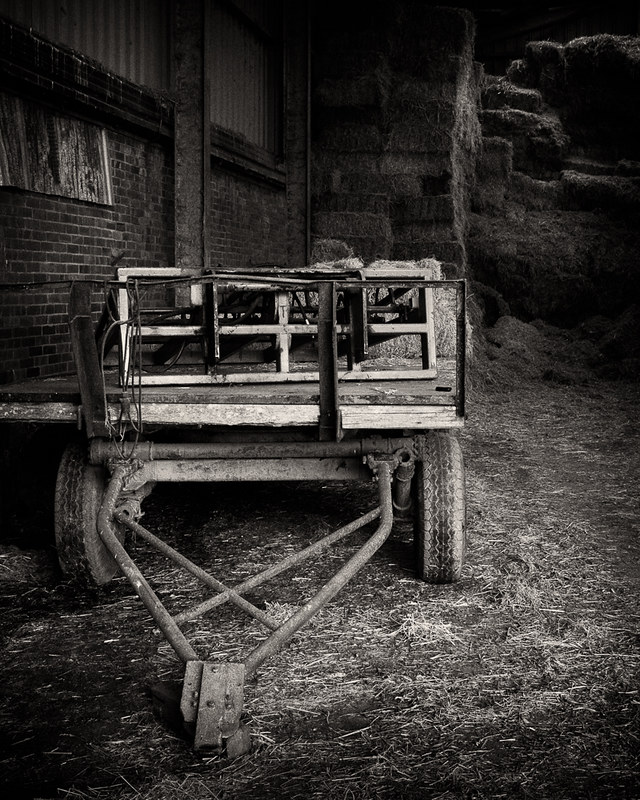
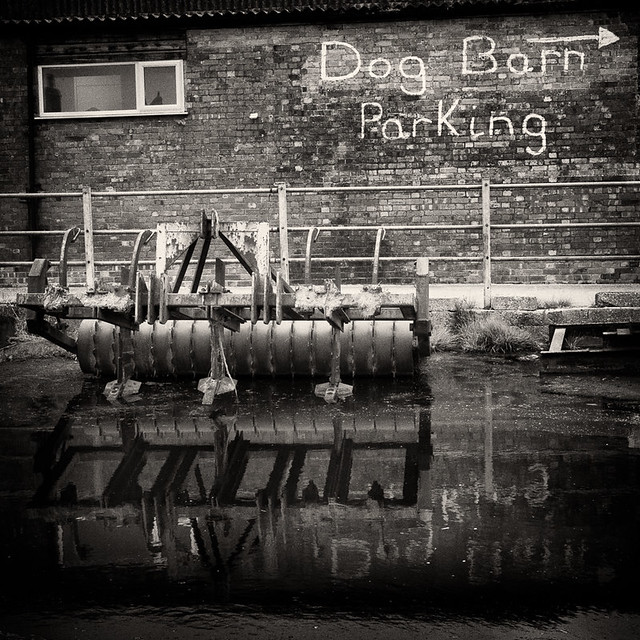
For those of you who read this blog regularly you will know that I very much enjoy and admire the work of Chris Tancock, who describes himself as a rural documentary photographer. Like him, I too am drawn to farms, their buildings, the machinery, the livestock and in many cases to the dereliction, where all manner of things both large and small are left lying round, probably for months if not for years. Whether or not these two images document ‘life on the farm’ I don’t know but in my opinion they do begin to tell a story.

Dog Barn parking
Dog Barn Parking

The two images in this entry were both processed using Silver Efex Pro2. In fact I created a custom preset after processing the first image which I then applied to the second shot, to give some consistency to the appearance of the two photographs. I have saved the preset as I think  it works well for this type of image and I shall certainly be taking some more shots of this type in the future. They might not be to everyones taste but they appeal to me and I think that’s what really matters.

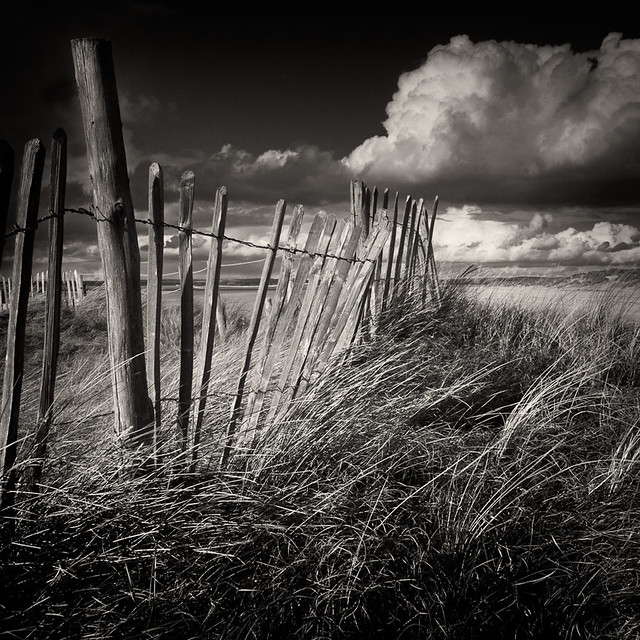
Looking through the archives again…..another fence in the dunes.

Fence in the dunes
Fence in the Dunes

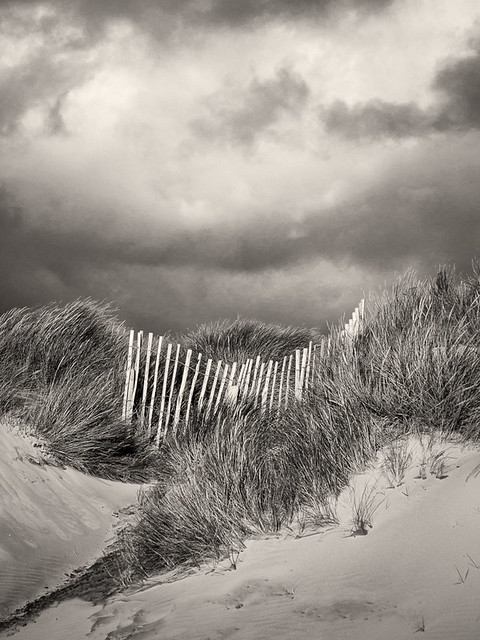
In my last post I went back in time to 2012 when I enjoyed a very pleasant afternoon taking some photographs at East Head in West Wittering along the Sussex Coast. At that particular time I was still using my Nikon D90, which I guess was my first serious or shall we say semi serious camera. A very capable DSLR with a cropped APS-C sensor. It has now been sold in favour of my Olympus micro four thirds system. Which in itself is still only an enthusiasts camera, although there are now a number of professionals who are happily using the Olympus EM1 and some of the best lenses available for this format. I am lucky enough to be using the EM1 and have done so since the early part of the year and although I really don’t feel I put it to the test I have been delighted with the results so far.

Anyway back to the reason for this entry and another image taken at East Head. I had previously dismissed this image, but two years down the road I like to think my processing skills have improved and the result is displayed at the start of the entry. Like so many of my images this was processed in Lightroom 5 and Silver Efex Pro. As opposed to a straight black and white conversion this photo has a ‘coffee tone’ added in Silver Efex, which gives a warmer feel I think it works on this occasion.  I hope you like it.

Looking through the archives – Dunes Fence

Dunes fence
Dunes Fence
There are occasions when I will look through my back catalogue and come across an image which I have not processed before. It can be fun, a voyage of discovery as I search through various folders hidden away in Lightroom, my default workflow program which I have used since 2009.
The above image of a fence on the dunes at East Head in West Wittering was taken in October 2012. When I first opened the shot, I thought it had promise and I immediately applied a square crop to the portrait 3×2 aspect ratio, as there was too much foreground and too much sky above the clouds. I also decided that I would process the image in a different way to my usual approach. After a quick black and white conversion in Lightroom, I exported the file into Photoshop, created a duplicate layer and smart object so that I could continue working on the image in Silver Efex Pro2.
After a few minutes of processing in Silver Efex, which included adding a ‘coffee’ tone, I returned to Photoshop for some fine tuning and the finished result heads this entry. Total processing time about 15 minutes. 
For me I enjoyed returning to a set of photographs taken about 18 months ago. Reliving the memories of a wonderful afternoon on the sands and the lovely cloud formations which are of course a key feature of this particular shot. I very rarely delete any photographs from my catalogue, unless they are obvious duds from the outset, and this is the reason why. Going back in time can reveal some new images which have some merit and are worth looking at in a fresh light, using perhaps some newly acquired processing skills to create an image which can be classified a ‘keeper’.

Taking inspiration from other artists – Chris Tancock

A few weeks ago I wrote about how I like to take inspiration from other artists – or to be more precise, how I like to enjoy the work of more accomplished artists and perhaps try and learn something in the process.

Today I just want to write a few words about the Welsh photographer – Chris Tancock, who describes himself as a rural documentary photographer as opposed to a landscape photographer, even though he takes photos of the countryside in which he lives.

I first came across his work when on holiday in Pembrokeshire in Wales a few years ago. His photographs were for sale in a gallery near St Davids and I found them particularly striking. The project was called ‘Quiet Storm’, and included a number of dramatic colour images of the Welsh landscape.

Later I found more of his work on the web, only to discover that he much prefers to work in black and white. Amongst his more recent projects are ‘Beating the Bounds’, ‘Off the Beaten Track’, ‘Farm’ and ‘The Dowrog’. I greatly admire his dedication to the work he produces. Beating the Bounds for example is a project spread over 5 years, where he walks the boundaries of 5 meadows, twice a day, every day, come rain or shine, observing and capturing the ever changing ‘story’ of the landscape he witnesses. The project is still incomplete but I am lucky enough to have the current version of his book called ‘Beating the Bounds’ which is published by Blurb.

20131230-_C300067.jpg

20131230-_C300070.jpg

20131230-_C300068.jpg

20131230-_C300069.jpg

I also have another book by Chris Tancock called ‘Wildwood’ again by the same publisher.

20131230-_C300071.jpg

20131230-_C300073.jpg

20131230-_C300072.jpg

To me these images are not what might be termed ‘classic’ landscapes, where the photographer has used a well established formula to arrive at the finished photograph. It is hard for me to put into words the ethos of Chris Tancock’s approach to photography, so to give you a flavour of his style I have included a quote from an interview with the magazine ‘Onlandscape’ in which he said –

“I don’t want to hurt peoples feelings, but I don’t like boulders in the foreground, sunsets in the background, diagonals in between them, repeated again and again and again, hunting the countryside until you find these things. What does it tell you about the landscape? Nothing. It tells you about composition and the photographer, it doesn’t tell you anything about the landscape, but they’re commercially viable. They are very easily read images. People forget we read images on different levels and an image like that has the reading age of a 5 year old, its the equivalent of a Janet and John book”. 

Strong, heartfelt words and perhaps the reason why his images are documentary in style. His photographs may not necessarily be called beautiful but they certainly tell a story about the landscape and the countryside in which he lives. Many have a mysterious quality about them, little details contained within the image which are not always noticed on first viewing. Personally I think there is a beauty about the them and I very much enjoy following his latest work which he posts on Pictify.

If you are interested in learning more about Chris Tancock and his individual approach to his work, then you can read the full interview with “Onlandscape’ here.

For now I shall continue to admire his work and try and learn something from his approach to this particular style of documentary photography.
New Forest Ponies

Pony in the New Forest

The New Forest is a very well known National Park in southern England.  Bordering The Solent to the south, it is situated mainly in the county of Hampshire but extends to the north into Wiltshire. It covers an area of 218 square miles and is home to some 4,000 ponies, deer, cattle and pigs which can roam freely through the ancient forest woodland and heaths.

For reasons which will become clear in a future blog entry we had to visit the New Forest quite recently on our way down to Dorset. Time was short but I did grab the chance to take a few photographs of a small group of ponies as we drove through the quiet narrow lanes of the forest. It was also the first chance I have had to use my new camera, the Olympus OMD EM1. Paired with the Panasonic 35 -100mm f2.8 zooms lens, the camera performed effortlessly and handles so much better then the EM5 which has been my workhorse to date. I will write at greater length about my new acquisition but for the time being I hope you enjoy these few images of the New Forest ponies.

New Forest pony

Pony crossing